

More news on this day
South Korea is joining Japan, China, the United States, Taiwan, Brazil, Hong Kong and the United Kingdom in bracing for a powerful wave of concert tourism as BTS’s historic full-group comeback triggers triple digit growth in airline searches and hotel bookings across key routes.
Get the latest news straight to your inbox!
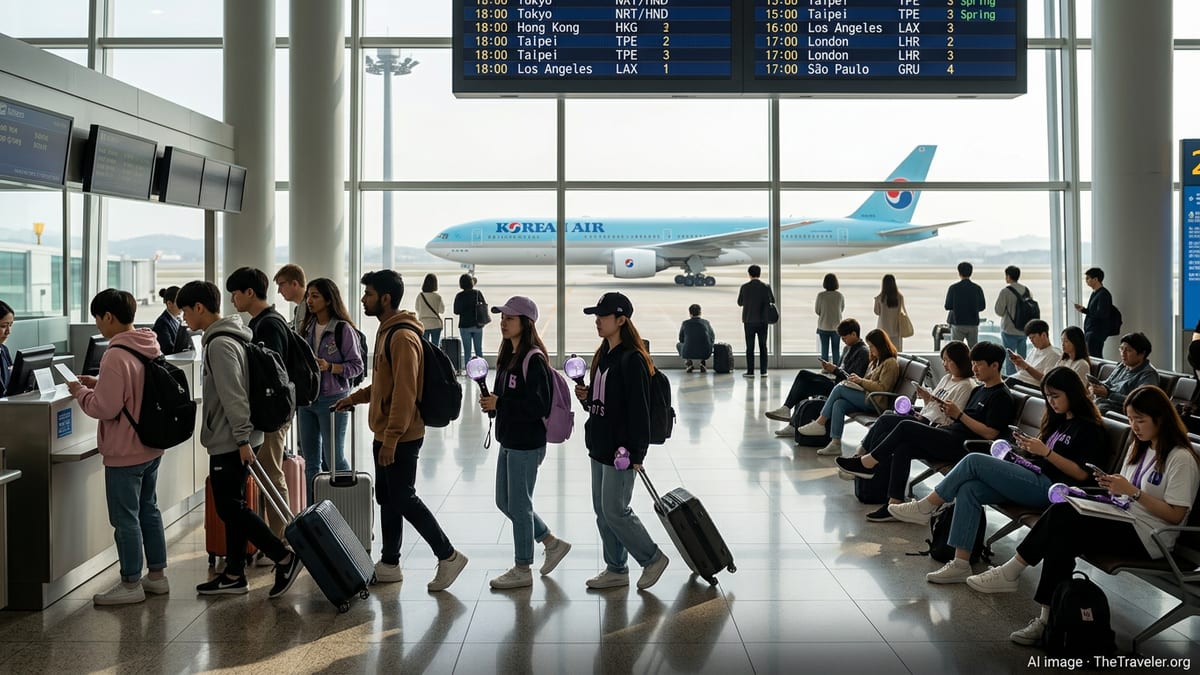
Historic Comeback Turns Into Global Travel Catalyst
The return of BTS as a seven member group in 2026, following the completion of South Korea’s mandatory military service, is rapidly evolving from a music industry milestone into one of the most influential travel events of the year. Publicly available booking data from online travel platforms shows that the announcement of the group’s new album and world tour has unleashed a surge in demand for flights and accommodation tied to concert dates.
Travel and tourism analysts describe the comeback as a textbook example of how fan driven travel can reshape visitor flows. Reports indicate that in the 48 hours following the first wave of tour announcements, searches for flights and hotels to South Korea’s major cities climbed at a pace rarely seen outside of global sporting tournaments. Industry commentary suggests that in some corridors, overall interest in travel connected to the BTS tour is running at more than double typical levels.
While exact figures differ by market and platform, compiled data from hotel and flight search providers points to increases of around 200 percent or more in certain segments when compared with the weeks before the comeback was confirmed. The trend is not confined to South Korea alone. Cities scheduled to host the group in North America, Europe and South America are also reporting a clear uplift in demand traced to concert dates.
South Korea Leads a Regional Tourism Wave
South Korea sits at the center of this momentum. Travel focused publications report that searches for Seoul and Busan have soared since the 2026 world tour schedule and comeback activities were revealed, with some providers citing triple digit percentage jumps in hotel interest for dates surrounding key shows. Local media coverage notes that municipal and national agencies are aligning crowd management, transport capacity and tourism promotion around what is being framed domestically as a landmark cultural moment.
The immediate effect is visible in traditional gateway cities. Seoul, already one of Asia’s fastest recovering hubs, is registering spikes in inbound searches that far outpace general demand trends, particularly among younger travellers in their twenties and thirties. Busan, which has marketed itself as a coastal culture destination, is experiencing an outsized lift as fans pair seaside stays with concert nights.
Event linked travel is also spreading benefits beyond the main arenas. According to published coverage in regional business and tourism outlets, interest is rising in nearby satellite cities such as Goyang and Incheon as fans look for more affordable or readily available rooms within commuting distance of venues. Package operators are responding with combinations that bundle airport transfers, accommodation and themed city tours around BTS related landmarks.
Japan, China, Taiwan and Hong Kong Drive Asia Pacific Demand
Across Asia Pacific, Japan, China, Taiwan and Hong Kong rank among the strongest outbound markets for the BTS comeback. Online travel agencies cited in Japanese and Taiwanese media report that searches for flights to Seoul and Busan surged immediately after the tour calendar was published, in some cases several times higher than comparable periods last year.
In Japan, where K pop related trips were already popular before the pandemic, interest in short haul weekend itineraries tied to concert slots is intensifying. Travel trade press notes that low cost carriers on routes such as Tokyo to Seoul and Osaka to Busan have seen sharp increases in forward bookings, while full service airlines are assessing capacity adjustments on peak dates. Tour operators are promoting two and three night packages that combine performances with time in shopping districts and K culture neighborhoods.
From greater China and Hong Kong, demand is being shaped by both proximity and pent up appetite for cross border leisure. Reports from regional booking platforms highlight strong search growth for multi city routes that link South Korea with onward stops in Japan or Southeast Asia. In Taiwan, travel media describe the BTS tour as a catalyst for fans to return to international travel, with some agencies designing charter products targeting specific concert weekends.
United States, United Kingdom and Brazil See Concert Tourism Surge
Beyond Asia, the United States, the United Kingdom and Brazil are emerging as focal points of the group’s global travel footprint. American entertainment and business outlets note that major cities slated to host stadium dates are tracking elevated hotel and flight searches on and around performance days, with some markets reporting booking curves that are running months ahead of previous tours by other international acts.
Inbound travel works in both directions. As the home base for BTS, South Korea is seeing a notable jump in interest from US travellers planning long haul trips that combine concerts with broader sightseeing, according to aggregated search data published by travel industry news sites. These itineraries often bundle time in Seoul with side trips along the peninsula or short onward hops to Japan.
In the United Kingdom, hospitality analysis in national newspapers links the upcoming BTS dates to projected lifts in occupancy for London and other host cities, particularly in the youth and group travel segments. Meanwhile in Brazil, where fan culture around the group is especially visible, local coverage describes the planned shows as among the most sought after international events of the year, with bus and flight platforms reporting strong advance demand into São Paulo and other major urban centers.
Airlines and Hotels Race to Capture 200 Percent Booking Gains
Airlines and hotels across the affected markets are adjusting strategies in response to the surge. Aviation focused publications report that carriers in South Korea, Japan, China and the United States are closely monitoring load factors on routes linked to tour stops, with some already adding frequencies or upgauging aircraft around high demand weekends. Budget airlines in particular are using targeted fare promotions to convert search spikes into confirmed bookings.
On the ground, hotel groups and alternative accommodation providers are preparing for compressed peak periods. Industry commentary suggests that properties near stadiums and concert halls in Seoul, Busan, Tokyo, Los Angeles, London and São Paulo are approaching sell out conditions on key dates, pushing some fans to consider stays in secondary districts. Revenue managers are using dynamic pricing tools to capture the upside while travel advisers warn leisure guests to book early if their plans overlap with concert windows.
The overall effect, according to comparative analyses from travel research firms, is that BTS’s historic comeback is delivering booking increases of around 200 percent in some city pairs and stay dates when measured against normal seasonal baselines. For a global tourism sector still working through uneven recovery patterns, the phenomenon underscores how a single cultural event can accelerate demand across continents and travel categories.