

More news on this day
As the Iran war reverberates across the Middle East and beyond, governments and risk analysts have converged on an extraordinary warning for 2026: a de facto blacklist of 24 countries now viewed as “no go” for discretionary travel, reflecting spiraling security threats, widespread airspace closures and mounting uncertainty for global tourism.
From Regional Flashpoint to Global Travel Red Lines
The latest escalation, triggered by coordinated United States and Israeli strikes on Iran in late February, has rapidly redrawn the risk map for international travel. Retaliatory missile and drone attacks across the Gulf, repeated strikes on infrastructure and a rolling state of emergency in Israel have pushed multiple states in the region to the highest danger tier on official advisories. Risk consultancies and major travel insurers have in turn upgraded their 2026 security maps, clustering these countries into an informal set of “no go” destinations for leisure travelers.
United States guidance has been pivotal. Since February 28, the State Department has paired a rare Worldwide Caution with targeted orders for Americans to “depart now” from more than a dozen countries, including Iran, Iraq, Israel, the Palestinian territories, Syria, Yemen and several Gulf monarchies. Similar hardline wording has appeared in advisories issued by Canada, the United Kingdom, Australia and parts of the European Union, often instructing citizens to avoid all travel to these states and, where possible, to leave while commercial options still exist.
Overlaying those government alerts with 2026 security risk maps from major insurers and global assistance firms produces a working list of 24 nations widely treated as no go zones. Alongside the Middle Eastern combat theaters, that list includes chronically unstable states in the Sahel, the Horn of Africa and parts of Eastern Europe, where armed conflict, terrorism or state collapse already made travel exceptionally hazardous before the current crisis.
While exact lineups differ by country, the emerging consensus is that nonessential trips to these 24 states should be postponed indefinitely. For business travelers whose visits are unavoidable, travel managers are being urged to apply war zone protocols, including professional security support, contingency evacuation planning and strict limitations on movement.
The 24 “No Go” Nations and Why They Are on the List
At the core of the 2026 no go roster are Iran, Iraq, Syria and Yemen, all facing direct or proxy involvement in the Iran war and years of prior instability. Iran has been hit by repeated long range strikes and remains subject to intermittent blackouts in civilian air operations. Iraq, long a patchwork of rival armed groups, is again host to direct clashes involving foreign forces. Syria and Yemen remain fragmented by internal conflict, where front lines can shift with little warning and basic services are unreliable.
Israel, the West Bank and Gaza are also categorised at the highest risk level following cross border attacks and intensive military operations. Even where daily life continues in parts of Israel and Jordan’s border crossings technically remain open, the possibility of sudden escalation, rocket fire and airport closures has led multiple foreign ministries to warn against all but the most essential travel. Lebanon joins them on the list amid heightened exchanges of fire along its southern border and the risk that localised clashes could draw in external actors.
Across the Gulf, Bahrain, Qatar, Kuwait, Oman, Saudi Arabia and the United Arab Emirates have all faced varying degrees of missile threats, drone incursions or nearby strikes since the end of February. Several governments temporarily closed airspace or suspended flights after projectiles were intercepted near major hubs. Even as limited services resume, officials have underlined that the operating environment remains highly volatile, with commercial airlines ready to divert or cancel routes with minimal notice.
Beyond the immediate conflict zone, the de facto blacklist is rounded out by long standing crisis states such as Afghanistan and Libya, as well as high risk parts of the Sahel and Horn of Africa where insurgencies, coups and kidnap threats are entrenched. Security risk maps for 2026 commonly place countries like Somalia, Mali, Burkina Faso, South Sudan and parts of Ukraine at comparable danger levels to the Middle Eastern war theaters, prompting many corporate travel programs to apply the same blanket prohibition on nonessential trips.
Airspace Closures, Stranded Tourists and a Fractured Aviation Network
The practical impact of these designations is most visible in the skies. Within hours of the first wave of strikes on Iran, airspace closures rippled across the region, forcing airlines to reroute or cancel flights that normally cross the Gulf and Levant on their way between Europe, Asia and Africa. Major hubs such as Dubai, Abu Dhabi and Doha saw schedules slashed, while services into Tehran and other Iranian cities were halted entirely.
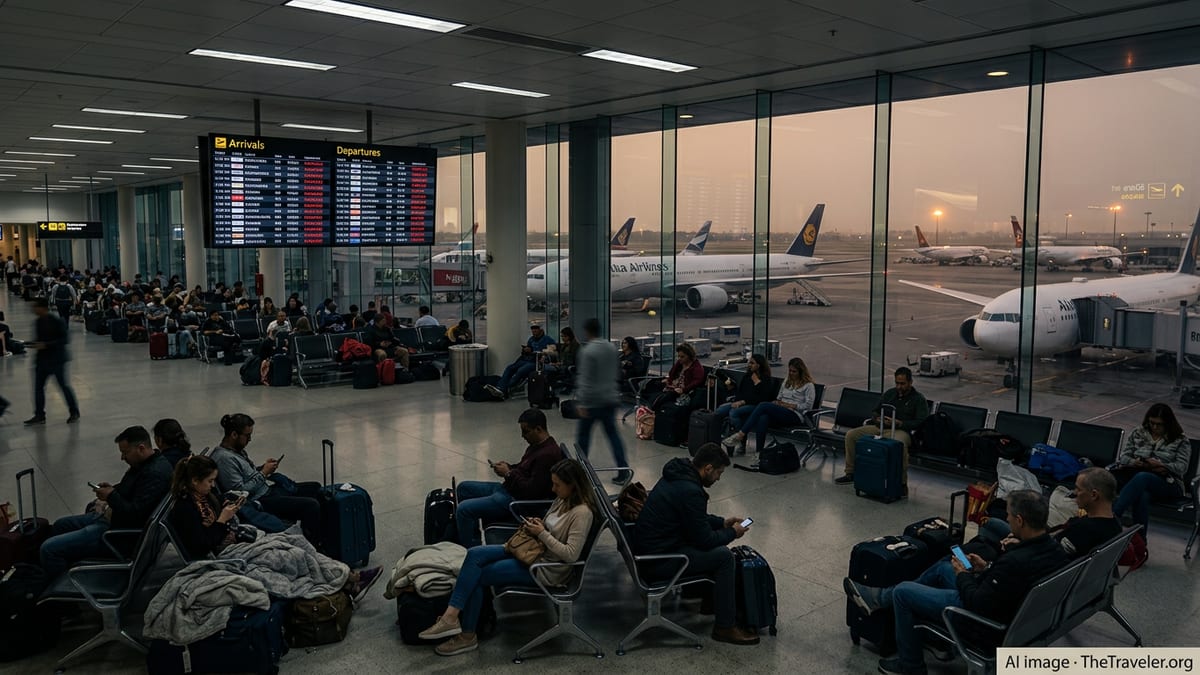
Hundreds of thousands of passengers have since found themselves stranded or facing marathon diversions. Evacuation style flights, arranged by national governments or chartered by large corporations, have begun operating on a limited basis from safer regional gateways. However, uncertainty over overflight permissions, refuelling stops and security at destination airports continues to complicate planning. Airlines are also dealing with crew safety concerns and insurance constraints that can make even technically open routes commercially unviable.
The disruption extends well beyond the 24 no go nations. Carriers in Europe and Asia that once depended on Gulf connections for long haul itineraries have had to rebuild networks almost overnight, lengthening flight times and pushing up costs. Secondary tourism markets from Southeast Asia to East Africa that rely on Middle Eastern transit hubs are reporting a sharp fall in arrivals. Analysts warn that, if the conflict continues into the northern summer, global passenger numbers could undershoot earlier 2026 forecasts by tens of millions.
Travel insurers, meanwhile, are invoking war and sanctions clauses, often excluding cover for trips to affected countries or for incidents tied directly to the conflict. This hardening of policy terms reinforces the practical effect of government warnings: for most individual travelers, visiting a no go nation now means accepting the risk of traveling without standard insurance protection, evacuation support or reliable commercial flight options home.
How Governments and Industry Are Rewriting the Travel Rulebook
For foreign ministries and consular services, the speed of events has forced a shift from slow moving advisory updates to real time crisis communication. Social media alerts, messaging app broadcasts and dedicated hotlines are being used to tell citizens not only where not to go, but how to get out. Officials concede that, in several Gulf states, the initial call to “depart now” came just as airspace was closing, leaving citizens scrambling to find scarce seats on remaining flights or to reach neighbouring countries by road.
Universities, international NGOs and multinationals are reevaluating their risk thresholds. Many had already restricted travel to parts of the Middle East and North Africa since 2023, but the 2026 conflict has prompted blanket bans on new trips to the 24 flagged states, and in some cases the relocation of staff and operations. Travel managers are revisiting crisis playbooks, testing evacuation partners and mapping alternative hubs that can substitute for Dubai or Doha if disruptions persist.
Tour operators and cruise lines are pivoting itineraries away from the eastern Mediterranean and Gulf, replacing stops in Israel, Egypt or the United Arab Emirates with ports in southern Europe, the Indian Ocean or East Asia. Industry executives say demand for travel is still strong, but customers are increasingly wary of itineraries that route through any state bordering the conflict zone. Some operators now advertise “conflict free” routing as a selling point, highlighting itineraries that avoid the 24 no go nations and their immediate neighbours.
For individual travelers, the emerging rulebook is blunt but clear. Before booking, officials advise checking the latest government advisories, verifying that airlines are still operating and confirming that travel insurance remains valid. Those already in the region are urged to keep passports and essentials ready to move, register with consular services and avoid nonessential road journeys, border areas and large public gatherings that could be targeted or disrupted.
A Long Shadow Over Global Tourism in 2026
Travel economists warn that the proliferation of no go zones will cast a long shadow over the industry even if a ceasefire is reached in the coming months. War in such a critical aviation crossroads magnifies the impact of every decision to close an airport or air corridor. Tourists unnerved by images of missile interceptions near airliners or of stranded families sleeping in terminals may shy away not only from the Middle East, but from long haul trips in general.
Destinations that had banked on Gulf carriers to feed them visitors are scrambling to diversify. Some European and North African resort regions hope to capture tourists who might otherwise have travelled to Dubai, Oman or the Red Sea, promoting themselves as stable alternatives. Yet they, too, are vulnerable to higher fuel prices and airline capacity cuts linked to the conflict, which can make flights more expensive or less frequent.
For the 24 nations now widely regarded as too dangerous for leisure travel, the economic hit is likely to be profound. Years of investment in hotels, airports and marketing campaigns risk being undone in a single season, compounding the humanitarian cost of war and instability. Even when security conditions eventually improve, analysts say it can take a decade or more for visitor numbers to recover to pre crisis levels once a country has been etched into public consciousness as a war zone.
With no clear timeline for de escalation, 2026 is shaping up as a year in which risk maps matter as much as guidebooks. For travelers, the message from diplomats, insurers and airlines aligns with unusual force: there are places in the world that, for now, are simply off limits.