

More news on this day
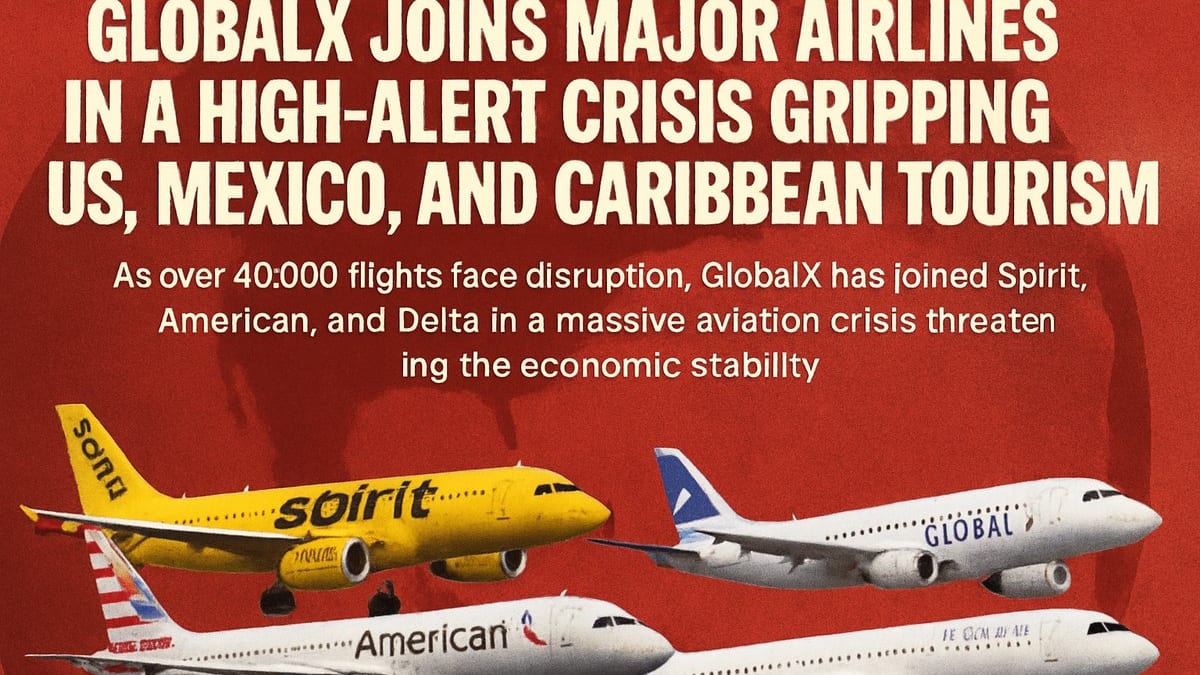
A cascading series of security shocks, weather extremes, and operational breakdowns across the United States, Mexico, and the Caribbean is pushing airlines onto high alert, and charter carrier GlobalX is increasingly being swept into the turbulence alongside much larger scheduled operators.
Get the latest news straight to your inbox!
Charter Specialist on the Front Line of a Volatile Corridor
Global Crossing Airlines, which operates as GlobalX, has built its business around charter and wet-lease flying in exactly the regions now under the greatest strain. Publicly available company information shows that the Miami based carrier focuses on contract flying for tour operators, sports teams, and other clients linking the United States with Mexico, the Caribbean, and Latin America. As disruption spreads across these markets, charter operators like GlobalX are being called on to help plug capacity gaps and reposition aircraft, but are simultaneously exposed to the same airspace, airport, and security constraints hitting scheduled airlines.
Recent coverage of GlobalX’s growth highlights how deeply the airline has tied its fortunes to the Caribbean and Mexican leisure sectors, from contracts serving island hubs to agreements with regional carriers. In normal times, this model allows GlobalX to flex capacity quickly for peak seasons such as spring break and winter sun travel. In the current high alert environment, however, the same dependence on a volatile corridor means the airline’s operations can be rapidly upended by developments well beyond its direct control.
GlobalX has also featured prominently in monitoring of U.S. government charter activity, including immigration related flights. This segment relies on predictable access to U.S. and regional airspace and airports. As airspace closures, ground stops, and security incidents ripple across the Americas, this government contract flying faces many of the same risks as leisure charters, further tightening the operational vise on a relatively small but highly utilized fleet.
For travelers, the presence of unfamiliar charter brands such as GlobalX on their itineraries can add another layer of anxiety at a time when aviation reliability is already under question. Online discussions show passengers trying to understand the role of these carriers when their original airline substitutes a GlobalX-operated aircraft to keep a route running, underscoring how invisible charter capacity has suddenly become a focal point of the broader crisis.
Security Flashpoints in Mexico and the Caribbean
The ongoing security situation in parts of Mexico has emerged as one of the sharpest pain points for tourism across North America. Reports on recent cartel-related unrest describe airport operations in resort gateways being heavily curtailed, with international flights temporarily halted and domestic schedules slashed as access roads were blocked and gunfire erupted near key infrastructure. Airport operators in Pacific coast destinations reported widespread cancellations as airlines weighed the risks of continuing service while violence flared in surrounding states.
These security shocks have prompted foreign ministries in multiple countries to update travel advisories and emphasize the need for caution, particularly in western Mexican states and along some overland approaches to airports. For U.S. tourists who have long treated destinations such as Puerto Vallarta and coastal Jalisco as reliable beach escapes, the imagery of roadblocks, burning vehicles, and disrupted airport access has injected new uncertainty into vacation planning. Tour operators and airlines serving these markets, including charter specialists like GlobalX, now face the challenge of balancing demand with rapidly shifting risk assessments.
The Caribbean has not been immune to security related disruption either. Coverage of recent U.S. military operations in Venezuela detailed how a high profile intervention led to extensive flight cancellations and diversions across eastern Caribbean airspace during the busy New Year travel period. Federal airspace restrictions around the operation triggered groundings and reroutings for days, affecting island-hopping leisure travelers as well as those connecting through major hubs. Carriers operating ad hoc charters into the region, including GlobalX on some routes, had to navigate a patchwork of temporary restrictions layered on top of tightly scheduled holiday flying.
These episodes underscore how quickly geopolitical or law-and-order flashpoints can cascade into aviation turmoil across the wider Caribbean basin. Even airports in countries not directly involved in security operations find themselves coping with diversions, crew out-of-position problems, and backlogs of stranded passengers when airspace corridors suddenly close. For smaller airlines with limited spare aircraft, a single closure can consume significant capacity for days.
Weather Extremes and Ground Stops Strain U.S. Hubs
While security concerns capture headlines, severe weather has been an equally disruptive force for airlines serving the Americas in early 2026. Published accounts of a major winter storm in late January describe a sprawling system that swept from northern Mexico through the southern and northeastern United States, causing thousands of cancellations and creating the worst single day of U.S. flight disruption since the early pandemic years. Airports across Texas, the Gulf Coast, and the Eastern Seaboard reported hours-long delays, with carriers struggling to reposition aircraft and crews.
More recently, strong thunderstorms and flash flooding at the end of March have paralyzed segments of the U.S. aviation grid, especially in Texas and the central states. Aviation tracking data referenced in travel industry reporting shows hundreds of delays and dozens of cancellations linked to convective weather near major hubs, including Dallas Fort Worth and Houston. Another wave of disruption has unfolded around Chicago O’Hare, where a combination of weather issues, a reported measles exposure, and staffing-related ground stops led to one of the highest global cancellation tallies of any airline hub in early April.
These conditions directly affect leisure flows to Mexico and the Caribbean, because many holiday itineraries require passengers to connect through large U.S. hubs. When aircraft stack up out of position at Chicago, Dallas, or Houston, downstream flights to Cancun, Montego Bay, or Punta Cana are often among the first to be delayed or cut. Airlines have issued rolling travel waivers, but operational recovery can lag demand for days, leaving spring break travelers stranded at gateway airports or forced into complex rebookings.
For GlobalX and other charter-focused operators, severe weather at U.S. departure points can be particularly damaging. Charter flights are frequently tightly scheduled for specific events, cruise departures, or package-tour changeover days. When storms trigger ground stops, there is far less flexibility to simply move passengers to a later rotation, because hotel contracts and cruise embarkation times are fixed. That leaves charter airlines juggling aircraft swaps, crew duty limits, and last-minute reroutes while trying to protect long term relationships with tour operators and institutional clients.
High Alert for Airlines Balancing Contracts, Compliance, and Capacity
Across this turbulent backdrop, airlines active in the U.S.–Mexico–Caribbean corridor are operating in what industry observers describe as a near constant state of high alert. Carriers must track evolving security advisories in Mexico, monitor potential military or political flashpoints that could trigger Caribbean airspace restrictions, and respond to increasingly frequent episodes of extreme weather that snarl U.S. hubs. The cumulative effect is a system in which relatively routine disturbances can now cascade into widespread, multi-day crises.
GlobalX’s business model highlights both the opportunities and vulnerabilities of this environment. The airline’s reliance on contracts with tour operators, regional carriers, and government entities provides a diversified revenue base, but also locks it into obligations that can be difficult to fulfill when conditions change abruptly. Publicly available contract announcements emphasize the importance of regulatory approvals from agencies such as the Federal Aviation Administration and the U.S. Department of Transportation, underscoring how crucial compliance and safety oversight are for a charter carrier that often operates at the margins of busy airspace and congested airports.
At the same time, GlobalX’s fleet remains modest compared with the giants of U.S. aviation. Analyst coverage notes that the airline has gradually built up a narrowbody fleet of Airbus A319 and A320 aircraft, along with freighter capacity, to service a wide mix of routes. With limited spare aircraft and crews, however, each disruption carries greater relative weight. A diverted or stranded aircraft on a Caribbean island can mean multiple missed missions elsewhere, amplifying the impact of security closures or weather events relative to a large network carrier with hundreds of planes.
This dynamic helps explain why charter operators are increasingly part of the broader conversation around aviation resilience. As major airlines lean on wet-lease partners like GlobalX to cover schedule gaps, the reliability of these smaller carriers becomes integral to the functioning of the overall system. In an era of overlapping crises, their ability to maintain safety, regulatory compliance, and on-time performance under pressure is emerging as a key indicator of how well the travel industry can adapt.
Travelers Face a New Risk Calculus Across the Region
For travelers contemplating trips to Mexico and the Caribbean from the United States, the current wave of disruption is reshaping expectations. Instead of viewing weather as the primary variable, many vacation planners are now weighing a more complex mix of factors, including potential airport access issues in parts of Mexico, the possibility of sudden airspace restrictions tied to regional security operations, and mounting evidence that U.S. hubs are vulnerable to chain-reaction delays from storms and staffing gaps.
Consumer-facing travel advisories increasingly encourage passengers to build extra buffer time into connections, favor early morning departures from major hubs, and remain flexible about routing. Some guidance also points out that unfamiliar carrier names such as GlobalX on an itinerary may reflect common industry practices like charter or wet-lease arrangements rather than inherently higher risk, but acknowledges that passengers should still pay close attention to operational alerts and schedule changes.
Airlines, in turn, are adjusting their messaging and policies. Travel industry resources emphasize the importance of clear, timely communication around disruptions and the need for robust rebooking and refund options when events beyond passengers’ control make trips impossible. As crises intersect across security, weather, and infrastructure, the airline that can most transparently manage expectations may hold an advantage in retaining customer trust, whether it is a global network carrier or a niche charter specialist like GlobalX.
The coming months, traditionally a high season for travel in many Caribbean and Mexican destinations, will test that trust. With multiple fault lines now visible in the region’s aviation ecosystem, every player from major airlines to specialized charter operators is operating with heightened vigilance, knowing that the next disruption could arrive with little warning and global repercussions for holidaymakers and essential travelers alike.