

More news on this day
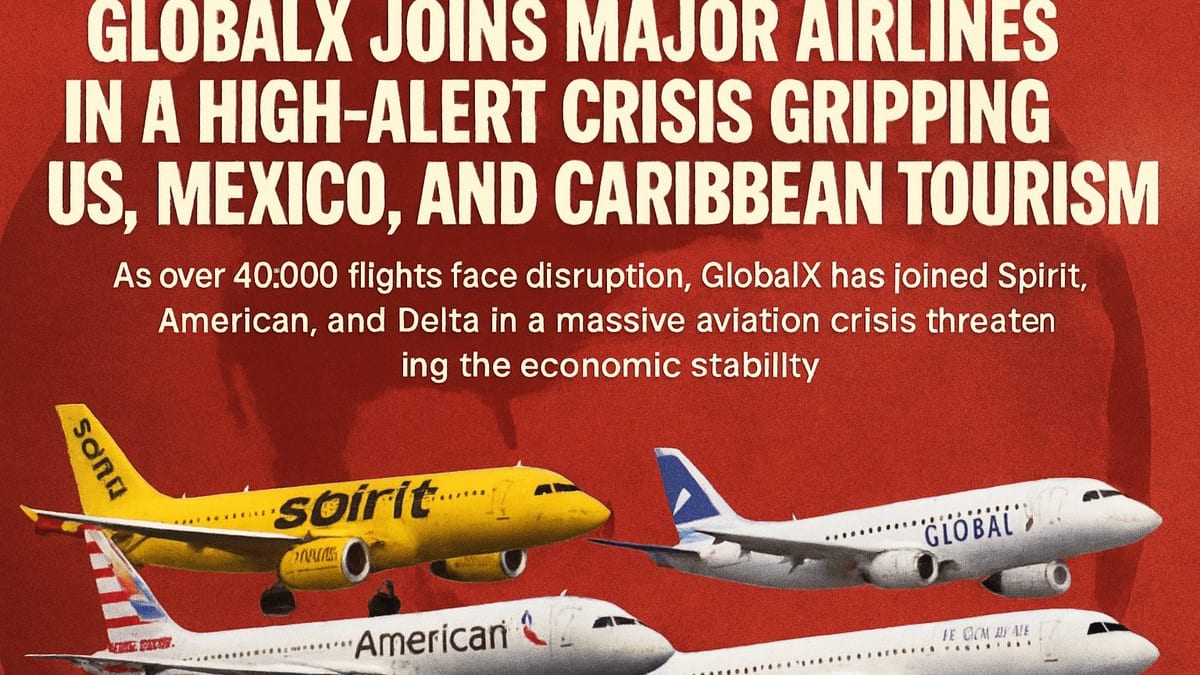
GlobalX is being swept into a wider regional crisis gripping air travel and tourism across the United States, Mexico, and the Caribbean, as security alerts, airspace disruptions, and rapidly shifting traveler demand combine to put carriers on high alert along some of the hemisphere’s busiest leisure routes.
Get the latest news straight to your inbox!
Security Alerts in Mexico Reshape Tourist Flight Patterns
A series of high-profile security operations in Mexico since late February 2026 has pushed tourism corridors into an extended period of uncertainty. Publicly available advisories from the U.S. diplomatic mission in Mexico describe travelers in multiple states being urged to shelter in place during cartel-related unrest, with widespread roadblocks and criminal incidents affecting mobility on the ground. While airports generally remained open, the alerts note that access roads were intermittently blocked, and some domestic and international flights were cancelled or heavily disrupted at key gateways such as Guadalajara and Puerto Vallarta.
The resulting patchwork of warnings and waivers has had a direct impact on air travel. Coverage in travel industry outlets highlights how major U.S. carriers, including United Airlines, introduced flexible rebooking policies for passengers ticketed to Jalisco during and after the peak of the unrest, effectively acknowledging that a portion of their Mexico-bound spring travel demand would need to be rerouted or postponed. These interventions coincided with a period that is typically critical for Mexico’s Pacific coast resorts, as U.S. spring break travel overlaps with domestic holiday traffic.
On the opposite coast, the Mexican Caribbean has moved rapidly to reassure travelers. Reports from regional tourism media point to a large-scale deployment of security personnel in Playa del Carmen and along the Riviera Maya in the days leading into Holy Week, with local authorities emphasizing visible patrols, coordinated surveillance, and crowd management around busy beach zones and nightlife districts. The messaging from local tourism boards and hotel associations has focused on maintaining a sense of normality for visitors despite the broader security headlines.
For airlines like GlobalX, which specialize in charter services and leisure-focused flying, this environment demands constant recalibration. Although publicly available filings and financial updates show GlobalX leaning heavily into contracts that serve the U.S., Caribbean, and Latin America, the volatility in Mexico’s security landscape means that even indirect exposure through tour operators, cruise-linked flights, and sports or entertainment charters can carry operational and reputational risk.
Caribbean Islands See Surging Demand as Travelers Pivot
As security concerns and sporadic disruptions ripple across parts of Mexico, Caribbean destinations are emerging as major beneficiaries of shifting demand. Recent booking analyses published by resort and travel trade outlets describe double-digit to near 50 percent year-over-year increases in reservations for popular islands, with some all-inclusive resorts reporting compressed availability heading into late spring and early summer 2026. Advisors participating in regional industry forums have flagged the Caribbean as one of the most resilient segments in the global leisure market this year.
This surge is particularly significant for airlines that, like GlobalX, have positioned their networks and contract flying around sun-and-sand traffic. Company disclosures and aviation trade reporting underscore that GlobalX has been concentrating new capacity on U.S.–Caribbean and broader Latin American routes rather than accelerating expansion into Europe. That strategy now aligns with traveler behavior, as vacationers looking to avoid areas perceived as unstable in Mexico redirect to destinations such as the Dominican Republic, the Bahamas, and smaller Eastern Caribbean islands.
Major scheduled carriers are also adjusting. Industry coverage notes that several large North American airlines have been fine-tuning capacity, trimming select routes into Mexican airports affected by unrest while increasing frequencies or deploying larger aircraft to Caribbean hubs. These moves are framed as routine commercial decisions, but the timing coincides with a clear repositioning of demand away from certain Mexican cities and toward islands viewed as comparatively insulated from the current wave of security alerts.
The Caribbean’s relative stability does not remove all risk, particularly amid broader geopolitical tensions and economic uncertainty. However, from a tourism perspective, many islands are currently seen as offering a clearer, more predictable environment for resort-focused travel. For GlobalX, which sells lift directly to tour operators, sports teams, and other institutional customers, the Caribbean’s upswing provides an opportunity to deepen long-term charter relationships that are less vulnerable to sudden advisory changes.
US Airspace Strains Add Another Layer of Complexity
The challenges are not confined to Mexico. In the United States, an early 2026 combination of heavy spring break traffic and operational strains has led to notable congestion at several airports, particularly in the South and along major connection corridors to Mexico and the Caribbean. National media coverage has documented multi-hour security lines at some hubs and recurring complaints from travelers about delays and last-minute gate changes as airlines and airport authorities try to manage peak demand against staffing and budget constraints.
Separately, the wider security backdrop has become more complicated. Public records and aviation reports cite recent temporary closures or restrictions in portions of U.S. airspace for security reasons, an unusually rare step that recalls earlier eras of heightened alert. These measures have tended to be short-lived and geographically limited, but they contribute to a perception of fragility in the broader system at a time when travelers are once again packing flights to resort destinations.
For GlobalX and its peers, this environment magnifies operational challenges that are already inherent to charter-heavy models. Sports teams, cruise lines, and tour operators often demand tight, event-driven schedules with limited flexibility, leaving carriers with little margin when airspace constraints or airport disruptions cascade. Fleet utilization, crew planning, and aircraft positioning all become more complicated when a single security incident can close a key transit airport or force lengthy diversions.
Aviation analysts monitoring the sector have noted that niche carriers with flexible contracts can sometimes adapt more quickly than large network airlines by redeploying aircraft to less affected routes or time periods. However, the same analysts caution that repeated shocks, even when short, can erode confidence among corporate and institutional customers that rely on consistent, on-time operations for their high-profile events and group movements.
GlobalX’s Expansion Strategy Meets a Volatile Region
Against this backdrop, GlobalX’s latest financial and strategic disclosures take on added significance. Recent earnings statements and independent aviation analysis highlight that the Miami-based carrier achieved its first annual operating profit in 2025, driven largely by a pivot toward longer-term ACMI contracts and dedicated charter operations for sports franchises, music tours, and government work. The airline has signaled plans to add additional Airbus A320 family aircraft in 2026, targeting what it describes as a structural shortage of narrowbody capacity in North America.
Crucially for the current moment, GlobalX has emphasized the U.S., Caribbean, and Latin America as its primary growth zones. Trade coverage notes that executives have deliberately slowed or sidelined ambitions for near-term European expansion in order to consolidate around these core markets. That decision now places GlobalX squarely inside the triangle of turbulence linking U.S. hubs, Mexican resort cities, and Caribbean islands, where demand is strong but the risk profile is rising.
Regulatory filings and safety databases show GlobalX operating under a standard U.S. Part 121 certificate, with the associated oversight from the Federal Aviation Administration. Public documents also point to a focus on charter and ACMI flying rather than mass scheduled service, which can insulate the airline from some day-to-day volatility in individual leisure markets. Even so, the reliance on tourism-driven partners and event-based contracts means that any deep or prolonged shock to confidence in Mexico or Caribbean travel would reverberate quickly through its customer base.
Industry observers following GlobalX suggest that the airline’s ability to maintain profitability in 2026 will depend on how effectively it can ride the current wave of Caribbean demand while managing exposure to Mexican routes and U.S. operational chokepoints. The balance between flexibility and overextension is becoming a central question as the carrier weighs new aircraft deliveries against signs of stress in the broader regional system.
Tourism Outlook: High Demand, Elevated Risk
Despite the array of alerts and disruptions, overall demand for leisure travel across the U.S., Mexico, and Caribbean remains robust. Travel data providers and resort groups continue to report strong booking pipelines into summer 2026, buoyed by pent-up appetite for international vacations, the draw of Mexico’s co-hosting role in the 2026 World Cup, and the enduring appeal of Caribbean beach escapes. Many travelers appear willing to navigate a more complex risk environment in exchange for long-awaited trips.
At the same time, the geographic distribution of that demand is clearly shifting. Publicly available booking analyses point toward continued strength for Mexico’s Caribbean coast and a notable move toward island destinations, while parts of Mexico’s Pacific region work to rebuild confidence after a wave of security headlines and temporary travel waivers. For airlines, the challenge lies in matching capacity to these evolving patterns quickly enough to capture revenue without being caught out by sudden advisories or operational bottlenecks.
GlobalX’s situation encapsulates this tension. The airline finds itself aligned with some of the fastest-growing segments in the leisure market, yet those same segments now sit within a broader high-alert environment that can change with little notice. Its fortunes are increasingly intertwined with how effectively U.S., Mexican, and Caribbean authorities manage security operations, communicate risk, and keep critical air and ground corridors open during peak travel periods.
For travelers planning spring and summer trips, the crisis unfolding across these interconnected skies may be largely invisible until a flight is delayed, a route is canceled, or a last-minute advisory triggers a scramble to change plans. For GlobalX and its larger peers, however, the current moment is a real-time stress test of strategies built around cross-border tourism at a time when demand is surging and the margin for error is narrowing.