

More news on this day
Globus, one of the world’s largest escorted tour companies, has suspended its tours to the Middle East through August as operators and travelers navigate ongoing regional instability and airspace disruptions.
Get the latest news straight to your inbox!
Extended Suspension Covers Key Middle East Itineraries
Publicly available information indicates that the Globus family of brands has halted its organized tour programs across key Middle East destinations through at least the end of August, affecting departures that typically include cultural and religious itineraries in countries such as Jordan, Israel, and Egypt. The move aligns with broader caution across the travel industry as uncertainty around airspace access and security conditions continues into the peak summer planning period.
While detailed departure-by-departure lists have not been widely circulated, tour listings and agency communications show that Middle East departures are currently unavailable or flagged as suspended through late summer, even as European and other long-haul products remain on sale. The suspension effectively removes a full season of guided touring in a region that normally attracts strong demand for historical, pilgrimage, and bucket-list trips.
The pause underscores how quickly demand patterns can shift for complex, multi-country itineraries that rely on stable borders, predictable flight networks, and close coordination with local partners. For many travelers, escorted tours are the preferred way to navigate the Middle East’s layered history and logistics, meaning the temporary halt is likely to reshape long-planned journeys.
The timing is particularly significant because August often anchors late-summer vacations and shoulder-season departures into September. With programs paused through that month, many travelers eyeing 2026 or 2027 for major Middle East trips may now look to postpone or reroute plans to other regions.
Geopolitical Tensions and Airspace Disruptions Weigh on Planning
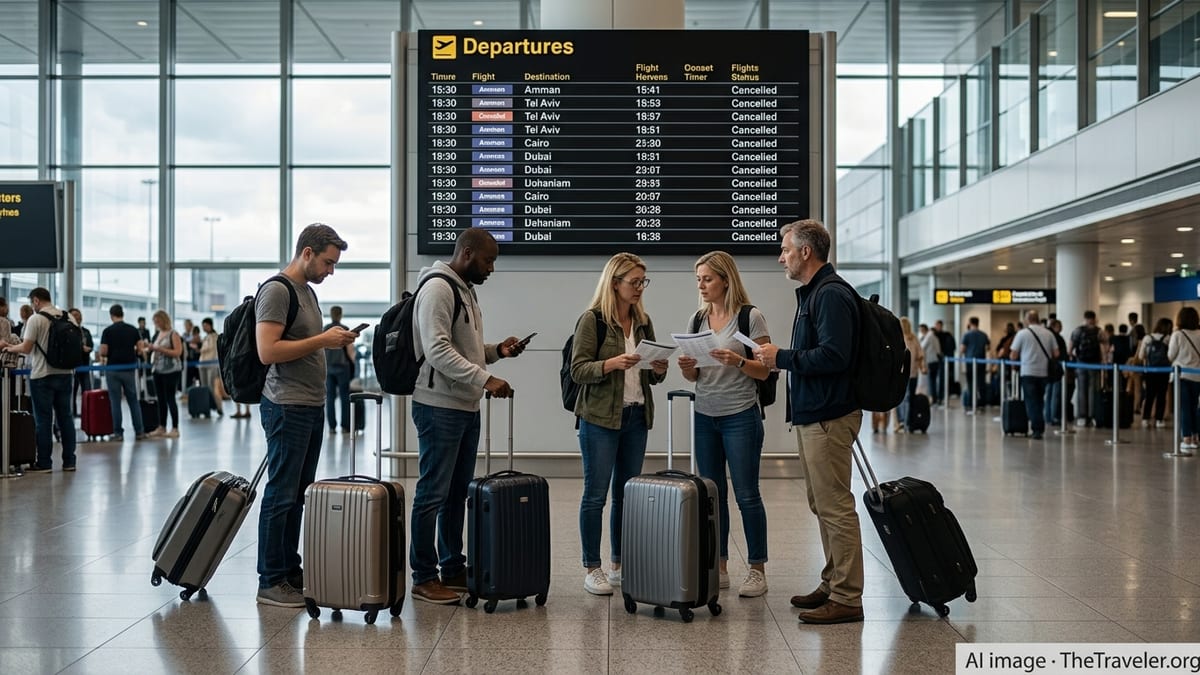
The decision to suspend tours does not exist in a vacuum. In recent weeks, airlines and travel providers have been adjusting operations across the Middle East as tensions and conflict centered on Iran ripple across regional airspace. Published reports describe a patchwork of flight cancellations, re-routings, and schedule reductions affecting hubs from Tel Aviv to Dubai and Abu Dhabi, creating added complexity for land-based tour programs that depend on reliable long-haul and intra-regional air links.
Coverage in mainstream travel media highlights how closures and restrictions in certain flight corridors can lengthen journey times, increase operating costs, and introduce last-minute uncertainty for travelers. Tour operators, which must coordinate dozens of moving parts from airport transfers to hotel allocations, typically require a high degree of predictability months in advance to confidently operate escorted departures.
Industry observers note that even when on-the-ground conditions in specific cities may remain relatively calm, overlapping government advisories, insurance constraints, and volatile airspace conditions can make large-scale group touring more difficult to deliver consistently. Operators therefore often choose to suspend or consolidate programs temporarily rather than risk fragmented itineraries or repeated last-minute alterations.
In this context, Globus’ decision to hold Middle East tours through August reflects a wider pattern of caution visible in airline waivers, rebooking policies, and route suspensions. The focus, travel analysts suggest, is on protecting travelers from disruption while giving the company time to reassess the feasibility of itineraries later in the year.
Impact on Travelers and Booking Options
For travelers who had planned a Middle East tour with Globus, the suspension through August will likely mean rebooking, rerouting, or delaying long-anticipated trips. Tour documentation and general terms describe structured policies around cancellations, revisions, and future travel credits, and many agencies are now working within those frameworks to reposition clients into alternative destinations or later departure dates.
Recent guidance from consumer travel outlets on disrupted Middle East trips emphasizes the importance of reviewing tour operator terms, airline conditions, and any separate travel insurance purchased for the journey. When a company cancels a tour, customers commonly receive options that may include a refund or protected rebooking, though specifics vary by operator and booking channel. Travelers who packaged air, insurance, and land through different providers may need to manage several parallel processes.
Advisers also recommend that affected travelers document all communications, keep original invoices and booking references, and consider whether shifting to a different region for the same travel window is preferable to waiting for Middle East departures to resume. Europe, North America, and parts of Asia currently present strong alternatives for cultural touring during the northern-hemisphere summer, with many escorted operators still reporting robust availability.
For some, however, the Middle East remains a once-in-a-lifetime goal tied to specific religious observances or family milestones. Those travelers may opt to defer their plans entirely, waiting to see how tour availability, insurance coverage, and airline schedules evolve beyond August before setting new dates.
Broader Signals for Middle East Tourism
Globus’ suspension through August is part of a broader pattern of recalibration across Middle East tourism as operators, airlines, and destination marketers respond to shifting risk assessments. Reports of route suspensions and travel waivers involving Gulf and Levant destinations illustrate how quickly a region that has invested heavily in tourism infrastructure can face headwinds when security concerns rise.
Major hubs such as Dubai and Abu Dhabi, which have positioned themselves as global connectors and stopover gateways, are particularly sensitive to changes in long-haul demand and confidence. Any sustained reduction in group tours and leisure traffic can ripple through hotel, attraction, and ground-handling sectors, even if core business and transit traffic remains.
At the same time, tourism boards and local partners are likely to focus on signaling readiness to welcome visitors once conditions stabilize and major operators return. Past episodes of regional tension have shown that demand for cultural and religious travel to the Middle East often rebounds when flight networks normalize and tour programs restart, though the pace of recovery can vary widely by destination.
For now, however, Globus’ pause through August serves as a clear indicator that one of the sector’s most influential players is taking a measured approach to Middle East operations in the face of unpredictable conditions. Other operators, both large and niche, are expected to continue reviewing their own risk calculations as summer approaches.
What Prospective Travelers Should Watch Next
Travelers considering Middle East itineraries later in 2026 and into 2027 will be watching several signals in the coming months. Key among them will be updates from major tour operators on the reinstatement of specific departures, changes in airline schedules and routing, and the tone of government travel advisories for key countries in the region.
Prospective guests weighing whether to book for autumn or winter may find it helpful to look for flexible booking conditions that allow for changes without heavy penalties if circumstances shift again. Some operators and airlines have expanded their use of waivers and credits during recent disruptions, offering more adaptable terms than were common prior to the latest round of regional tensions.
Travel risk specialists underline the value of monitoring reputable news outlets and official advisory channels rather than relying solely on social media impressions of the situation on the ground. In addition, travelers are encouraged to examine insurance products that explicitly address geopolitical events, evacuation, and trip interruption, rather than assuming standard policies will cover all eventualities.
As summer approaches, Globus’ cancellation of Middle East tours through August stands as a bellwether for how mainstream, volume-focused travel brands are reading the risk environment. The company’s next round of scheduling decisions for late 2026 will be closely watched by agents and travelers alike as they gauge when large-scale escorted touring might return to some of the world’s most storied cultural landscapes.