

More news on this day
Across the Atlantic, 2026 is shaping up as a pivotal year for two very different players in the Europe South America corridor, as Brazil’s GOL Linhas Aéreas and Portugal’s TAP Air Portugal pursue contrasting strategies in long haul expansion, fleet renewal and passenger experience.
Get the latest news straight to your inbox!
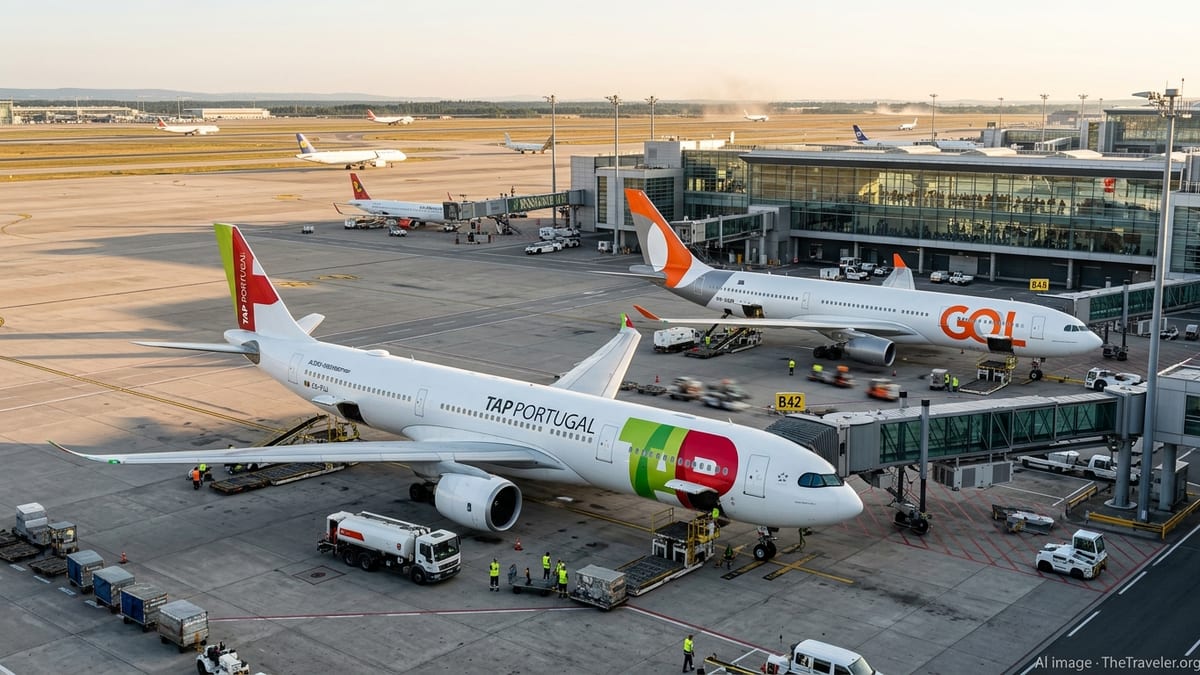
Contrasting Business Models Converge on the Atlantic
GOL has long been known as a low cost, Boeing narrowbody operator focused on Brazil’s dense domestic and short haul regional markets. Publicly available information shows that changed direction in early 2026, when the carrier confirmed plans to add Airbus A330neo widebodies to serve long haul routes between South America, Europe and North America. Reports indicate the first phase will center on a Rio de Janeiro to New York service due to start in July 2026, marking GOL’s return to true long haul operations and a significant shift away from its single type strategy.
TAP Air Portugal enters 2026 from a different starting point. The Lisbon based airline has spent the past decade positioning itself as a mid sized network carrier linking Europe with Brazil, North America and Africa, operating an all Airbus fleet that already includes A321LR and A330neo aircraft. Recent investor disclosures and industry coverage indicate that TAP ended 2023 with close to 100 aircraft in service and has additional A320neo family and A330neo deliveries scheduled between 2026 and 2028, deepening its long haul capabilities while maintaining a dual focus on widebody and long range narrowbody operations.
The result is an unusual competitive narrative on the South Atlantic. GOL, emerging from a period of restructuring and Chapter 11 proceedings, is using long haul growth as part of a five year plan to restore profitability and diversify revenue. TAP, by contrast, is refining a hub and spoke model that already relies heavily on Brazil, adding frequencies and cities to defend and grow its historical market leadership between Europe and the Portuguese speaking world.
New Long Haul Routes and Network Strategies
TAP’s 2026 network announcements underline how central the Atlantic has become to its growth. At Portugal’s main tourism fair in Lisbon, the airline detailed new long haul routes and additional frequencies for the 2026 2027 season, including a new Lisbon Orlando service from October 2026 and the elevation of Porto Boston to year round status. Separate schedule updates show an ambitious Brazil plan for TAP’s 60th anniversary in the market, with new flights to Curitiba and São Luís and more capacity on existing Brazilian routes, reinforcing Lisbon as a gateway for both European and North American passengers heading to South America.
For GOL, the approach to transatlantic growth is more indirect but no less significant. The carrier already relies on extensive codeshares with Air France and KLM to connect Brazilian cities with Europe and beyond, allowing its customers to continue from domestic GOL flights onto long haul services operated by its partners. Industry route filings and alliance announcements in 2025 highlighted further expansion of these codeshares, including additional links via Fortaleza, that effectively extend GOL’s virtual network into Europe and North America even before its own widebodies enter service.
The decision to add A330neo aircraft gives GOL new options. It can deploy its own metal on high demand trunk routes such as Rio de Janeiro to New York or major European hubs, while still feeding partner services from secondary Brazilian cities. Analysts note that this hybrid strategy mirrors broader industry trends in which medium sized carriers balance organic long haul growth with alliance and codeshare driven reach, aiming to manage risk while tapping premium transatlantic demand.
Fleet Upgrades: Widebodies vs Long Range Narrowbodies
Fleet strategy is at the heart of the 2026 showdown. GOL, which operated an all Boeing 737 fleet until 2026, has ordered A330 900neo aircraft as its long haul platform. Publicly available fleet data suggests an initial batch of five aircraft, enough to open a small portfolio of intercontinental routes while the airline evaluates performance and demand. The move also diversifies GOL’s supplier base beyond Boeing, a notable shift after years of relying on 737 NG and MAX jets for all operations.
TAP’s fleet plan goes in the opposite direction, emphasizing continuity more than disruption. The airline was the launch customer for the A330neo and has steadily grown a long haul fleet that mixes A330 900neo widebodies with A321LR single aisle aircraft capable of crossing the Atlantic on thinner routes. Portuguese language corporate filings and fleet summaries indicate that around 20 additional Airbus aircraft, including more A320neo family jets and at least two A330neo units, are due to arrive between 2026 and 2028, replacing older aircraft and lifting efficiency.
This fleet architecture gives TAP considerable flexibility. On dense corridors such as Lisbon São Paulo or Lisbon New York, A330neo widebodies provide capacity and range, while A321LR aircraft are deployed on secondary North American and Brazilian destinations where demand is strong but not sufficient to fill a widebody year round. GOL, at least in the near term, will rely on a small A330neo subfleet primarily for marquee routes, while its 737 MAX family continues to shoulder most of the domestic and regional feed that makes long haul services viable.
Cabin Experience and Product Differentiation
While GOL’s precise long haul cabin plans have not yet been fully detailed in public documentation, the introduction of A330neo aircraft is expected to bring a step change in onboard experience compared with the airline’s high density 737s. Industry observers anticipate a two or three cabin layout with a lie flat business class and an upgraded economy section tailored to overnight transatlantic journeys, aligning GOL’s product more closely with that of full service competitors on Brazil United States and Brazil Europe routes.
TAP, meanwhile, has already set out a detailed roadmap for passenger experience upgrades in 2026. The airline has announced the launch of a new cabin positioned between business and economy on its A330 and A321LR fleets from summer 2026, effectively introducing a premium economy style product on long haul routes. Aviation analysts note that this will create a four tier offering on many aircraft, with business, premium economy, extra legroom economy and standard economy, designed to capture more revenue from price sensitive but comfort conscious travelers, including long haul leisure passengers connecting between Brazil, Europe and North America.
In parallel, TAP has been rolling out new inflight technology, including Bluetooth audio connectivity on most of its A330neo and A321LR aircraft, allowing passengers to pair their own wireless headphones with seatback entertainment. Combined with incremental upgrades to soft products, this positions the Portuguese carrier firmly in the mid to upper segment of the transatlantic market, leaning on comfort and connectivity rather than ultra low fares.
Sustainability, Economics and Competitive Outlook
Both airlines are making these moves against a backdrop of rising costs and growing scrutiny of aviation’s environmental impact. Brazil’s domestic market has been recovering strongly, but local industry commentary warns that fuel price volatility and tax changes risk squeezing margins and pushing airlines to accelerate fleet modernization. The adoption of newer generation aircraft such as the A330neo and A321neo, with lower fuel burn per seat, fits into this broader push toward more energy efficient operations on long haul sectors.
For GOL, emerging from court supervised restructuring, the economics of long haul flying will be closely watched. Success on early A330neo routes could support its five year recovery plan by unlocking higher yielding international revenue and reinforcing its role as a key partner for European network carriers. Failure, on the other hand, could expose the risks of moving beyond a pure low cost, single fleet model at a time when domestic competition in Brazil remains intense.
TAP faces a different set of challenges. The airline is preparing for a new phase of partial privatization and potential strategic investment as Portugal seeks to reshape its flag carrier’s ownership structure. Its aggressive 2026 expansion in Brazil and North America, combined with premium economy and fleet renewal, is widely viewed by analysts as an effort to enhance valuation and prove the resilience of its Lisbon and Porto hubs. How well TAP manages capacity growth and yields on transatlantic routes will be critical in determining its competitive position.
As 2026 progresses, the Atlantic will serve as a proving ground for both carriers. GOL’s debut A330neo flights and TAP’s new cabins and Brazil routes highlight two distinct visions for connecting Europe and South America: one built from a low cost domestic base reaching outward, the other from a long established network carrier sharpening its product and deepening its footprint. Passengers on both sides of the ocean stand to benefit from more choice, newer aircraft and a rising focus on comfort on some of the world’s most important long haul corridors.