

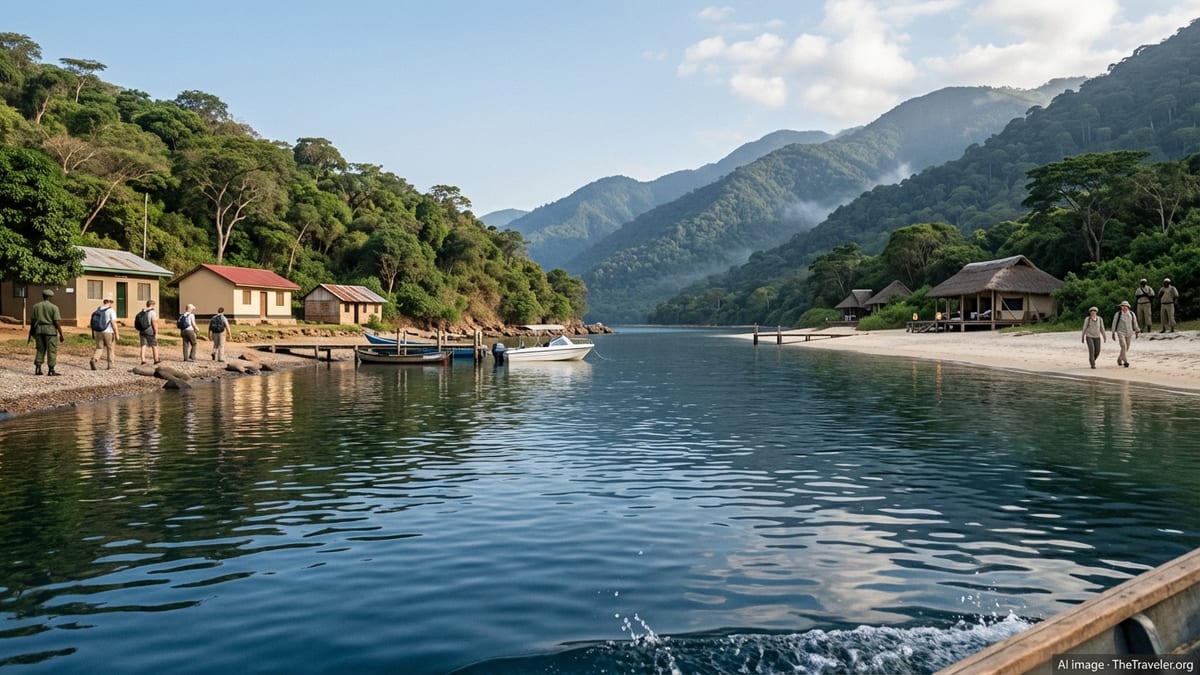
Approaching Gombe Stream National Park and Mahale Mountains from Lake Tanganyika.
I went to Tanzania determined to answer a very specific question for myself: if you can only do one chimpanzee trek, should it be Gombe (Option A) or Mahale Mountains (Option B)? I had read all the usual marketing lines about “remote paradises” and “life-changing encounters,” but I wanted to see how the two parks actually compare on cost, logistics, comfort, crowds and, most importantly, the quality of the chimpanzee experience. After trekking in both, talking with rangers and lodge staff, and making more than a few mistakes along the way, I walked away with a much clearer picture of who each place is really for.
First Impressions: History vs Wilderness
My first real decision moment was which park to visit first. I chose Gombe, mostly because of its history. Walking into the same hills where Jane Goodall did her groundbreaking research felt irresistible. The scale is intimate. Gombe is a small park hugging the shore of Lake Tanganyika, and when I arrived by boat from Kigoma, it felt more like approaching a village than a vast wilderness. The chimpanzee community is relatively compact, the forest is close, and the atmosphere is surprisingly low-key. I could literally see the forested ridge where we would trek from the beach where I stepped off the boat.
Mahale hit me very differently. The Mahale Mountains loom above the lake like a wall of emerald, and the park is huge compared to Gombe. Distances are bigger, the forest feels deeper, and the whole place has a raw, isolated energy that Gombe cannot match. I remember standing on the white sand outside my camp, looking up at the forested slopes and realizing that the chimps could be almost anywhere up there. Instead of a historic research site, Mahale felt like stepping into a full-scale wilderness, with me as a temporary guest.
Emotionally, Gombe felt more personal and human. The ranger station, the simple accommodation options and the research legacy make it feel approachable and almost familiar, even if you have never studied primatology. Mahale felt more like a high-commitment pilgrimage. I had the sense that I had come a long way, at some expense and effort, to be allowed into the chimps’ world on their terms. That shift in mindset colored everything that followed.
Getting There: Logistical Reality vs Brochure Fantasy
Reaching both parks starts the same way: get yourself to Kigoma in western Tanzania, usually via a domestic flight from Dar es Salaam or sometimes Arusha. The second major decision moment for me was how much time and money I was realistically prepared to spend getting from Kigoma to each park, and that turned out to matter more than it looks on paper.
For Gombe, the transfer is relatively simple by local standards. The park is only accessible by boat, but the ride from Kigoma can be as short as about an hour by speedboat. I used a motorboat organized through my operator; prices for boat transfers commonly fall in the roughly 25 to 50 US dollars per person range for a round trip, depending on the type of boat and how many people share the cost. It was not cheap, but it was manageable, and I appreciated that I could leave Kigoma in the morning and be checking into my room at Gombe before lunch. If you are tight on time, that is a real advantage.
Mahale immediately felt more complicated. It sits much further down the same lake, and although there are occasional shared or scheduled boats, most visitors end up on private or lodge-arranged transfers that take considerably longer. My transfer involved a small plane to an airstrip serving the park region, then a long boat ride to the lodge. Some itineraries use a charter flight directly into a Mahale-area strip from Arusha or Dar es Salaam, but that raises costs significantly. By the time I finally stepped onto Mahale’s beach, I had burned essentially a full travel day. It was beautiful, no question, but there was no pretending that it was easy or cheap.
If you hate long transfers or are squeezing chimp trekking into a tight overall safari schedule, Gombe clearly wins on convenience. If you are prepared to treat the journey itself as part of the adventure, and your budget can cope with an extra internal flight or charter, Mahale’s remoteness starts to feel like a feature rather than a flaw.
Costs, Park Fees and Overall Value
For both parks, conservation and park entrance fees are serious line items, and I am glad I dug into the numbers before I went. Tanzania’s national park fees are updated periodically, but at the time of my trips, Gombe carried one of the higher daily conservation fees among Tanzanian parks, often quoted around the 100 to 120 US dollars per adult per 24 hours, while Mahale’s conservation fee typically sat lower, around the 90 to 100 US dollars per adult per day. Exact figures vary slightly by source and season, but the pattern was consistent: Gombe costs a bit more per day just to step into the park, while Mahale is slightly cheaper on the paper of conservation fees alone.
That said, when I added the full picture, Gombe did not automatically come out cheaper. I had to factor in boat transfers, accommodation, chimp trekking permits where charged separately, ranger or guide fees and the usual extras like tips and drinks. Chimp tracking permits for Gombe, where listed separately from basic park fees, are often bundled through operators, so the real cost emerges when you price a full package. For Mahale, I ran into the same thing: relatively modest conservation fees on paper, but accommodation and getting there pulled the total up sharply.
Accommodation was the biggest swing factor. In Gombe I found options ranging from very simple park bandas and guesthouses to a couple of modest lodges. Nightly rates stretched from basic but workable for a budget traveler up into mid-range territory. It was far from cheap by global standards, but I did feel that I had choices if I was willing to compromise on comfort.
In Mahale the story was very different. The main places to stay are high-end tented camps or lodges that bundle full-board accommodation and activities. Prices regularly run into several hundred dollars per person per night, often more, and this is before adding internal flights or private boat transfers. I had to accept that Mahale is, in practical terms, a luxury destination. I do not regret the money I spent for the experience I got, but I would not describe it as accessible for most budgets. If your total budget for a chimp trek is tight, Gombe offers a path that Mahale realistically does not.
On the Trail: The Actual Chimpanzee Experience
All the logistics and fees only matter if the chimpanzee experience delivers. This is where I paid very close attention, because it was the heart of why I came. In Gombe, the trekking distances were generally shorter, and the terrain, while still steep in places, felt less punishing. On my first morning, we hiked from the lakeshore up into the forest for just over an hour before hearing the first distant calls. By mid-morning, we were with a small group of chimps feeding and grooming in the trees above us, then occasionally coming to the ground to move between trees.
Gombe’s chimp population is smaller and more concentrated than Mahale’s, and the trackers know the individuals extremely well. That familiarity showed in the way our guides moved, reading subtle audio clues and vegetation disturbances. Success rates reported by operators are typically high, often in the 80 to 90 percent range for sightings over a visit of a day or two. I did see chimps on my main trek, but one of my afternoons turned into a long, hot walk with only distant vocalizations and no clear view. It was a sobering reminder that this is not a zoo and that success is never guaranteed, even in a small park.
Mahale’s actual chimp encounters felt different from the start. The forest is denser and steeper, and our treks ran longer, from about two hours up to around six depending on where the group had ranged that day. The habituated chimp community in Mahale is larger, and sightings are often described by guides as above 90 percent over a multi-day stay, but you pay for that in sweat. On one day, we climbed steadily for hours before dropping into a small valley and suddenly finding ourselves in the middle of a party of chimps spread across the trees and forest floor. At one point, a dominant male crossed the path barely a few meters in front of me, perfectly within the rules on distance but still intense enough to make my heart rate spike.
The rules in both parks follow the same basic principles: limited daily time with the chimps, a controlled maximum group size, no trekking if you show signs of contagious illness, and an enforced distance for safety and to protect the animals. In practice, I found the enforcement consistent but slightly stricter in Mahale, probably because the terrain makes it easier to get inadvertently too close. I appreciated that seriousness; it was clear that the aim was to prioritize the chimps’ welfare, not my photo opportunities.
If your priority is a high likelihood of long, immersive encounters and you are reasonably fit, Mahale has a clear edge. If you prefer a slightly gentler trek, or if you value the historical context as much as the wildlife itself, Gombe still delivers a powerful and sometimes more reflective experience.
Comfort, Crowds and Atmosphere
Another key decision moment for me was choosing where to stay within each park and how much privacy I realistically wanted. Gombe, being relatively close to Kigoma and historically associated with research and lower-cost trips, has a more mixed crowd. During my stay, I met backpackers, researchers, mid-range safari clients and a few Tanzanian visitors on shorter trips. There are fewer beds overall than in popular savannah parks, but I still shared the main common areas, and chimp groups sometimes felt a bit busy once everyone converged on the same sighting. Group sizes are capped, yet when two groups ended up in the same area, I sometimes felt the chimps had more human eyes on them than I personally liked.
Comfort in Gombe is very much what you make of it. My room was simple, with intermittent power and modest facilities. It was perfectly adequate but not glamorous, and the food mirrored that: filling, repetitive, basic. If you go in expecting polished hospitality, you will probably be disappointed. If you expect a national park outpost with the charm and frustrations that implies, you will be fine.
In Mahale, the atmosphere was strikingly different. Because accommodation is limited to a small number of high-end camps, overall visitor numbers are lower and more controlled. On most treks, my group size was small, and we often felt like the only humans in the forest. Back at camp, the experience was closer to a remote beach lodge than a research station. My tented suite had a proper bed, an en suite bathroom and thoughtful touches that I would expect in a high-end safari camp. Meals were creative and well executed, and service was both warm and professional.
The catch is that all of this comes at a price. There were moments in Mahale when I felt a mild disconnect between the rough reality of long, muddy treks and the gently curated comfort back at camp. It is not that the contrast is bad, but you do need to be comfortable with the idea that your money is buying both conservation access and a level of luxury that slightly insulates you from the hardship of the region. If you want a more stripped-back, research-like environment, you may actually prefer Gombe’s straightforward simplicity.
Seasonality, Weather and When I Would Go Again
When to go turned into another real decision moment. Western Tanzania has a pronounced rainy season roughly from around November into April, with the heaviest rains typically between March and May, and a drier, often more pleasant season from about June through October. I visited Gombe toward the end of the dry season and Mahale a bit earlier when some trails were still damp. That timing shaped my experience more than I expected.
In Gombe during the drier months, trails were tricky in places but broadly manageable, and the forest undergrowth felt open enough to follow the chimps without too much bushwhacking. On the downside, the heat was intense on the steep sections, and there was more dust on the exposed ridges. A ranger told me that in some parts of the wet season, trails can be extremely slippery and certain routes become slow and tiring, and that lined up with stories from other travelers I met later on. The chimps can also range a bit higher when food is more widely available, which may stretch trekking times.
In Mahale, even a modest amount of recent rain changed things. The forest floor turned slick, leeches appeared in some areas and the humidity was punishing. On one day, we hiked a long loop up a muddy slope, slipping frequently, only to have the chimps move off quickly once we caught them, forcing another climb. It was memorable, but not in a way everyone would enjoy. Guides told me that the drier months, especially between July and October, usually bring more stable trails and can make it easier for trackers to locate the chimps efficiently, though the animals’ movements still depend heavily on what is fruiting at the time.
If I were to plan again purely for best trekking conditions, I would aim for both parks between about July and early October, accepting that it is also peak season for fees and demand. If I had to risk some rain to get lower prices and fewer visitors, I would do that in Gombe before Mahale, because Gombe’s shorter distances make marginal conditions feel more manageable. Mahale in heavy mud is serious work, and I would not recommend it to anyone with mobility or fitness concerns.
Safety, Rules and Practical Details That Actually Matter
Before going, I worried about safety in a general sense: wild animals, remote locations, boat transfers on a very deep lake. On the ground, the risks felt controlled but real. Boat travel is central to both parks, and while my transfers were well managed, I did insist on life jackets and was glad I did. Lake conditions can change fast, and sitting in a small boat with no visible land beyond the forested shore reminded me just how far from large medical facilities I really was.
Within the parks, both Gombe and Mahale have clear rules designed to protect visitors and chimpanzees. Group sizes for trekking are limited, visits with the chimps are capped at about an hour once the group is located, and minimum distances should be maintained even when curious individuals move closer. Rangers checked that no one in the group had visible cold or flu symptoms before each trek, and I watched one visitor in Mahale get firmly but politely turned back after admitting to a sore throat. At the time it felt strict; in hindsight, I was glad the rules were taken seriously.
Another practical detail that affected my planning was payment and booking. Park and activity fees in Tanzania are often paid electronically, and many operators now bundle the necessary permits and conservation fees into all-inclusive packages. Walking into Gombe or Mahale and trying to organize everything on arrival would be both stressful and risky, since beds and permits are limited and can sell out in peak months. I booked months in advance for Mahale and still found that some preferred dates and camps were already full. For Gombe I had more flexibility, but I still would not recommend leaving arrangements to the last minute.
On the health side, a realistic approach is important. Both parks lie in areas where malaria is present, and I took prophylaxis on advice from my doctor. Basic medical support is limited; if something serious happens, evacuation takes time. That risk is not a reason to avoid the trip, but it is a reason to have proper cover, carry your essential medications and respect ranger guidance once you are in the field.
Who Each Park Is Really Best For
After doing both, I stopped thinking in terms of “which park is better” and started thinking about “which park is better for which kind of traveler.” If I had to generalize, Gombe is best for people who value history, shorter travel times and a more modest budget, while Mahale is best for travelers who prioritize wildness, exclusivity and deeper immersion and are willing to pay for it.
If you are on a limited timeline, say adding chimp trekking to a larger Tanzania safari, Gombe fits more easily. You can realistically fly to Kigoma, boat across, stay for two or three nights, trek twice and get back to the main safari circuit without breaking your schedule or budget too badly. You still have a good chance of quality chimp encounters, you walk in the footsteps of Jane Goodall, and you experience one of Africa’s great lakes up close. The tradeoffs are simpler accommodation, potentially more people around the chimps at peak times and a slightly lower probability of extended, intimate encounters.
Mahale demands more from you. It requires a larger time block, a healthier budget and a willingness to embrace remoteness. In return, you get some of the most intense primate encounters I have experienced, often with very few other humans in sight. The setting is spectacular: jungle-clad mountains dropping straight into a crystal-clear lake, white sand beaches, sunsets that feel almost unreal. Even with high expectations, I found the experience lived up to its reputation, though the travel days and cost did hit harder than I expected when I finally did the math.
If money were no object and I had at least four or five nights to dedicate solely to chimp trekking, I would choose Mahale again. If I were traveling on a tighter budget, exploring Tanzania largely independently, or trying to balance savannah game viewing, cultural visits and a quick primate experience, I would choose Gombe and feel good about that choice.
The Takeaway
After seeing both Gombe and Mahale firsthand, my conclusion is not that one definitively wins over the other, but that they answer slightly different questions. Gombe is the more practical and historically rich choice. It is easier to reach from Kigoma, somewhat more flexible for shorter stays, and offers a strong chimp experience anchored in one of the most important primate research sites on earth. The simplicity of the place can be both its charm and its frustration: do not expect luxury, but do expect a sense of connection to the story of chimpanzee conservation.
Mahale is the deeper plunge into wilderness. It is more remote, more expensive and more demanding, but it also delivers longer, more intense encounters on average, in a landscape that feels almost cinematic. The limited number of high-end camps keeps visitor pressure low, and that shows in the quietness of the forest and the unhurried time you can spend watching chimps move naturally through their environment.
If you value comfort, privacy, and are willing to trade money and travel time for a higher chance of exceptional encounters, Mahale is the better trek. If you value access, affordability relative to the region and the chance to blend science history with wildlife, Gombe may suit you better. In a perfect world, you would do both as I did and let the contrasts deepen your appreciation of each.
If I had to give one piece of hard-earned advice, it would be this: decide first what matters most to you, then choose the park that matches that priority rather than trying to make one park be something it is not. Both Gombe and Mahale are worth the effort. The right choice is the one that fits your time, budget and appetite for adventure, not the one that looks best in a brochure.
FAQ
Q1. Is Gombe or Mahale better if I only have two or three days for chimp trekking?
For a very short trip, Gombe is usually the better fit. Travel from Kigoma is shorter and simpler, and you can realistically fit in one or two treks without losing entire days to transfers. Mahale’s longer travel times make it more efficient if you can commit at least four or five days on the ground.
Q2. Which park is more expensive overall, not just in park fees?
When you add everything up, Mahale is generally more expensive. Even if Mahale’s conservation fee can be slightly lower than Gombe’s, the high-end accommodation, necessary internal flights and longer boat transfers make the total cost higher. Gombe still is not cheap, but it offers a more accessible overall budget.
Q3. How physically demanding are the treks in each park?
Gombe’s treks are shorter on average and felt moderate to me, with some steep, sweaty sections but manageable distances. Mahale’s treks were longer and often steeper, with days of two to six hours on the move, especially if the chimps ranged higher. Reasonable fitness is important in both, but Mahale demands more stamina.
Q4. How likely am I to actually see chimpanzees?
No operator can promise sightings, but based on my experience and typical ranger estimates, Gombe offers a strong chance over one or two days, and Mahale usually edges ahead when you stay several days. Across multiple treks in Mahale, I had longer and more frequent encounters, but I did have one tough, low-visibility day in each park, which underlined that nothing is guaranteed.
Q5. Can I visit either park independently without a tour operator?
In theory, you can organize Gombe more independently by getting yourself to Kigoma, arranging a boat and booking park accommodation directly, though it still takes planning. Mahale is much harder to do without an operator or lodge package, largely because of the internal flights, private boats and very limited bed capacity. For Mahale especially, I would not recommend a fully do-it-yourself approach.
Q6. Which park has better accommodation and comfort levels?
Mahale has far superior comfort, with high-end tented camps and lodges that deliver strong hospitality, good food and thoughtful details. Gombe offers simpler park bandas, guesthouses and modest lodges. I found Gombe perfectly acceptable but basic; Mahale felt like a remote boutique beach lodge combined with a forest camp.
Q7. How far in advance should I book Gombe or Mahale?
For Mahale, I would aim to book several months in advance, especially for peak season between roughly July and October, because camp space and flights are limited. For Gombe, there is a bit more flexibility, but I would still try to secure accommodation, permits and boat transfers at least a few weeks to a couple of months ahead for popular periods.
Q8. Is one park safer than the other?
In terms of wildlife and on-trail safety, both felt comparable: rangers enforce distance rules, group sizes are limited, and health checks reduce disease risk for the chimps. The main additional risk is transport; both involve lake boat transfers, and Mahale adds more flight segments. I did not feel unsafe in either, but the remoteness of Mahale makes solid medical and evacuation insurance especially important.
Q9. Which park is better for serious photographers?
If photography is your top priority and you can handle the cost and physical effort, Mahale is the stronger choice. The combination of more extensive chimp communities, fewer other tourists, longer encounters and stunning landscapes gives you more opportunities. Gombe still offers good shots, especially linked to the Jane Goodall legacy, but the experience felt slightly more constrained and busier at key sightings.
Q10. If I had to choose just one, which would I personally go back to?
For my own preferences, I would return to Mahale if I had the budget and time, because the depth of the encounters and the overall sense of wilderness matched what I love most about travel. If I were traveling on a tighter budget, or introducing friends to chimp trekking for the first time with only a couple of spare days, I would choose Gombe and feel entirely comfortable with that compromise.