

More news on this day
Los Angeles International Airport experienced one of its most turbulent Good Friday travel periods in recent memory, with 265 flights disrupted and thousands of passengers facing missed connections, long queues, and hours of uncertainty across crowded terminals.
Get the latest news straight to your inbox!
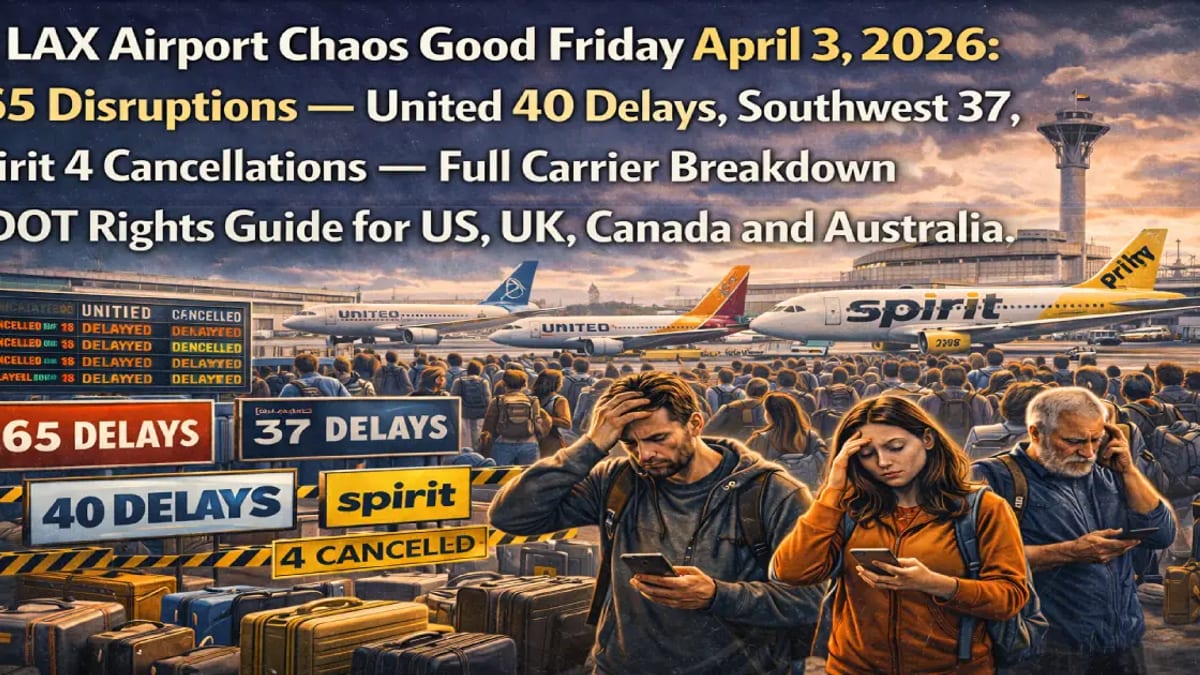
Good Friday Surge Collides With Strained Flight Operations
The latest disruption at Los Angeles International Airport unfolded during a peak spring getaway window, when Good Friday traditionally sends passenger numbers higher as families, students, and holiday travelers converge on major hubs. Publicly available flight-tracking data and industry coverage indicate that LAX saw 265 combined delays and cancellations over the course of the day, a volume in line with recent spikes during spring break and winter-weather events that have repeatedly tested the airport’s resilience.
The timing magnified the impact. Good Friday traffic layered on top of already robust leisure demand and ongoing operational constraints across the U.S. aviation system, including tight aircraft and crew rotations and lingering staffing pressures in air traffic control. As the disruptions accumulated, departure boards at LAX filled with rolling delay estimates, while arrival banks compressed into narrower windows, making it harder for airlines to maintain orderly gate flows.
Recent travel-industry reporting focused on LAX has highlighted how even a few dozen cancellations can trigger knock-on problems for hundreds of flights as aircraft and crew fall out of position. With 265 flights affected on Good Friday, the result was a day defined by backed-up security lines, congestion at boarding gates, and extended waits in customer service queues as passengers scrambled to salvage Easter weekend plans.
The episode follows other high-impact days at the airport during the current travel season, including a March spring break surge when more than 250 LAX flights were delayed or canceled and a winter weather system in February that snarled roughly 150 flights. Together, these events underscore how little slack now exists in the system when travel peaks coincide with any operational strain.
Why 265 Disruptions Matter at a Hub Like LAX
On paper, 265 affected flights represent a fraction of Los Angeles International Airport’s daily schedule, yet the practical fallout is far more extensive. As one of the world’s busiest origin-and-destination airports, LAX handles a high proportion of travelers who either begin or end their journeys in Los Angeles instead of simply connecting through. That means every disrupted departure or arrival strands large groups of passengers who must rebook, reclaim baggage, or find last-minute accommodation.
Published analyses of prior delay-heavy days at LAX have shown that when more than 200 flights run late, gate areas can quickly reach capacity, with passengers crowding around overtaxed power outlets, food concessions, and information screens. The Good Friday disruptions created similar scenes, with travelers funneling into customer assistance lines as airlines attempted to rework itineraries using limited remaining seat inventory on one of the busiest weekends of the spring.
Because many Good Friday flights feed onward connections across North America and to the Pacific, disruptions at LAX also ripple far beyond Southern California. A delayed departure to a regional hub can cause passengers to miss onward links to smaller cities, while late-arriving international services compress already tight connection windows on domestic routes. As aircraft arrive out of sequence, airlines often must swap gates or hold aircraft on taxiways, adding further delay to a system already under strain.
Observers of recent nationwide flight-meltdown events note that such days rarely stem from a single dramatic trigger. Instead, they tend to reflect the cumulative effect of heavy demand, weather or airspace constraints, and thin margins in airline and air traffic staffing. Good Friday at LAX appeared to fit that pattern, with the 265 disruptions representing the visible manifestation of broader systemic pressures.
Contributing Factors: Weather, Staffing and Systemic Strain
Good Friday’s problems at LAX unfolded against a backdrop of ongoing operational challenges in the wider U.S. air network. Over recent months, coverage from aviation and travel outlets has documented recurring instances in which air traffic control staffing shortfalls prompted ground-delay programs, particularly at large coastal hubs such as Los Angeles, Newark, and major East Coast and Midwest airports.
When air traffic facilities reduce the number of aircraft they can safely handle per hour, airlines must adjust schedules on short notice. Flights may depart later than planned, be rerouted to less congested airspace, or, in more extreme cases, be canceled outright to prevent gridlock. Even modest reductions in throughput can quickly create long queues for departures and arrivals, as aircraft wait for available slots in increasingly crowded skies.
Weather can further complicate this picture. Earlier in the year, winter systems brushing Southern California produced days when more than 150 LAX flights were delayed or canceled, illustrating how shifts in wind patterns, visibility, or runway configurations can significantly curtail capacity. While Good Friday did not coincide with a major storm over the airport itself, scattered weather-related constraints in other regions, particularly on cross-country routes, likely contributed to late arrivals that cascaded into later-than-scheduled departures in Los Angeles.
Industry reporting also points to persistent tightness in airline staffing and aircraft availability. After years of route expansion and strong leisure demand, carriers operate with leaner spare capacity, leaving less room to recover when disruptions occur. Once a Good Friday schedule begins to slip, it becomes increasingly difficult to restore normal operations before the day’s final departures, especially when aircraft and crews are scheduled to continue to other cities overnight.
Impact on Travelers: Long Queues, Missed Holidays and Frayed Nerves
For travelers caught in the Good Friday turmoil, the statistics around 265 flight disruptions translated into very personal setbacks. Social media posts and traveler accounts from similar recent disruption days at LAX describe families camping out on terminal floors, long lines for food concessions, and passengers making repeated trips between gates as departure times and aircraft assignments shifted.
On a holiday weekend, the stakes are often higher. Passengers traveling to reunite with relatives for Easter, attend weddings, or embark on long-planned vacations are especially vulnerable to missed connections and overnight delays. When a key flight cancels late in the day and alternative options are limited or already full, some travelers may not reach their destinations until well after the holiday they set out to celebrate.
Good Friday’s busy schedule also complicated the work of airport and airline staff on the ground. Publicly available reporting on previous disruption episodes at LAX notes that front-line agents typically manage a surge in rebooking requests at the same time that boarding processes grow more hectic, with standby lists swelling and overhead bin space growing scarce. Under such conditions, even routine tasks such as processing seat changes or printing boarding passes can take longer, adding to the sense of congestion.
Customer service challenges extend beyond the airport itself. During widespread disruption days, airline call centers and chat channels often face increased wait times as passengers seek confirmation about future segments, request refunds, or ask about hotel and meal assistance. With 265 flights affected at LAX alone on Good Friday, it is likely that many travelers faced extended waits not only at the terminal but also online and by phone.
What Travelers Can Learn for Future Peak Travel Days
Although the Good Friday chaos at LAX was disruptive for thousands, it also offers lessons for travelers planning future trips through major hubs during peak periods. Travel-rights organizations and aviation analysts frequently recommend building extra connection time into itineraries that pass through busy airports like Los Angeles, particularly on days leading into major holidays or school breaks.
Passenger advocates also emphasize the importance of using official airline apps and flight-status tools, which can provide faster updates than departure boards when disruption unfolds rapidly. On days like Good Friday, when 265 flights face delays or cancellations, travelers who receive early notifications may be able to switch to alternative departures or reroute through different hubs before seats disappear.
Published guidance from consumer-focused aviation outlets notes that passengers flying from LAX should consider arriving at the airport earlier than usual during peak travel periods, both to navigate security lines and to preserve options if something goes wrong. Extra time at the terminal can make the difference between catching a rebooked flight and facing an unexpected overnight stay.
Finally, the Good Friday episode underscores that even when weather appears calm over Los Angeles, conditions and constraints elsewhere in the network can still upend plans. For travelers, that reality means treating every major holiday period as a potential stress test of the system, and preparing with flexible itineraries, backup plans, and a clear understanding of their rights when flight schedules fall apart.