

More news on this day
As spring break crowds converge on Portland International Airport, a partial U.S. government shutdown is adding fresh uncertainty for PDX travelers already bracing for the year’s busiest leisure travel weeks.
Get the latest news straight to your inbox!
Shutdown Collides With Peak Spring Travel
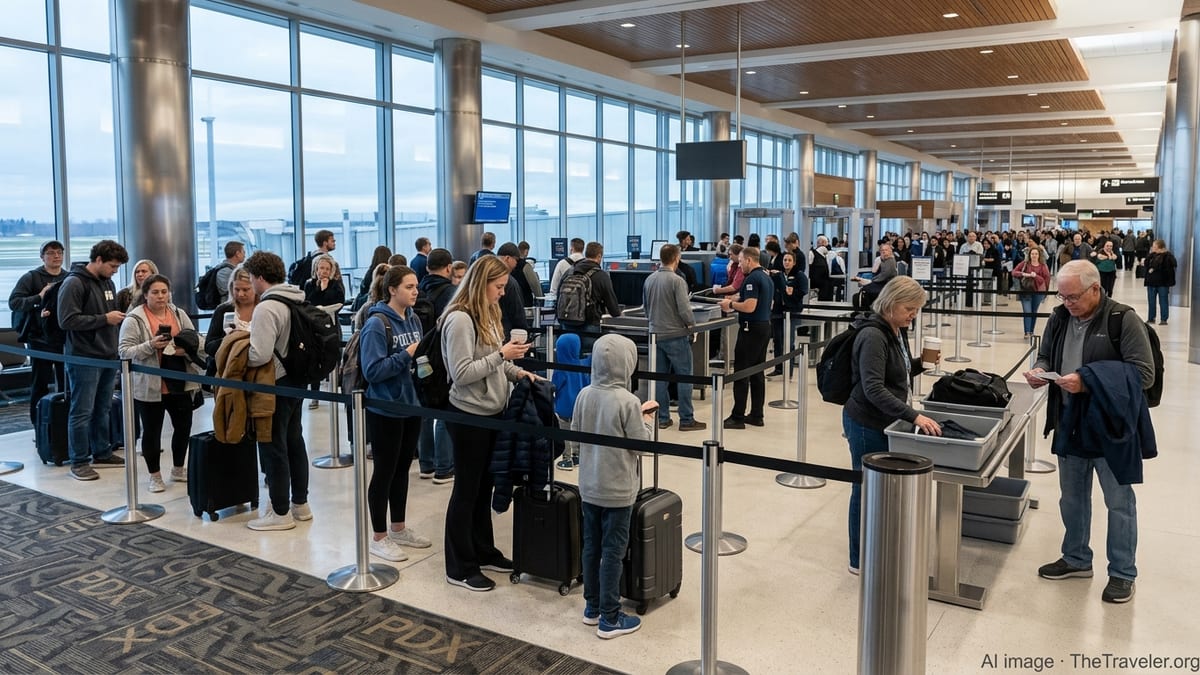
The current lapse in federal funding has left large parts of the Department of Homeland Security operating on contingency plans just as spring break peaks at airports across the United States. Portland International Airport is not exempt from those pressures. While flights are continuing to operate, the combination of heavier seasonal demand and strained federal staffing is increasing the risk of longer security lines, tighter connections and occasional disruption.
Transportation Security Administration officers and Federal Aviation Administration air traffic controllers are classified as essential personnel, which means they are generally required to continue working during a shutdown even when paychecks are delayed. Recent coverage from national outlets indicates that prolonged funding gaps have already driven higher attrition among TSA staff and contributed to uneven wait times at security checkpoints around the country. Those same dynamics can quickly spill over to mid-sized hubs such as PDX when schedules are full and traveler volumes spike.
Industry groups tracking the impact of past shutdowns on travel and tourism note that the most visible effects tend to surface at airports first. Publicly available analyses from travel associations describe billions of dollars in economic losses tied to delayed or disrupted air travel during extended funding lapses, as well as broader knock-on effects for hotels, restaurants and attractions that rely on smooth airport operations.
What PDX Passengers Are Seeing on the Ground
Locally, public information and traveler accounts suggest that Portland International Airport has so far avoided the worst scenes reported at some of the nation’s largest hubs, where hourslong lines have periodically formed at security checkpoints when staffing thins. Posts in regional travel and community forums over the past several days describe relatively normal screening times at PDX during off-peak periods, even as other airports report unpredictable surges.
However, that relative calm can change quickly. National reporting in outlets such as the Associated Press shows that security wait times have become highly variable during the shutdown, with some airports swinging from severe congestion in the morning to short lines later the same day. Because TSA’s ability to actively update its own wait time tools and social channels is limited during funding lapses, official estimates may lag behind real conditions on the concourse.
For PDX passengers, that means the experience at the checkpoint may be more of a coin toss than in a typical year. Even if Portland’s TSA operation is adequately staffed at the start of a shift, last-minute absences or schedule changes elsewhere in the region can lead to reassigned personnel and thinner coverage. With spring break flights running near capacity, a modest slowdown at security can cascade into missed boarding times, crowded gate areas and increased stress for families traveling with children.
Security Screening, Trusted Traveler Programs and Immigration
One of the clearest national impacts of the current shutdown has been on expedited screening programs. Publicly available federal notices in late February indicated that TSA PreCheck enrollment and Global Entry processing would be temporarily suspended as a cost-saving measure, even as existing members can continue to use dedicated lanes where open. For PDX travelers who were hoping to sign up before spring break, that pause may remove a tool that typically shortens their time in line.
Reports on operations during recent shutdowns show that Customs and Border Protection has generally kept primary inspection booths open at major international gateways, including West Coast ports of entry. Essential CBP officers typically remain on duty without pay so that arriving international passengers can still be processed. At PDX, which handles a growing roster of transborder and overseas routes, that approach means flights are still being cleared, but travelers may encounter reduced staffing at secondary inspection, trusted traveler enrollment centers or agricultural checks.
Security experts and union representatives quoted in national coverage have also flagged the risk that extended periods of unpaid work can erode morale and accelerate departures among experienced officers. While safety standards are not being relaxed, a thinner bench of veteran staff can leave airports more vulnerable to operational hiccups during peak travel periods such as March and April. Portland-area travelers returning from Mexico, Canada or Europe during spring break could feel those pressures in the form of slower-than-usual lines at passport control when multiple widebody arrivals converge.
Flight Schedules, Delays and What Airlines Are Doing
Beyond the security checkpoint, the shutdown is also straining the air traffic system that keeps flights moving. Federal contingency plans described in aviation and policy briefings call for thousands of FAA employees in training, inspection and support roles to be furloughed during a funding lapse. While front-line controllers stay on the job, reductions in hiring pipelines, overtime capacity and supervisory staff have been linked in recent months to more frequent flow restrictions and delays at busy airspace choke points.
Airline executives, in an open letter covered widely by national business media, recently urged Congress to restore full Homeland Security funding and pay for aviation workers, warning that repeated shutdown episodes are turning air travel into what they described as a political football. The letter referenced mounting delays tied to staffing constraints and emphasized that, while carriers can adjust schedules and waive certain fees, they cannot control the pace of federal screening and air traffic services.
For PDX passengers, the practical impact may be felt in longer-than-normal taxi times, holding patterns before landing at congested hubs, and tighter connection windows on itineraries that route through cities already experiencing disruption. Airlines serving Portland have been updating travel advisories to reflect the possibility of operational slowdowns linked to the shutdown, with some carriers offering limited flexibility for customers who want to move flights away from peak days or times.
How Portland Travelers Can Minimize Disruption
Travel industry groups and consumer advocates are offering recurring guidance for passengers navigating shutdown-related uncertainty, much of it applicable to those flying out of Portland. Advisory documents from trade associations for tour operators and travel advisors recommend arriving at the airport earlier than usual, particularly in the early morning and late afternoon waves that see the highest volume of departures. For PDX, that can mean planning to be at the terminal at least two hours before a domestic flight and three hours before an international departure, with extra buffer on weekends.
Analysts also stress that mobile tools and alert systems are more important than ever during a funding lapse. Because official wait time feeds may not be updated in real time, travelers are turning to a mix of airline apps, airport social media updates and crowd-sourced reports to gauge conditions at their home airports. While these sources are imperfect, they can provide directional insight into whether security lines at PDX are currently moving quickly or backing up toward the ticketing lobby.
Finally, experts in travel risk and insurance caution that standard trip protection policies do not always treat government shutdowns the same way they handle weather or mechanical issues. Some guidance documents produced for advisors note that coverage for delays caused by lapses in federal funding can be limited or excluded, depending on the policy language. Portland travelers are being encouraged to review their terms carefully and, where possible, to build in extra connection time, pack essential items in carry-on bags and maintain flexible expectations as the shutdown continues to intersect with peak spring break demand.