

More news on this day
A new Dutch rail startup, GoVolta, is preparing to shake up cross-border travel between the Netherlands and Germany with low-cost trains linking Amsterdam to Berlin and Hamburg from March 2026, as both countries seek faster, greener and more affordable rail alternatives to short-haul flights.
Get the latest news straight to your inbox!
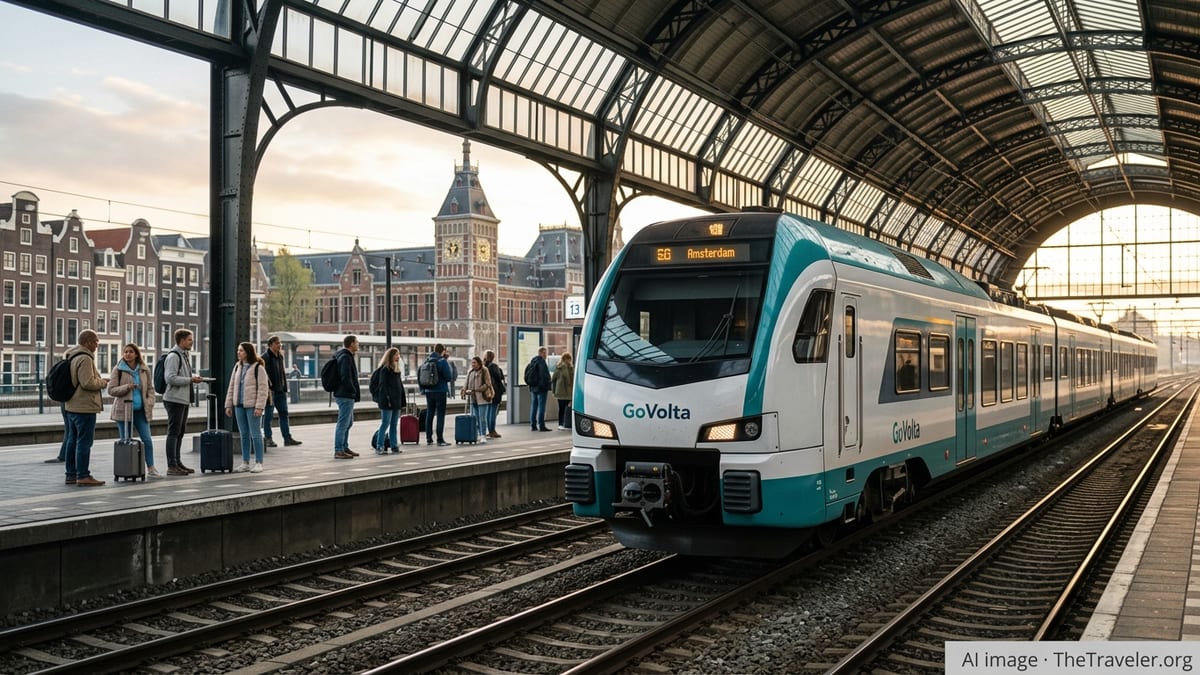
Binational push to strengthen rail between the Netherlands and Germany
Publicly available policy documents from both the Dutch and German governments highlight a shared ambition to improve international rail links, with the Amsterdam–Berlin corridor repeatedly identified as a priority connection. Joint declarations on better rail connectivity point to the need for more frequent, faster and more competitively priced services between the two countries, in order to shift passengers away from cars and planes.
Against this backdrop, private operator GoVolta is positioning itself as a new player on one of Europe’s busiest cross-border leisure and business corridors. The company is based in the Netherlands and registered as GoVolta Exploitation B.V., with a business model built around open-access services that operate on existing infrastructure rather than under a state-owned franchise.
According to industry coverage, the Netherlands and Germany are also working in parallel on upgrades to existing Amsterdam–Berlin services run by incumbent operators, including plans for shorter journey times and updated rolling stock. GoVolta’s entry adds a low-cost, point-to-point option that complements these government-backed improvements while increasing overall capacity on the route.
Sector analysts note that this combination of public policy support for rail and private investment in new cross-border services reflects a wider European trend. Liberalization of long-distance passenger markets in several EU countries has opened the door for newcomers like GoVolta to compete on key international axes such as Amsterdam–Berlin and Amsterdam–Hamburg.
GoVolta’s launch timetable and routes from Amsterdam
GoVolta plans to begin operating its first trains between Amsterdam and Berlin on 19 March 2026, followed by an Amsterdam–Hamburg service from 20 March 2026. Reports indicate that both routes will initially run several times per week before ramping up to daily departures during the 2026 summer season, reflecting expected peak demand from tourists and city-break travelers.
Timetables published in trade and travel media show the Amsterdam–Berlin service departing Amsterdam Centraal in the morning and arriving at Berlin Gesundbrunnen in the mid-afternoon, with a journey time of just under seven hours. The return service is scheduled to leave Berlin in the late afternoon and reach Amsterdam shortly before midnight, allowing same-day trips in either direction.
En route to Berlin, GoVolta trains are expected to call at Amersfoort, Deventer and Hengelo in the Netherlands, before crossing the border at Bad Bentheim and continuing via Osnabrück and Hannover. This pattern offers new direct options not only for end-to-end Amsterdam–Berlin passengers but also for smaller intermediate cities that currently have fewer low-cost long-distance choices.
The Amsterdam–Hamburg route is due to follow a similar path through the Netherlands, with stops at Amersfoort, Deventer and Hengelo before entering Germany at Bad Bentheim and continuing via Bremen to Hamburg. The scheduled arrival around early afternoon is designed to connect with onward regional and long-distance trains along Germany’s north-south corridors.
Ultra-low fares aimed at budget-conscious travelers
GoVolta has attracted attention by promising promotional fares from as low as 10 euros for early bookers on its Amsterdam–Berlin and Amsterdam–Hamburg services. Travel industry coverage compares the approach to low-cost airlines, with a tiered pricing structure in which a limited number of the cheapest seats are released on each departure and prices rise as trains fill up.
The company presents itself as a no-frills but comfortable alternative to more traditional long-distance rail products. Information published to date suggests a single “Comfort Class” style of seating rather than a multi-class layout, with on-board services simplified to keep operating costs low. Food and drink are expected to be available for purchase, while optional extras such as seat selection or flexible tickets are likely to carry additional fees.
Analysts point out that headline fares of 10 euros undercut many existing train and bus offers on the Amsterdam–Berlin corridor, especially for late bookers who would otherwise be paying higher last-minute prices with incumbent operators. For price-sensitive travelers, particularly younger passengers and city-break tourists, the combination of direct routing and very low entry fares is expected to be a strong draw.
At the same time, commentators note that the average one-way fare is expected to be higher than the minimum promotional price, with estimates around 30 euros cited in several reports. Even at these levels, GoVolta’s tickets would remain competitive against other rail options and, on some dates, against discounted airfares once luggage and airport transfers are taken into account.
Broader European expansion plans and future destinations
While the initial focus is on links between the Netherlands and Germany, GoVolta has signaled broader ambitions for a pan-European low-cost rail network. Published statements from the company outline plans for an Amsterdam–Paris route targeted for December 2026, followed by potential services connecting Amsterdam to cities such as Frankfurt, Munich, Basel, Bruges and Copenhagen.
These ideas remain at a planning stage and would require the company to secure additional rolling stock paths and regulatory approvals across several national networks. However, they illustrate how the Amsterdam–Berlin and Amsterdam–Hamburg launches are being framed as a first step in building a wider open-access network linking major European cities with a consistent low-cost product.
Observers of the European rail market note that GoVolta’s strategy aligns with a broader shift toward competition on high-demand cross-border routes. In recent years, other newcomers have launched night trains and daytime open-access services on axes such as Brussels–Prague and Paris–Milan. GoVolta’s focus on daylight city-to-city connections from Amsterdam fits into this growing ecosystem of independent operators.
If the Dutch–German routes perform well, sector commentary suggests that it could strengthen the case for further liberalization and infrastructure investment on other international corridors. In that context, Amsterdam–Berlin is seen as a test case for how far open-access operators can help meet policy goals around modal shift, while still operating commercially without direct operating subsidies.
Implications for travelers and the climate
For travelers, the arrival of GoVolta on the Amsterdam–Berlin and Amsterdam–Hamburg routes is expected to mean more choice in terms of departure times, price points and on-board experience. Direct trains reduce the need for multiple changes, a key factor for families, groups and passengers with luggage, and may make rail more attractive compared with low-cost flights that involve extra time reaching airports outside city centers.
From a climate perspective, additional rail capacity on busy cross-border corridors fits into wider European efforts to lower emissions from transport. Published analyses from European institutions consistently show that long-distance rail produces substantially lower carbon emissions per passenger-kilometer than short-haul aviation. By focusing on routes currently well served by airlines, GoVolta and similar operators are targeting segments where a switch to rail can deliver significant environmental gains.
Some commentators caution that the success of such services will depend heavily on reliability and coordination between infrastructure managers in the Netherlands and Germany. Open-access operators are reliant on the performance of the wider network, including path allocation, punctuality and capacity at congested nodes such as Amsterdam Centraal and key German junctions.
Nonetheless, the planned 2026 launch of GoVolta’s Amsterdam–Berlin and Amsterdam–Hamburg services is being watched closely across the European rail sector. If demand for low-cost international trains proves strong, it may encourage further cooperation between the Netherlands and Germany on timetable planning and cross-border infrastructure, while giving travelers a new, more affordable way to move between some of northern Europe’s most-visited cities.