

More news on this day
As Malta’s tourism sector breaks new records, the island of Gozo is emerging as a quieter Mediterranean refuge, attracting travelers seeking seclusion, raw coastal scenery and a slower pace of life.
Get the latest news straight to your inbox!
Rising Visitor Numbers on Malta’s Quieter Sister Island
Recent tourism data indicate that Gozo, together with the smaller island of Comino, is drawing a growing share of Malta’s record inbound visitors. National statistics for 2025 show that more than 2.3 million tourists visited Gozo and Comino, including both same-day and overnight visitors, up from just over 2 million the previous year. Publicly available figures also show that Malta as a whole welcomed around 4 million tourists in 2025, reflecting the archipelago’s wider tourism boom but with Gozo increasingly in focus as an escape from busier mainland districts.
Despite this growth, Gozo still receives a fraction of Malta’s total bed capacity, helping preserve a sense of small-scale, village-based tourism. Industry reports describe an increase in overnight guests on Gozo, but also highlight that day-trippers continue to dominate overall visitor flows. This dynamic means that the island can feel busy around ferry terminals and key beaches at peak times, yet many corners of the landscape remain strikingly quiet outside the height of summer and away from the main resort areas.
Economic outlooks for 2025 to 2027 published in Malta point to tourism as a central driver of Gozo’s employment growth. Forecasts suggest that job creation on the island is closely tied to visitor demand, from small-scale accommodation and food services to outdoor activities and heritage tourism. At the same time, local commentary increasingly stresses the importance of managing this growth so that Gozo’s appeal as a peaceful, nature-oriented destination is not eroded.
Secluded Coastlines, Clifftop Trails and Rural Heartland
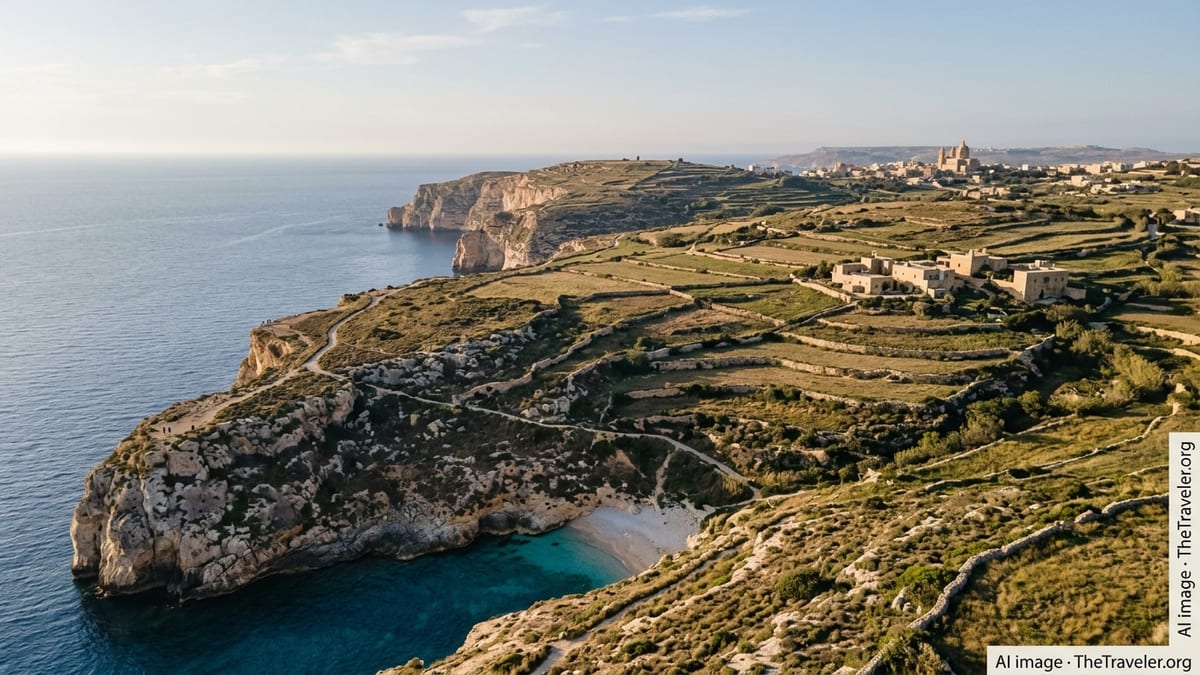
Gozo’s compact geography hides a varied landscape of limestone cliffs, terraced fields and tucked-away bays that contrasts with the more urbanized stretches of mainland Malta. Along the island’s northern rim, areas such as Għajn Barrani present steep, undeveloped cliffs descending to a small, difficult-to-access beach, known in travel coverage for its sense of isolation and the absence of large-scale tourist facilities. Elsewhere, the wide sands of Ramla Bay and the inlets around Marsalforn Bay remain among the few places where infrastructure has expanded, yet even here, quieter corners can be found outside peak hours.
Hiking reports and independent travel accounts increasingly frame Gozo as a long-distance walking and coastal trekking destination. Multi-day itineraries link villages, sea cliffs and inland valleys, using public paths and rural lanes that thread between stone-walled fields and small vineyards. Walkers describe stretches where only farmhouses, chapels and distant sea views break the horizon, reinforcing Gozo’s reputation as a place where relatively short distances can still feel remote.
Beyond the coast, the island’s interior retains a strongly agricultural character, with pockets of carob, olive and citrus groves punctuating low, rounded hills. Heritage assets such as the UNESCO-listed Ġgantija Temples and traditional hilltop settlements around Victoria broaden the appeal for culture-oriented travelers who may pair coastal walks with archaeological sites and quiet church squares. Museum collections in Victoria, including the Gozo Nature Museum, add context on the island’s geology, flora and fauna, supporting a broader narrative of Gozo as a landscape shaped by both natural forces and centuries of rural life.
Connectivity, Fast Ferries and the Search for Seclusion
Improved connectivity has made Gozo more accessible for visitors who base themselves on mainland Malta yet seek a day or more in a calmer setting. High-speed passenger ferries link Valletta to Gozo’s Mġarr harbour in about 25 minutes, while traditional car ferries operate between Ċirkewwa in northern Malta and Gozo throughout the year. Travel guides report that standard ferry services run in most weather conditions, reinforcing Gozo’s viability for short, last-minute getaways even in shoulder seasons.
The expansion of fast ferry services over the past several years has encouraged more spontaneous day trips, as visitors can now step from Malta’s capital directly onto Gozo’s quayside. Local analyses, however, suggest that this ease of access has also contributed to pressure points at certain times of day, including queues at terminals and congestion around popular bays. Commentators in Maltese media describe the island as shouldering large numbers of same-day visitors relative to its small resident population, raising questions about how to protect the quiet atmosphere that many travelers seek.
Longer-term infrastructure debates, including shelved plans for a permanent tunnel between Malta and Gozo, have drawn attention to the trade-offs between connectivity and preservation. Publicly available planning documents and economic assessments frequently reference Gozo’s value as a distinct, rural destination within the national tourism offer, underscoring concerns that heavy new transport infrastructure could alter the landscape and development patterns that underpin the island’s charm.
Sustainable Tourism Vision and Landscape Protection
Policy discussions in Malta increasingly cast Gozo as a testing ground for sustainable and high-quality tourism. Under the national Vision 2050 framework, government communications and meeting summaries highlight Gozo’s potential as an all-season destination built around nature, culture and low-impact activities rather than high-density resort development. Social partners participating in national advisory councils have emphasized the need to safeguard agricultural land, manage climate impacts and avoid overbuilding in coastal and rural zones.
Environmental initiatives across Malta and Gozo, including clean-up campaigns and new public green spaces, also form part of a broader push to enhance the quality of outdoor areas that residents and visitors share. Official information on the Islands Cleanup campaign, for example, points to projects that improve coastal and countryside environments, while separate initiatives by agencies such as Project Green aim to expand parks and open spaces on both Malta and Gozo. These efforts are framed in public documents as central to maintaining the archipelago’s outdoor appeal in the face of rising visitor numbers.
In Gozo specifically, tourism associations and local councils have publicly discussed ways to disperse visitors more evenly across seasons and locations so that fragile sites are not overwhelmed. Concepts such as promoting walking routes, cycling, cultural events and agritourism feature in strategy papers and industry commentary, positioning the island as a model for slower, experience-based travel. For visitors, this translates into growing opportunities to explore beyond the best-known bays, including rural hamlets, secondary valleys and lesser-visited chapels and viewpoints.
Balancing Popularity With the Promise of Quiet
The challenge now facing Gozo is how to reconcile its growing popularity with its reputation as a place of seclusion. Tourism observatories report that day visitors to Gozo and Comino have risen at a double-digit pace in recent years, with 2025 figures pointing to more than 2.3 million combined visitors to the smaller islands. At the same time, local surveys suggest that not all tourism businesses feel uniformly positive effects, citing pressure on infrastructure, seasonal peaks and rising costs, including accommodation and rents.
For travelers, this means that expectations of solitude may need to be calibrated to season and location. Published visitor feedback and travel writing describe summer weekends when key beaches and ferry queues feel busy, contrasted with midweek winter days when clifftop paths and inland lanes are almost empty. The island’s modest size makes it possible to move quickly from a crowded waterfront to a quiet stretch of countryside, but also heightens the visibility of tourism in village life.
Despite these pressures, Gozo retains many of the qualities that first drew visitors looking for a different kind of Mediterranean break: low-slung villages rather than high-rise skylines, working fields within sight of the sea, and a coastline where undeveloped headlands still dominate many vistas. As Malta’s record-breaking visitor numbers focus global attention on the archipelago, Gozo’s future as a hidden gem may depend on how successfully tourism growth is balanced with the landscapes and silences that continue to define the island for those who seek it out.