

More news on this day
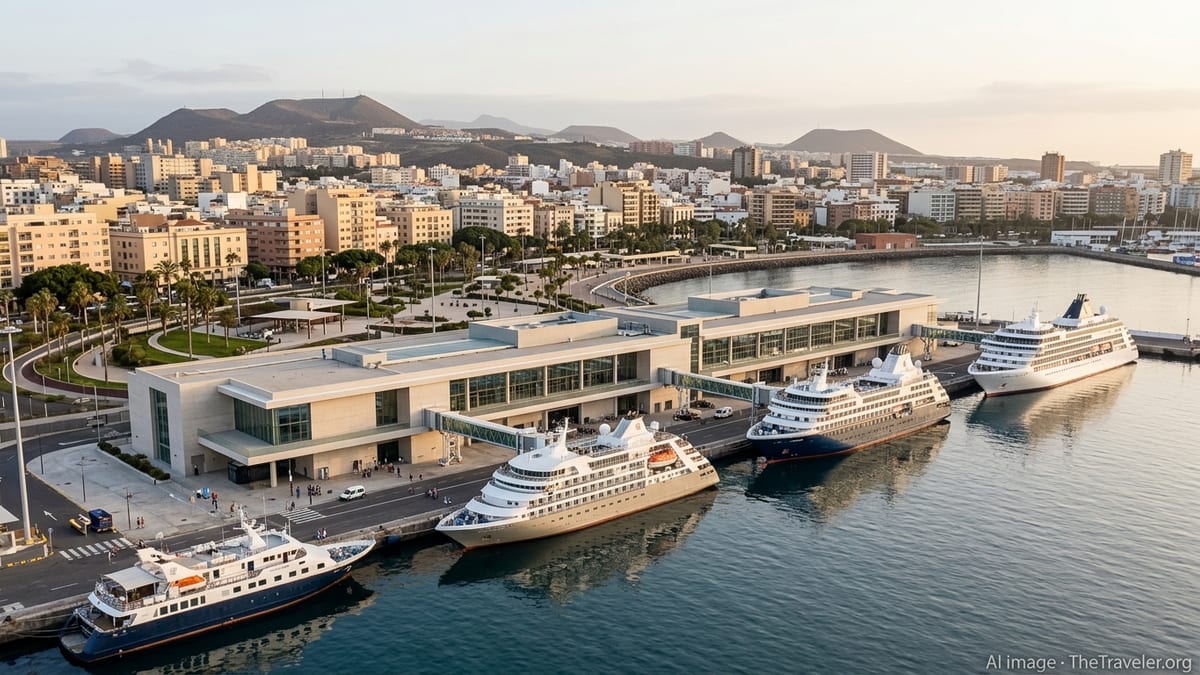
Gran Canaria has entered a new era of cruise travel with the opening of a 14,000-square-metre terminal at Las Palmas Cruise Port, described in industry coverage as the largest dedicated cruise facility in Europe and a new powerhouse gateway to the Canary Islands.
Get the latest news straight to your inbox!
A Record-Breaking Hub for Europe’s Cruise Market
The new Gran Canaria cruise terminal at Santa Catalina Pier in Las Palmas de Gran Canaria formally began operations in October 2025, welcoming Celebrity Cruises’ Celebrity Apex as its first call. Reports indicate that the building’s opening capped several years of construction and investment aimed at consolidating the port’s role as one of Spain’s busiest cruise gateways.
Publicly available information shows that the two-level terminal covers around 14,000 square metres and is designed to handle up to four cruise ships at the same time. Three passenger boarding bridges link directly to vessels, enabling more efficient embarkation and disembarkation for both homeport and transit calls.
Industry outlets describe the facility as Europe’s largest dedicated cruise terminal by built area and operational capacity. The project forms part of a broader 40 million euro investment programme led by Global Ports Canary Islands and local partners to modernise cruise infrastructure across Gran Canaria, Lanzarote, Fuerteventura and other islands.
The scale of the new complex is intended to position Las Palmas Cruise Port to accommodate the world’s biggest cruise ships simultaneously, while easing congestion during peak winter seasons when the Canary Islands serve as a major sun-seeking escape for European travellers.
Design Focused on Seamless, High-Capacity Operations
The terminal’s design prioritises smooth passenger flows from curb to cabin. According to port and operator documentation, the building separates arrival and departure streams, with spacious check-in halls, advanced security and baggage handling areas, and multiple embarkation gates feeding directly to the boarding bridges.
Outside, an extended esplanade of more than 17,800 square metres connects the terminal with the city via landscaped walkways and a restored palm grove. This configuration is intended to reduce bottlenecks at the pier while making it easier for visitors to move between ship, transport hubs and downtown Las Palmas de Gran Canaria.
The facility has been planned to support both transit calls and full turnarounds, with capacity for large volumes of baggage, coach parking for up to 40 buses, taxi ranks and dedicated zones for tour operators. Reports indicate that this dual-focus design aims to give cruise lines greater flexibility in building itineraries that start, end or simply pass through Gran Canaria.
Recent updates also highlight the installation of three new passenger boarding bridges, manufactured in Spain and shipped to Gran Canaria pre-assembled. These bridges were conceived to enhance accessibility, safety and operational efficiency, particularly when processing thousands of passengers from multiple vessels on the same day.
Sustainable Architecture Anchored in the Atlantic
The new Las Palmas terminal has been promoted within the industry as a flagship for more sustainable port infrastructure. Publicly available project details point to the extensive use of recycled and low-impact materials, a design aimed at reducing the building’s carbon footprint, and systems that prioritise natural light and ventilation in key public areas.
The facility’s integration with existing urban space also reflects current trends in waterfront redevelopment. The landscaped esplanade and palm grove create a buffer between heavy port activity and the city, while new retail and food-and-beverage areas inside the terminal are intended to cater to both cruise guests and local residents using the seafront.
The terminal has been included in European initiatives promoting cleaner ports and healthier marine environments, underlining the strategic importance of the Canary Islands as an Atlantic crossroads between Europe, Africa and the Americas. Project documents describe the cruise complex as a step towards positioning Las Palmas as a regional hub for low-impact, year-round cruise tourism.
As cruise lines bring in newer and more efficient ships, such as next-generation LNG-ready vessels, Gran Canaria’s upgraded infrastructure is expected to support broader sustainability targets across the region by allowing larger, more efficient ships to operate at high occupancy levels with minimal turnaround times.
Boost for Canary Islands Tourism and Local Economy
The opening of Europe’s largest cruise terminal comes at a moment of renewed growth for the Canary Islands’ cruise sector. Recent traffic statistics for the Las Palmas port system show double-digit increases in passenger volumes, with more than one million cruise visitors recorded in the first half of 2025 and further growth projected as the new terminal ramps up operations.
Economic studies cited in industry coverage estimate that cruise tourism contributes billions of euros annually to Spain’s economy, supporting tens of thousands of jobs in hospitality, retail, transport and port services. Each cruise passenger is reported to spend, on average, over 200 euros per embarkation, underlining the significance of improved infrastructure for local businesses.
The new terminal is expected to attract a larger share of homeport operations, particularly from Northern European, British and North American cruise lines seeking convenient year-round access to the Canary Islands. This shift could encourage visitors to extend their stays before or after sailings, benefiting hotels, restaurants, attractions and tour providers beyond the port gates.
Las Palmas de Gran Canaria already ranks among Spain’s top cruise destinations, alongside Barcelona and the Balearic Islands. With the expanded capacity and upgraded facilities now in place, regional tourism bodies are positioning the island as a central node for Atlantic repositioning cruises linking the Caribbean, the Mediterranean and Northern Europe.
Gateway to Unforgettable Canary Islands Adventures
For travellers, the biggest change will be felt in the ease of embarking on island-hopping itineraries across the archipelago. From the new terminal, ships can reach nearby islands including Tenerife, Lanzarote, Fuerteventura and La Palma, offering diverse combinations of volcanic landscapes, black and golden sand beaches, wine regions and historic towns within short sailing distances.
Gran Canaria’s own attractions begin within walking distance or a short transfer from the cruise pier. The revitalised connection between the terminal and the city centre makes it simpler for passengers to explore the capital’s beachfront promenades, museums and historic quarters on short calls or turnaround days.
Cruise programmes from Las Palmas also increasingly tie into active and nature-based excursions. Established routes take visitors into the island’s mountainous interior, a UNESCO Biosphere Reserve known for its dramatic ravines, pine forests and traditional villages. Other excursions focus on surfing and sailing along the north and east coasts, or relaxed resort stays in the south for guests combining cruising with longer holidays.
As itineraries evolve, the new Gran Canaria cruise terminal is positioned to serve not only as a technical hub for ship operations, but as the front door to a region marketing itself on year-round sunshine, varied landscapes and a mix of Spanish, African and Atlantic influences. For passengers, that promises smoother arrivals and departures alongside deeper, more seamless access to the Canary Islands’ signature experiences.