

More news on this day
Greece has emerged as the undisputed powerhouse of the global yacht charter industry in 2025, with publicly available data indicating a fleet of more than three thousand charter vessels and fast-rising demand in the luxury catamaran and high-end travel segments.
Get the latest news straight to your inbox!
From Mediterranean Favorite to Global Charter Leader
Industry reports for the 2024 and 2025 seasons indicate that Greece now captures the largest share of global yacht charter activity, building on several years of strong growth in the Eastern Mediterranean. Analysts tracking superyacht and crewed yacht bookings report that Greece accounts for roughly one quarter to one third of worldwide charter demand, placing it ahead of other long-established hubs such as France, Italy and the western Mediterranean.
While the wider Mediterranean continues to dominate the summer charter calendar, Greece’s expansive coastline, thousands of islands and comparatively flexible charter regulations have allowed it to scale faster than rival destinations. Market surveys show that Greece is now the top choice for yachts over 25 meters and a leading destination for charters across most size categories, from crewed sailing yachts to large motor yachts.
Global yacht charter market analyses put the overall charter fleet at tens of thousands of vessels across all regions and sizes, with Europe accounting for the majority of revenue. Within that framework, Greece has shifted from a strong regional player to a global benchmark, consistently ranking first in charter bookings and in the share of summer itineraries centered on its island groups.
The country’s ascent is supported by both demand-side trends, such as the rising popularity of experiential, water-based travel, and supply-side factors, including regulatory liberalization that has opened Greek waters to a broader range of foreign-flagged charter yachts.
Fleet Expansion Tops Three Thousand Charter Vessels
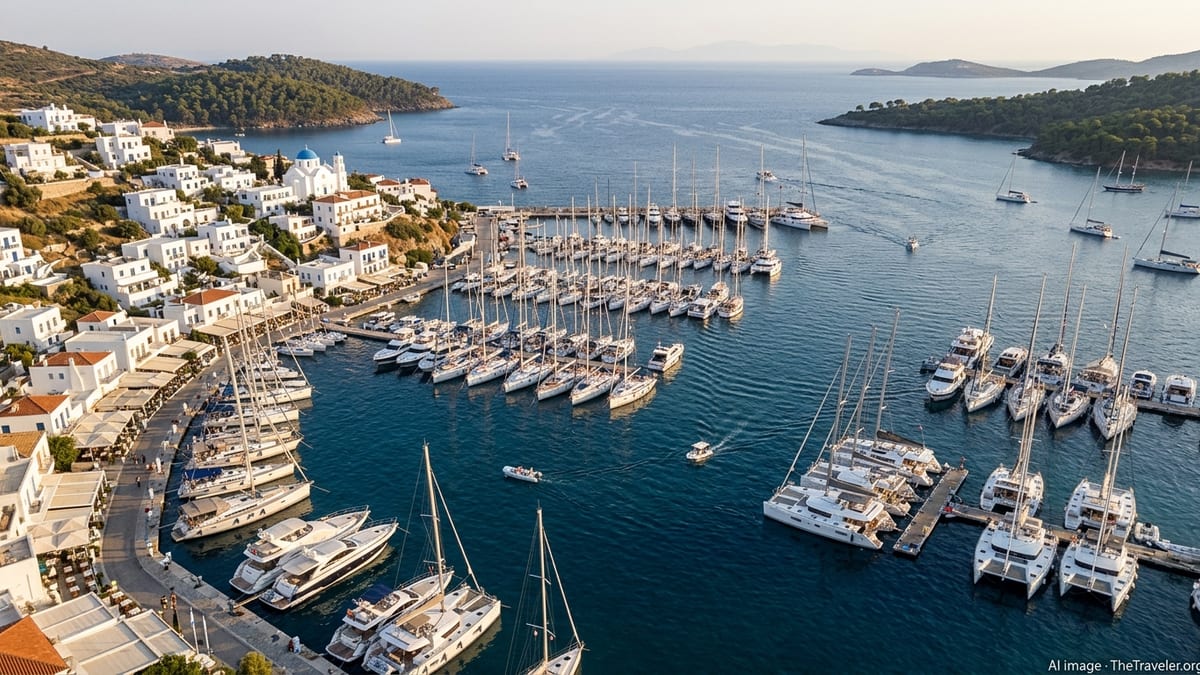
Although there is no single centralized registry for all charter yachts, aggregated data from charter platforms, brokerage firms and regional market reports point to a Greek charter fleet that now surpasses three thousand vessels of various categories active in 2025. This figure includes bareboat sailing yachts, crewed motor yachts, gulets, day cruisers and an expanding cohort of luxury catamarans operating from major bases such as Athens, Lavrio, Lefkada, Corfu, Rhodes and Kos.
European yacht industry statistics note that Greece already ranks near the top in Europe for the number of commercially registered charter yachts, with more than two thousand vessels documented in earlier counts focused mainly on sailing yachts and monohulls. When crewed yachts, motor yachts and catamarans operating seasonally or under foreign flags are added, the effective charter fleet serving Greek itineraries rises above three thousand units for the 2025 season.
Individual operators underscore the depth of the market. Leading Greek and international charter companies report fleets ranging from several dozen to several hundred yachts each based in Greek marinas, while many smaller local operators add significant capacity in popular island groups such as the Cyclades, Ionian and Dodecanese. Superyacht intelligence services also register several hundred large yachts basing in or frequenting Greek waters each summer for high-value charter weeks.
This overall scale positions Greece not only as a top destination by bookings, but also as one of the densest yacht charter markets globally, with extensive choice across budget tiers and vessel types.
Luxury Catamarans Drive Premium Growth
Within Greece’s expanding fleet, luxury catamarans have become one of the fastest-growing segments. Market commentary from charter management platforms describes catamarans as central to fleet strategies in the Eastern Mediterranean, with Greece and neighboring destinations increasing investment in high-specification, crewed catamarans sized between roughly 45 and 80 feet.
Catamarans appeal strongly to affluent travelers seeking more space, comfort and stability than traditional monohull sailing yachts. Wider beams allow for larger suites, expansive outdoor lounges and water-level platforms, features that align well with the expectations of luxury clients and multigenerational families. As a result, Greek marinas are seeing a noticeable shift in recent deliveries toward catamaran models configured for fully crewed, resort-style experiences.
Industry reports highlight that experiential tourism trends are reinforcing this shift. High-net-worth travelers increasingly request bespoke itineraries that combine secluded anchorages, wellness services and gourmet dining with easy access to water sports. Crewed catamarans, with their shallow draft and generous deck areas, are particularly well suited to exploring Greece’s smaller islands and remote coves where hotel infrastructure is limited.
The premium catamaran segment also benefits from operational efficiencies. Newer composite designs and hybrid propulsion systems promise lower fuel consumption and quieter operation, features that resonate with clients who are more conscious of environmental impact and onboard comfort. As more owners place late-generation catamarans into charter management, availability in Greece is expanding quickly for the 2025 and 2026 seasons.
Luxury Travel Demand Reshapes the Greek Summer
The rise of Greece as a yacht charter leader is closely tied to broader momentum in the global luxury travel sector. Market research on high-end tourism found that wealthy travelers are directing a growing share of spend toward private experiences on the water, viewing yacht charters as an alternative to villa rentals and five-star resorts.
Reports on global yacht charter spending in 2024 and early 2025 show record levels of charter fees, with some brokerage groups citing charter revenues in the hundreds of millions of dollars across their fleets. A significant portion of that activity is concentrated in the Eastern Mediterranean, where Greece commands the largest share of summer bookings. Charter days sold into Greek itineraries continue to climb, even as the global fleet expands and average charter weeks per yacht adjust.
Luxury travel observers link this demand to several post-pandemic behaviors. Clients increasingly value privacy, control over itinerary and the ability to avoid crowds, all of which favor yacht-based vacations. At the same time, social media visibility of Greek island cruising and the perceived exclusivity of superyacht life have elevated the country’s profile among new generations of affluent travelers.
High repeat rates among charter guests further reinforce Greece’s position. Market analyses note that a substantial share of luxury clients return for multiple charter seasons, often exploring different regions such as the Ionian in one year and the Cyclades or Dodecanese the next, supporting consistent utilization of the Greek fleet.
Regulation, Infrastructure and Outlook for 2026
Policy and infrastructure developments have also contributed to Greece’s leadership in the yacht charter arena. Recent regulatory reforms, including digital charter permission systems for certain foreign-flagged yachts, have expanded the pool of vessels legally able to operate in Greek waters. Market research notes that Greece’s charter framework, including comparatively favorable tax treatment and simplified procedures for large yachts, has been an important factor in attracting international owners and managers.
Port and marina investments in Athens, the Peloponnese and key island hubs have improved berthing capacity for larger yachts and modern catamarans. Upgrades in shore power, refit yards and crew services are designed to support the heavier seasonal traffic that now characterizes the Greek summer, particularly at the height of July and August when demand and rates typically peak.
Forward-looking market forecasts for the yacht charter industry project continued global growth through the end of the decade, with Europe and the Mediterranean maintaining a dominant role. Within that outlook, Greece is widely expected to retain its leadership in both bookings and fleet presence, supported by more than three thousand active charter vessels and a still-expanding luxury catamaran segment.
Operators and analysts point to several risks, including sensitivity to economic cycles, potential regulatory shifts and environmental pressures on popular cruising grounds. Even so, based on currently available data, Greece enters the 2025 and 2026 seasons as the clear reference point for the modern yacht charter market, blending fleet scale, destination appeal and luxury travel momentum in a way few rivals can match.