

More news on this day
Greece’s cruise sector is on track for another record year in 2025, with industry data and forecasts indicating an increase of more than eleven percent in ship arrivals to around 6,000 calls and passenger volumes expected to exceed eight million across the country’s ports.
Get the latest news straight to your inbox!
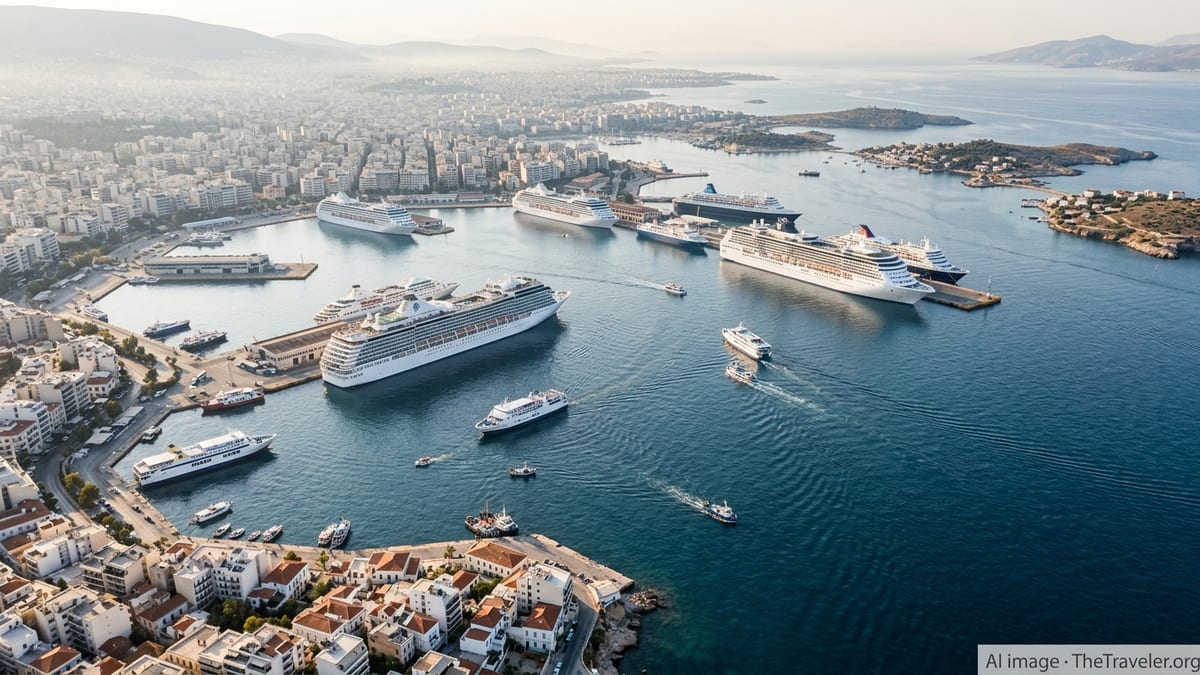
Record-Breaking Momentum After a Strong 2024 Season
The latest projections for 2025 build directly on a landmark 2024 season for Greek cruising. Data compiled by the Hellenic Ports Association for 48 cruise destinations showed 5,490 ship calls and almost 7.93 million passenger visits in 2024, a historic high that firmly reestablished Greece among the Mediterranean’s leading cruise hubs.
Analyses drawing on Bank of Greece statistics and port authority records indicate that cruise receipts in 2024 reached around 1.1 billion euros, reflecting both higher passenger numbers and increased onboard and onshore spending. Reports also highlight that cruise passenger visits grew far faster than overall tourist arrivals, underlining the sector’s expanding weight within the wider Greek travel economy.
Industry-focused coverage notes that the jump from just over 5,200 cruise ship calls and about seven million passengers in 2023 to nearly 5,500 calls and close to eight million passenger movements in 2024 laid the foundation for the sharper growth forecast for 2025. With pre-bookings and itineraries already in place, the step up to roughly 6,000 calls and more than eight million passengers this year is widely viewed as a realistic scenario rather than an optimistic outlier.
This performance comes despite broader geopolitical and economic headwinds, with analysts pointing out that Greece’s well-established ports, extensive island network and strong air connections have helped it capture itineraries diverted from other regions while simultaneously deepening its role as a homeporting base in the eastern Mediterranean.
Piraeus Leads as a Mediterranean Hub While Island Ports Scale Up
Piraeus continues to anchor Greece’s cruise success. Preliminary figures and port statements for 2024 show the country’s main port handling around 810 cruise ship calls and more than 1.7 million passengers, including approximately one million homeport passengers who begin or end their cruise there. This represents a significant rise from 2023 and cements Piraeus as a leading Mediterranean turnaround port.
In parallel, secondary destinations across the Aegean and Ionian seas are scaling up. Reports indicate that ports such as Santorini, Mykonos, Rhodes, Corfu, Heraklion and Chania now account for the bulk of Greek cruise activity, with a small group of about ten destinations capturing more than 70 percent of total cruise calls and around 90 percent of passenger visits. Forecasts for 2025 show several of these ports planning for further increases in calls and passenger volumes.
Mykonos, for example, is projected in sector briefings to approach 900 cruise ship arrivals in 2025, up from around 768 in 2024, with passenger numbers expected to exceed 1.5 million. Thessaloniki, traditionally more oriented toward cargo, is set to welcome a broader mix of cruise lines and first-time calls, highlighting how Greek mainland ports beyond Piraeus are seeking a larger role in the cruise market.
The combined effect is a broadening of Greece’s cruise map. While Piraeus remains the principal gateway, the strengthening of island and regional ports is helping distribute passenger traffic more widely, support shore-excursion spending in multiple regions and extend cruise itineraries deeper into the country’s archipelagos.
Forecasts Point to Double-Digit Growth in 2025
Forecasts compiled by the Hellenic Ports Association and referenced in Greek and international business coverage consistently indicate that cruise traffic in 2025 is expected to rise by more than ten percent compared with 2024. The projected outcome of around 6,000 ship arrivals represents an increase of at least 11 percent from last year’s 5,490 calls across Greece’s cruise ports.
Passenger volumes are expected to grow in tandem, crossing the symbolic threshold of eight million visits. Industry observers underline that these figures reflect a combination of more scheduled calls and higher occupancy on larger, newer vessels deployed in the eastern Mediterranean. The still-evolving impact of route adjustments linked to the security situation in the Red Sea is also steering additional capacity toward Greek waters as lines reconfigure long-haul itineraries.
Market analyses stress that the growth is not occurring from a low base. Greece had already surpassed its pre-pandemic cruise levels by 2023, and the 2024 performance was itself a record. The anticipated 2025 increase therefore points to sustained structural expansion of the sector rather than a temporary rebound effect, with Greece consolidating its status as a core deployment area for global cruise brands.
Capacity planning for subsequent years appears to reinforce this view. Reports on forward bookings from ports and cruise lines suggest that higher numbers of calls are already penciled in for 2026 and beyond, particularly at major destinations such as Piraeus, Corfu and ports in Crete, indicating that the 2025 peak may serve as a stepping stone rather than a plateau.
Economic Impact and Homeporting Benefits for Greece
The rapid expansion of Greece’s cruise sector carries significant economic implications. Tourism research drawing on Bank of Greece data estimates that cruise activity generated about 1.1 billion euros in receipts in 2024, a year-on-year increase of more than 20 percent. With both ship calls and passengers set to rise again in 2025, analysts expect another uplift in direct and indirect revenues.
Homeporting is a key driver of this trend. Passengers who embark or disembark in Greek ports typically spend nights in local hotels, dine in nearby restaurants and use domestic transport and tour services, multiplying the economic footprint compared with transit-only visits. Piraeus’s strong homeport performance in 2024, with around one million such passengers, is seen as a model other ports aim to emulate on a smaller scale.
Additional economic benefits flow to a wide range of local suppliers, including bunkering services, port agents, technical support companies and provisioning businesses that supply food, beverages and other goods to ships. As more vessels call at Greek ports, these sectors stand to gain from higher volumes and longer operational seasons, particularly when cruise lines extend their schedules into spring and autumn.
Regional authorities and business associations in islands such as Crete, the Cyclades and the Dodecanese are using the current growth cycle to attract investment into port upgrades, terminal facilities and shore-excursion infrastructure. The expectation is that improved amenities and streamlined operations will help Greek ports retain and expand their share of itineraries even as competition intensifies across the Mediterranean.
Managing Capacity, Sustainability and Passenger Experience
The same growth that is propelling Greece’s cruise sector to new highs is also intensifying debates about capacity management and sustainability. Popular destinations such as Santorini and Mykonos have faced crowding pressures on peak days, prompting authorities to examine daily passenger limits, slot management systems and differentiated scheduling for cruise ships and domestic ferries.
Publicly available information indicates that national ministries and local port bodies are working on regulatory adjustments aimed at balancing economic gains with safety, environmental protection and resident quality of life. Measures under discussion include tighter coordination of arrival windows, caps on simultaneous ship berthing at smaller ports and incentives to spread traffic across shoulder seasons and lesser-known destinations.
Environmental considerations are increasingly central to these discussions. Greek ports participating in international environmental programs are pursuing initiatives such as shore-power readiness, upgraded waste-management facilities and emissions monitoring, reflecting broader European trends in maritime sustainability policy. Cruise operators serving Greek routes are also gradually deploying more efficient vessels and experimenting with cleaner fuels in line with their global decarbonization commitments.
For travelers, these adjustments may translate into more predictable port calls, improved crowd management and a broader mix of destinations on itineraries that combine headline islands with emerging stops. As Greece moves through another record-setting year in 2025, the challenge for policymakers and industry stakeholders will be to maintain growth in ship arrivals and passenger numbers while safeguarding the very coastal and island environments that underpin the country’s appeal as a cruise destination.