

More news on this day
Greece is moving ahead with the restoration of the historic watermill at Gortyna in Crete, preparing to reopen the once-working installation as an open museum within one of the island’s most important archaeological landscapes.
Get the latest news straight to your inbox!
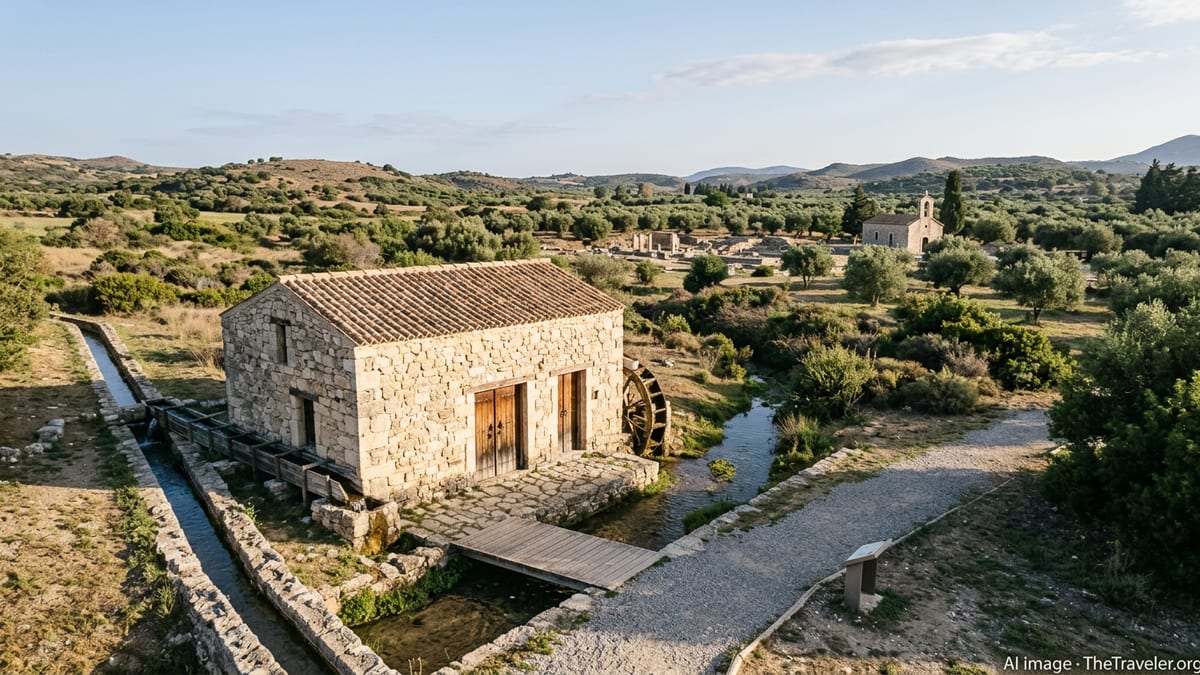
Historic Watermill Reenters the Spotlight at Gortyna
The archaeological site of Gortyna, spread across the fertile Messara plain in south-central Crete, is best known for its Roman Odeon and the celebrated Great Inscription that records one of Europe’s oldest legal codes. Recent project documentation and cultural heritage updates now highlight a different kind of monument at the site: a relatively recent watermill that operated until the mid-20th century and is slated to become an open museum space connected to the wider ruins.
According to publicly available information on the current upgrades at Gortyna, the restoration of the watermill forms part of a broader effort to expand the accessible area of the site and diversify what visitors can experience. Rather than focusing solely on classical and Roman remains, the initiative brings attention to pre-industrial rural technology and the ways water once powered everyday life in Crete.
Project descriptions indicate that the restored structure will be integrated into a defined visitor route that links the Roman Odeon, the Great Theatre, the famed evergreen plane tree, the watermill and the Church of Saint Titus. By placing the mill on equal footing with better-known monuments, planners present it as a key piece of living heritage rather than a minor technical curiosity.
From Working Mill to Open-Air Museum
The watermill at Gortyna is described in recent cultural tourism material as the most recent mill in operation at the site, with activity documented into the mid-1900s. This makes it a rare example of a hydraulic installation that bridges the gap between ancient agricultural traditions and the more mechanized practices of modern Crete.
The current project aims to restore and stabilize the existing masonry and mechanical elements so that visitors can understand how flour was once produced using the steady flow of water from the surrounding landscape. Publicly available descriptions of similar Greek projects suggest that such restorations generally retain original channels, millstones and auxiliary spaces where possible, while adding discreet interpretive signage to explain the process.
In keeping with Greece’s wider approach to industrial heritage, the Gortyna watermill is expected to function as an open museum rather than a sealed gallery. This typically means that visitors walk through the original structures in situ, grasping how they relate to nearby fields, riverbeds and settlements. The outdoor setting also allows the mill to be experienced in changing light and seasonal conditions, reinforcing its connection to the natural environment that once powered it.
Accessibility, Visitor Routes and Heritage Protection
The restoration of the Gortyna watermill is closely tied to a set of improvements that aim to make the archaeological site easier to navigate for a wider range of visitors. Recent project outlines emphasize new and upgraded paths, clearer circulation routes and enhanced accessibility for people with disabilities and limited mobility.
Information released by cultural and tourism bodies describes a two-tiered circulation system: a general visitor route and a specialized accessibility route. Both are designed to converge at major monuments, including the watermill, ensuring that the new open museum forms an integral part of the experience rather than an optional detour.
At the same time, the project reflects a broader policy in Greece of managing visitor flows to protect fragile heritage assets. By organizing movement along designated paths that link monuments in a logical sequence, the scheme helps to reduce random foot traffic, contain wear on sensitive structures and balance visitor interest between headline ruins and lesser-known sites such as the mill.
Crete’s Wider Strategy for Industrial and Rural Heritage
The Gortyna watermill initiative fits into a wider pattern across Crete and the rest of Greece, where traditional mills, presses and workshops are being repurposed as small-scale museums and cultural landmarks. National cultural reports and regional tourism campaigns increasingly showcase restored watermills, olive presses and rural installations as vital complements to ancient temples and fortresses.
On Crete, public information points to a growing network of such sites, from restored mills in inland villages to small museums dedicated to water power and agrarian technology. The aim is to present a continuous story of the island’s relationship with water, land and craft, spanning from Minoan engineering through Venetian and Ottoman periods to the twentieth century.
The open museum planned at Gortyna stands out because of its placement within a high-profile archaeological landscape. By connecting the watermill to the legal and political history represented by the Great Inscription and the Roman Odeon, authorities frame everyday rural labor and food production as part of the same cultural narrative that draws visitors to the island’s monumental ruins.
Implications for Cultural Tourism in Southern Crete
For travelers, the upgraded watermill and its open museum function are expected to enrich itineraries that already combine Gortyna with nearby sites such as Phaistos and the coastal village of Matala. Publicly available travel guidance increasingly portrays the Messara plain as a region where archaeological exploration, village life and agricultural landscapes can be experienced in a single day.
By adding an accessible, tangible example of pre-industrial technology to the mix, the Gortyna project may appeal to visitors interested in engineering history, family-friendly learning and slower, more immersive forms of tourism. The mill’s relatively recent working life also offers a bridge for local communities, for whom memories and oral histories linked to water-powered production may still be present.
The restoration further supports Greece’s positioning of Crete as a year-round destination, not only for beaches and summer resorts but also for off-season cultural trips. An open museum that can be visited outdoors, in combination with the surrounding ruins and nearby museums, gives tour operators and independent travelers new reasons to explore southern Crete beyond the peak months.