

More news on this day
Greece has launched a new digital platform, railway.gov.gr, that allows the public and authorities to track trains across the national rail network in real time, a high-tech step framed by officials as both a safety milestone and a pledge of greater transparency after the deadly Tempi collision in 2023.
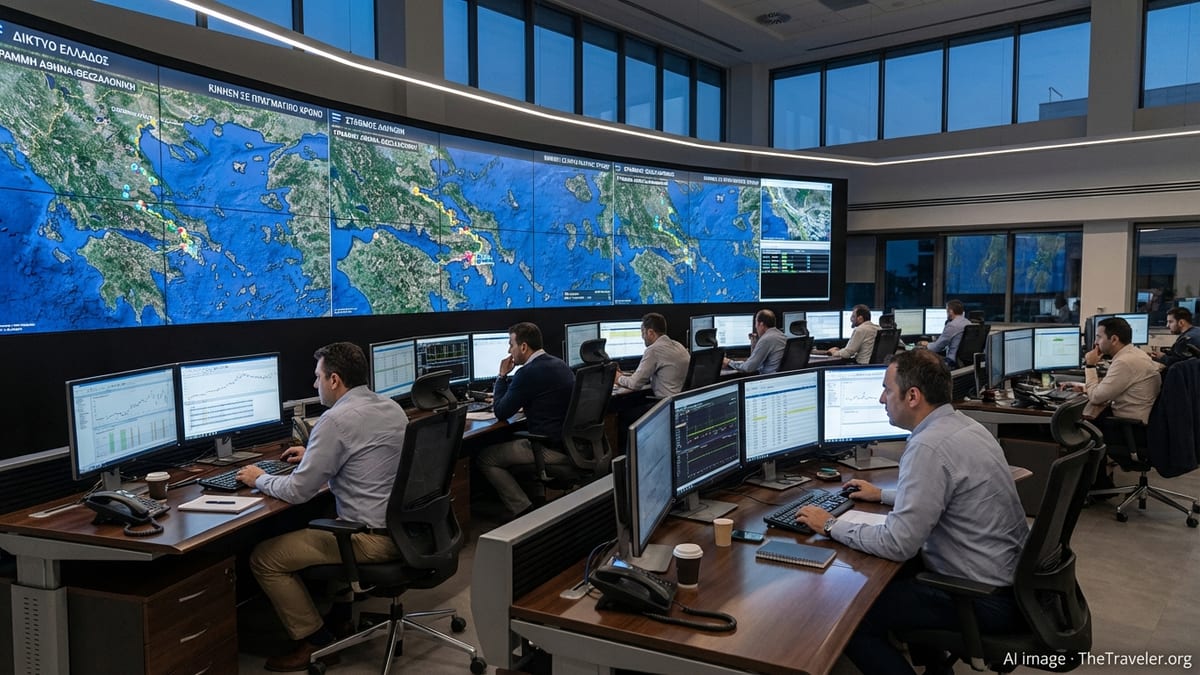
A Nationwide Window Into Train Movements
The government opened railway.gov.gr to the public on February 25, providing live monitoring of train locations, speeds, directions, estimated arrival times and delays. The platform debuts on the critical Athens to Thessaloniki corridor, where passenger trains can now be followed continuously on a digital map.
Officials say the system will expand rapidly. By the end of March 2026, trains running from the port of Piraeus through Athens to Greece’s northern borders are expected to be integrated. Full coverage of the roughly 2,000 kilometer network is planned by the end of April, when all locomotives will be equipped with the new technology.
What makes the initiative stand out is its public-facing character. Anyone with internet access can see train traffic live, in a level of detail that was previously confined to internal control systems. Government representatives describe this visibility as an extra layer of accountability over daily railway operations.
Deputy Infrastructure and Transport Minister Konstantinos Kyranakis has presented the platform as a digital safety net that reinforces, rather than replaces, existing signaling and control systems. He argues that the constant flow of data reduces blind spots on the network and allows faster intervention when something appears out of the ordinary.
High-Precision Satellite Technology at the Core
At the heart of railway.gov.gr is a high-precision satellite tracking system that combines Greece’s Hellenic Positioning System, known as HEPOS, with Europe’s Galileo satellite navigation network. The result is location accuracy measured in centimeters, far more precise than conventional GPS, which can deviate by several meters.
Each train is fitted with advanced GNSS receivers and inertial sensors that continuously send its position to the Hellenic Railways Organisation control center. The data is transmitted every few seconds with very low latency, allowing operators to see where each train is and on which track it is running, even in dense corridors where lines run in parallel.
Engineers have also built a digitally mapped model of the entire rail network into the platform. By matching live coordinates against this model, the system can distinguish between neighboring tracks, maintain accurate positioning when satellite signals are weak or obstructed, and keep monitoring even in tunnels.
Transport officials say this technical backbone transforms the platform from a simple mapping tool into an operational infrastructure. With every train digitally represented on screen, controllers gain a detailed picture of network performance in real time, including adherence to routes, headways between trains and emerging bottlenecks.
Safety Reforms in the Shadow of Tempi
The launch of railway.gov.gr comes just days before the third anniversary of the Tempi disaster on February 28, 2023, when a passenger train and a freight train collided head on, killing 57 people and triggering widespread anger over chronic weaknesses in Greece’s rail safety culture.
An official investigation into the crash identified a combination of human error and systemic failures, including incomplete automated control systems, gaps in oversight and poor data on day to day operations. The new platform is presented as a direct response to several of those findings.
According to the Ministry of Infrastructure and Transport, railway.gov.gr implements a number of safety recommendations issued after the accident. These include continuous digital monitoring of train movements, automated alerts when traffic rules are violated, and the creation of an incident and anomaly database to support risk assessment and trend analysis.
Authorities say that when the system detects an irregularity, such as a train deviating from its designated route or approaching another train too closely, it can trigger warning protocols at the control center. A dedicated team is tasked with investigating alerts and taking immediate action, adding another barrier against potentially dangerous situations developing unnoticed.
Transparency and Public Trust at the Forefront
Beyond the technical upgrades, the government has emphasized the symbolic and practical role of opening the system to citizens. By allowing passengers, families and local communities to observe train movements live, the platform aims to rebuild confidence in a network that has faced intense scrutiny since 2023.
Officials have framed this openness as a cultural shift for Greek railways, from fragmented and opaque management toward measurable, data driven performance. Every journey leaves a digital trace that can be scrutinized in real time and reviewed later, a change that supporters argue will deter complacency and improve accountability.
The launch coincides with continuing public debate over the pace of railway reforms and planned demonstrations to mark the Tempi anniversary. For many, the new platform will be seen as one test of whether the promises made in the wake of the tragedy are being translated into concrete, lasting improvements.
Industry observers note that Greece’s move also places it among Europe’s frontrunners in satellite based railway supervision. If the system operates as described, with full nationwide coverage and reliable performance, it could serve as a model for other countries seeking to harness high precision positioning to enhance rail safety and transparency.
A Pillar of Wider Rail Modernization
Railway.gov.gr is one element in a broader push to modernize Greece’s rail infrastructure, which includes upgrading signaling and remote control systems, renewing rolling stock and restructuring rail institutions. Legislation passed in 2025 laid the groundwork for these changes and made advanced tracking equipment mandatory on locomotives.
The government argues that bringing these strands together will move the railway from a patchwork of legacy systems to a unified digital environment. In that vision, real time data from the new platform feeds into maintenance planning, capacity management, timetable design and long term investment decisions.
For travelers, the most visible short term impact will be the ability to see whether a train is on time and exactly where it is along its route. For operators and regulators, the platform promises a rich source of information on punctuality, disruptions and safety critical events that can be analyzed to spot recurring issues.
As the phased rollout continues through March and April, attention will focus on how smoothly trains across the wider network are integrated and how effectively the data is used in daily operations. The success of railway.gov.gr will likely be judged not only by its technology, but by whether it tangibly improves reliability and safety for passengers across Greece.