

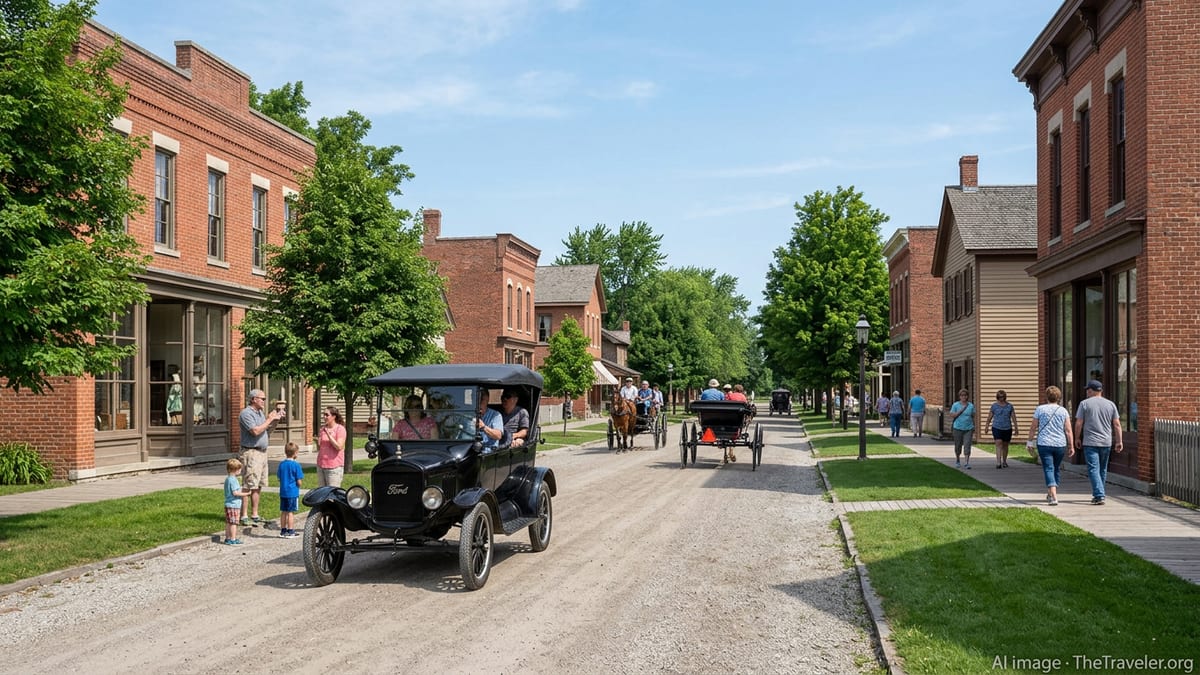
Few places in the United States let you step as convincingly into the past as Greenfield Village in Dearborn, Michigan. Created by Henry Ford in 1929 and expanded over the decades, this 80-acre outdoor museum gathers historic buildings and stories from across the country into one walkable village. From riding in a real Model T to ducking into Thomas Edison’s reconstructed Menlo Park laboratory, it is part theme park, part open-air museum and part working town, with costumed interpreters, horse-drawn vehicles and the smell of coal smoke and fresh-baked bread in the air.
Why Greenfield Village Belongs on Your U.S. Travel Itinerary
Greenfield Village is part of The Henry Ford, a larger complex that also includes the Henry Ford Museum of American Innovation and the Ford Rouge Factory Tour. The village itself opened in 1929 and today covers roughly 80 acres with more than 80 historic structures, from New England farmhouses to Midwest workshops, a working 19th-century railroad and even a Main Street with a general store and print shop. It feels less like a traditional museum and more like a small town where several centuries of American life coexist at once.
For travelers, the appeal is the mix of hands-on experiences and recognizable historical names. You can walk through the Dayton, Ohio, bicycle shop where Wilbur and Orville Wright honed the skills that led to powered flight, then turn a corner and find the Alabama home where civil rights leaders, including Martin Luther King Jr., strategized during the Selma to Montgomery marches. Nearby, a recreated Menlo Park complex brings Thomas Edison’s world to life, complete with demo experiments and interpreters who can explain how the light bulb moved from idea to industry.
Visiting Greenfield Village is not just about seeing old buildings. It is about hearing the clatter of a printing press, smelling wood smoke from a working farm kitchen and feeling the lurch of a 1910s automobile under your feet. Many visitors report spending a full day in the village alone, with some locals recommending at least four to six hours if you want to ride the historic train, step into several homes and catch a live presentation. This is especially true in summer and during special events, when the calendar fills with concerts, historical reenactments and seasonal programs.
From a practical standpoint, Greenfield Village is easy to fold into a Detroit or Great Lakes itinerary. It sits in Dearborn, about a 20-minute drive from downtown Detroit and roughly half an hour from Detroit Metro Airport, making it a logical day trip at either the beginning or end of a Michigan road trip. Many visitors pair a day in the village with a separate day at the indoor Henry Ford Museum to avoid rushing through both.
Tickets, Hours and How to Plan Your Day
As of early 2026, online general admission for Greenfield Village is typically in the mid-to-high 30 dollar range for adults, with discounted rates for seniors and youth and free entry for members. Seasonal pricing applies, and buying tickets online tends to be slightly cheaper than paying at the gate, where there is usually an additional onsite surcharge. Expect to pay a separate per-vehicle parking fee added to online orders, although members have parking included with their membership. Travelers using SNAP, EBT or WIC cards should look for a Museums for All discount program that offers significantly reduced admission for cardholders and their guests.
Operating hours vary by season, so it is important to confirm your specific dates before you go. In a typical year, Greenfield Village operates on a seasonal schedule, with regular daytime hours around 9:30 a.m. to 5 p.m. on open days. The main season usually begins in spring and runs into late fall, and there can be shoulder periods when it is open only a few days per week such as Thursday through Sunday. Holiday programs and evening events, including Halloween and summer concerts, run on separate ticketing and extended hours, so plan accordingly if you want those experiences.
For most travelers, arriving close to opening time pays off. Mornings are usually quieter, and the softer light makes for better photos of the historic streets and gardens. Early arrival is especially smart on weekends, during school breaks and on days with large events like the Salute to America July concerts or Hallowe’en in Greenfield Village, which often sell out in advance. Travelers driving in from other cities like Chicago, Cleveland or Toronto often book a nearby Dearborn hotel and walk or take a short drive to the entrance first thing in the morning.
How long should you budget? Many frequent visitors suggest that three to four hours is the minimum if you want to ride the train, step into a handful of key buildings and grab lunch without rushing. If you are traveling with children, plan on most of a day. Families often break the day into a morning of rides and outdoor experiences, a midday break or lunch, then a slower afternoon focusing on homes and talk-based demonstrations. If you also hope to see the Henry Ford Museum or the Ford Rouge Factory Tour, it is usually more relaxing to save those for another day rather than trying to combine everything into one visit.
Must-See Historic Districts and Buildings
Greenfield Village is organized into themed districts, each with its own feel and collection of buildings. One of the best starting points is the Main Street area, which recreates a late 19th- and early 20th-century American town. Here you will find a working print shop, glassworks studio, general store and spotlessly restored storefronts. It is a good place to grab a coffee or candy, watch a short demonstration and orient yourself before branching out into the more dispersed districts.
History enthusiasts will want to devote time to Edison’s Menlo Park complex, reconstructed from the inventor’s New Jersey laboratory buildings and outfitted with period equipment. Guides explain how Edison and his team worked long hours refining inventions such as the incandescent light bulb and phonograph. Practical demonstrations using replica equipment help connect the dots between a dimly lit 19th-century workshop and the electrified world travelers take for granted today. It is an especially engaging stop for older kids and teenagers who may know Edison from school but have never seen a 19th-century research lab brought to life.
Another standout area is the Wright brothers district, which includes the original Wright Cycle Company building and the brothers’ family home from Dayton, Ohio, both relocated to Dearborn with Orville Wright’s cooperation. Inside the cycle shop, interpreters explain how building and repairing bicycles sharpened the siblings’ understanding of balance, control and lightweight structures, practical skills that fed directly into their airplane experiments. For visitors who have been to sites like Kitty Hawk in North Carolina or the National Air and Space Museum in Washington, D.C., it is fascinating to see the modest storefront where that story began.
Scattered throughout the village are notable homes and community buildings from different regions of the country. You might step into a New England saltbox home from the 1700s, stroll through an early American farmstead or pause at a 19th-century village green. The range of architecture means you can move from a modest frontier cabin to a nicely appointed Victorian-era house within a few minutes’ walk. Interpreters tend to focus on everyday life: what people ate, how they heated their homes, how children learned and how communities handled chores long before electricity and indoor plumbing were standard.
Living History in Motion: Rides, Demonstrations and Daily Life
What makes Greenfield Village feel alive are the moving parts: vehicles, animals and working trades. One of the signature experiences is riding in a Model T, Ford’s early mass-produced automobile. On a typical day, a small fleet of black Model Ts circles the village on a set loop, and visitors can pay an additional fee for a short ride as a costumed driver explains what early motoring felt like. The sensation is more mechanical and direct than in a modern car; you feel the road through the wheels, hear the engine and glimpse other visitors on foot and on horse-drawn wagons as you putter past.
There is also a historic railroad line that loops around the property, pulled by a steam or vintage diesel locomotive depending on the day. Families often use the train as both a ride and a practical shuttle, hopping off at different districts instead of walking the full circuit. The views from the open-air cars help you grasp the scale of the village, from its tidy streets to its open fields and working farms. Train rides carry an additional fare, so many travelers buy a daily ride pass that covers the train, Model T and other transport experiences if they plan to use them multiple times.
Across the village, period trades and domestic skills are demonstrated throughout the day. At the glass shop, you might watch artisans blow molten glass into vases or ornaments, explaining how traditional techniques relate to modern manufacturing. In the machine shop, interpreters often run belt-driven equipment from the late 1800s, powered by overhead line shafts that once defined industrial workspaces. Farm areas frequently feature oxen or horses at work, seasonal planting or harvesting, and kitchen gardens that supply some produce to on-site eateries. Program schedules change, so check the day-of-visit leaflet or app to time your stop at the activities that interest you most.
Domestic life is equally vivid. In several historic homes, you may see interpreters cooking over open hearths, making candles or working spinning wheels. On a chilly autumn day, the warmth from a fireplace and the smell of stews or baked goods drifting into the hallway can make it easy to imagine living there. Some demonstrations invite light participation, such as churning butter, trying a quill pen or learning a simple 19th-century children’s game. These moments can be especially memorable for school-age children, who often connect more strongly with the past when they can touch and try rather than only look.
From Civil Rights to Rural Life: Stories Behind the Buildings
Beyond the big names like Edison and the Wright brothers, Greenfield Village quietly preserves powerful social and cultural stories. A notable example is the Alabama home once owned by Richie Jean Sherrod Jackson, a teacher and civil rights activist. Her modest house served as a gathering place for Martin Luther King Jr. and other leaders during the Selma to Montgomery marches in 1965, when they needed a secure space to strategize and rest. Relocated to the village, the home offers a tangible link to the civil rights movement, complete with interpretive materials that put visitors in the shoes of residents who risked their safety for voting rights and equality.
Elsewhere, farmsteads and workshops reveal what daily life looked like for ordinary Americans before mass consumer goods. Visitors can compare a small pioneer cabin, where an entire family might share a single room, with a later, more comfortable farmhouse featuring separate bedrooms and improved furnishings. Farm interpreters talk realistically about the labor required to maintain a household: hauling water, preserving food, managing livestock and coping with harsh Midwestern winters. For travelers used to supermarkets and central heating, the comparison makes today’s conveniences feel newly remarkable.
The village also includes examples of religious and communal buildings such as churches and one-room schoolhouses. Sitting in an old wooden desk or listening to a short “lesson” from an interpreter dressed as a 19th-century teacher gives shape to stories about American education that might otherwise remain abstract. In some seasons, visiting choirs or musicians perform in historic churches, blending architecture and live music in a way that suits the buildings’ original purpose.
Part of the power of Greenfield Village lies in how it juxtaposes different narratives. You might walk from the home of an industrial titan’s inspiration to a working-class neighborhood, or from a civil rights landmark to a rural crossroads, in a matter of minutes. For travelers who enjoy connecting dots between U.S. regions and eras, the village becomes a kind of three-dimensional textbook, but with living voices, working machinery and tangible spaces instead of printed pages.
Seasonal Events, Food and Practical Tips
Greenfield Village is very much a seasonal experience, and what you see changes dramatically between early spring and late fall. In summer, gardens are lush, farm fields are active and many visitors plan trips around big events. A long-running favorite is Salute to America, a series of July concerts that typically feature the Detroit Symphony Orchestra performing patriotic music on the village grounds, followed by fireworks. Travelers spread blankets on the grass, bring picnic-style snacks or buy food on site and enjoy an evening that combines live music with the backdrop of historic homes and a midsummer sunset.
Autumn brings a different kind of magic. Hallowe’en in Greenfield Village is one of metro Detroit’s most popular seasonal events, with evening hours, jack-o’-lantern–lit paths, costumed reenactors and themed vignettes. Tickets for these October nights often sell out well in advance, and crowd levels can be high, but many families return year after year. Cooler temperatures also make October and early November pleasant times for daytime visits, when fall color adds another layer of atmosphere to the streets and farms.
Food options inside the village range from quick snacks to sit-down meals in historic-inspired settings. You might grab a sandwich or salad at a main eatery, then treat yourself to a hand-dipped ice cream at an old-fashioned parlor or a bakery item from a shop that draws on 19th-century recipes. In recent years, upgrades have included refreshed dining spaces and menus that balance nostalgic comfort dishes with lighter options. Prices are in line with other major attractions: expect to pay what you would at a large zoo or theme park for lunch, and consider sharing larger items or packing some snacks if you are traveling with a group.
A few practical tips can improve your experience. The village is almost entirely outdoors, so check the forecast and dress for the weather. Summer days can be hot and humid, and there is a fair amount of walking on paved and gravel paths, so comfortable shoes are essential. Spring and fall can be chilly and breezy, especially in the morning and evening, so layers are helpful. Many visitors bring refillable water bottles, and families with young children often find a stroller useful, even for kids who have mostly aged out of using one at home.
Combining Greenfield Village With The Henry Ford Museum and Detroit
Because Greenfield Village is part of The Henry Ford, many travelers wonder how best to divide their time between the outdoor village, the indoor Henry Ford Museum of American Innovation and, for those interested in industry, the Ford Rouge Factory Tour. Each component tells a different piece of the American story. The village focuses on everyday life and working communities, the museum showcases artifacts such as historic automobiles, presidential limousines and civil rights exhibits, and the factory tour highlights modern manufacturing on the floor of a working Ford plant when production is running.
If you have two or more days in Dearborn, a popular strategy is to dedicate one full day to Greenfield Village and another to the museum, adding the Rouge tour if you are particularly interested in industry or engineering. This approach reduces the sense of rushing and allows time for lunch, breaks and gift shop browsing. Combination tickets and memberships often provide better value than buying separate single-day tickets, especially for families or anyone planning repeat visits.
Dearborn itself makes a practical base, with national-brand hotels clustered along the main corridors and within a short drive of The Henry Ford. Travelers who prefer boutique stays may find smaller independent hotels or short-term rentals in nearby neighborhoods. From Dearborn, it is easy to extend your trip into Detroit, visiting attractions such as the Detroit Institute of Arts, Motown Museum or the revitalized riverfront, all within roughly a 20- to 30-minute drive, depending on traffic. Many visitors treat Greenfield Village as one anchor day in a broader Detroit-area itinerary that mixes history, art, food and Great Lakes scenery.
For road trippers, Dearborn is a natural stop on routes connecting Chicago, Toronto, Cleveland and the rest of Michigan. Some travelers combine a day or two in the Detroit metro area with drives up the Lake Huron or Lake Michigan coasts, or with trips north toward Mackinac Island and the Upper Peninsula. In that context, Greenfield Village offers a concentrated immersion into American innovation and daily life before you head into rural landscapes and small towns where some of those histories first unfolded.
The Takeaway
Greenfield Village is more than a collection of old buildings. It is a deliberately assembled town where stories from across U.S. history play out in real time, from the invention of the light bulb to the fight for civil rights and the rise of everyday consumer life. Visitors can ride behind a steam locomotive, sit in a Model T, watch a blacksmith at work and step into the living rooms and kitchens of people whose names never appeared in textbooks yet shaped the nation’s character.
For travelers headed to Michigan or the broader Great Lakes region, setting aside a full day for Greenfield Village in Dearborn is an investment in context. The village makes the timelines behind America’s industrial, social and technological transformations feel tangible and personal. Whether you are a family with school-age children, a history enthusiast planning a themed trip or a casual visitor curious about how people actually lived in the past, this living history museum delivers an unusually rich and memorable experience.
With thoughtful planning around tickets, timing and weather, you can tailor your visit to your interests, whether that means focusing on iconic names like Edison and the Wright brothers, seeking out quieter corners and farms, or timing your trip to coincide with festive events such as Salute to America or Hallowe’en in Greenfield Village. Whichever path you choose, you will leave with the sense that you have walked, quite literally, through chapters of American history.
FAQ
Q1. How much does it cost to visit Greenfield Village?
The exact price varies by season, but recent online general admission for adults has been in the mid-to-high 30 dollar range, with lower rates for seniors and youth and free admission for members. There is usually a separate parking fee per vehicle and small discounts for buying tickets online instead of at the gate.
Q2. How much time do I need at Greenfield Village?
Plan on at least three to four hours for a first visit, which lets you ride the train once, step into several key buildings and have a relaxed lunch. Many visitors, especially families and history enthusiasts, spend most of a day in the village, arriving at opening time and leaving close to closing.
Q3. Is Greenfield Village open year-round?
The village typically operates seasonally, opening in spring and running into late fall, with hours that can vary by month and day of the week. Winter is generally reserved for maintenance and special programs rather than regular daily admission, so it is important to check current schedules for your exact travel dates.
Q4. What are the must-see attractions inside Greenfield Village?
Highlights for most visitors include the Wright Cycle Company building and Wright family home, Edison’s Menlo Park laboratory complex, the Main Street district with its working print and glass shops, the operating railroad and the Model T rides. Travelers with more time often add visits to farmsteads, historic homes and the civil rights–related Alabama house connected to the Selma to Montgomery marches.
Q5. Are rides like the train and Model T included with admission?
General admission covers entry to the village and most building exhibits, but rides on the train, Model T and some other historic vehicles usually require an additional fee. Many visitors purchase a daily ride pass that bundles several ride types, which can be good value if you plan to use them more than once during your visit.
Q6. Is Greenfield Village good for young children?
Yes. Children often enjoy the open space, animals, rides and interactive demonstrations such as trying old-fashioned games, watching glassblowing or sitting in a one-room schoolhouse. Strollers are common, and families often break the day into shorter segments with snack and rest stops to keep younger visitors comfortable.
Q7. Can I visit Greenfield Village and the Henry Ford Museum on the same day?
It is possible but can feel rushed, especially during busy seasons. Many travelers prefer to devote one full day to Greenfield Village and another to the Henry Ford Museum of American Innovation, which has extensive indoor exhibits ranging from historic vehicles to civil rights artifacts.
Q8. Do I need to buy tickets in advance?
While same-day tickets are often available, advance online purchase is strongly recommended during peak times, including summer weekends, school holidays and popular special events such as Hallowe’en in Greenfield Village and Salute to America. Buying ahead can help you avoid sell-outs and sometimes offers a small discount compared with onsite prices.
Q9. What should I wear and bring for a visit?
Because the village is almost entirely outdoors, wear comfortable walking shoes and weather-appropriate clothing, including layers in spring and fall and sun protection in summer. Many visitors bring a refillable water bottle, light snacks, a small daypack and, for families, a stroller, even for children who might not use one at home.
Q10. Are there discounts or special pricing options?
Yes. Memberships include free admission and parking and can quickly pay for themselves if you plan multiple visits or are traveling with a family. Programs tied to SNAP, EBT or WIC cards have offered reduced admission for qualifying guests, and active-duty U.S. military personnel may receive free or discounted entry during certain periods. Check the latest offers when planning your trip.