

Idaho is a big, rural state where distances are long, mountain passes can be challenging, and cell service is not always guaranteed. For visitors who would rather not drive, or residents trying to connect between small towns and larger hubs, understanding the patchwork of shuttles, buses, and regional services is essential. Ground transportation in Idaho is improving, but it remains a mix of public transit, private operators, and seasonal shuttles that requires some planning ahead.
Understanding Idaho’s Ground Transportation Landscape
Idaho’s geography shapes how people move. The state stretches from high desert in the south to forested mountains in the north, with only a few main highway corridors connecting its communities. That means ground transportation is not a single unified system but a collection of local transit agencies, intercity bus lines, and privately run shuttles that overlap along key routes such as Interstate 84, U.S. 95, and U.S. 20. Travelers who are used to big-city rail networks and frequent buses will find Idaho’s options less dense but often surprisingly practical if researched in advance.
Public transit is strongest around the Boise metropolitan area and a handful of regional centers, including Idaho Falls, Pocatello, Twin Falls, and Coeur d’Alene. Smaller communities, from mountain resort towns to farming valleys, tend to rely on flexible services such as demand-response vans, senior and medical shuttles, and contracted intercity buses backed by state and federal grants. Because many of these programs are tailored for local residents, visitors often benefit indirectly by being able to ride the same routes, sometimes at low cost or no fare at all.
At the statewide level, Idaho’s transportation department supports intercity bus connections that stitch together distant communities, while private companies operate scheduled buses and point-to-point shuttles. Recent planning documents highlight two primary intercity brands over Idaho’s main corridors, as well as a series of community systems that connect smaller towns into those long-distance lines. The result is a network that can get a determined traveler from border to border, though rarely in a single day and almost never without a transfer.
Because the system depends heavily on a mix of grants, local funding, and private operators, services can evolve from year to year. New routes are occasionally added and underused ones can be scaled back. Schedules may change to better match commuting patterns, school calendars, or tourism seasons. Anyone relying on ground transportation in Idaho should confirm routes and timetables as close as possible to their travel date and keep backup options in mind during winter or shoulder seasons.
Airport Ground Transport: Boise and Regional Gateways
Boise Airport is the primary commercial gateway to Idaho and a logical starting point for understanding the state’s ground transport. On the lower level outside baggage claim, travelers find the usual mix of taxis, app-based ride services, hotel courtesy shuttles, and rental cars. Local officials describe this curbfront as the main hub for airport ground transportation, with signage directing passengers toward different options and staff available during busy periods to answer questions. Many nearby hotels in Boise and Meridian operate their own shuttles, some of which run very early or late to match flight schedules.
Within the Boise metro area, a short taxi or rideshare trip can connect passengers to local bus routes operated by Valley Regional Transit, which serve downtown Boise, Meridian, Nampa, Caldwell, and other communities in the Treasure Valley. While buses do not yet pull directly into the terminal, stops near the airport perimeter and downtown transfer centers provide links to neighborhoods, shopping areas, and regional medical facilities. Travelers planning to rely primarily on transit often choose lodging close to major bus corridors or downtown hubs to simplify their movements.
Beyond Boise, regional airports such as Idaho Falls, Pocatello, Twin Falls, Lewiston, and Pullman–Moscow Regional operate on a smaller scale and typically rely on a combination of taxis, hotel shuttles, and prearranged rides. In many of these markets, visitors are advised to confirm in advance whether their hotel offers pickup, since late-night and early-morning flights may not coincide with regular taxi hours. In some cases private shuttle companies specialize in airport transfers, sometimes using vans or small buses that can be booked by the seat or chartered by groups.
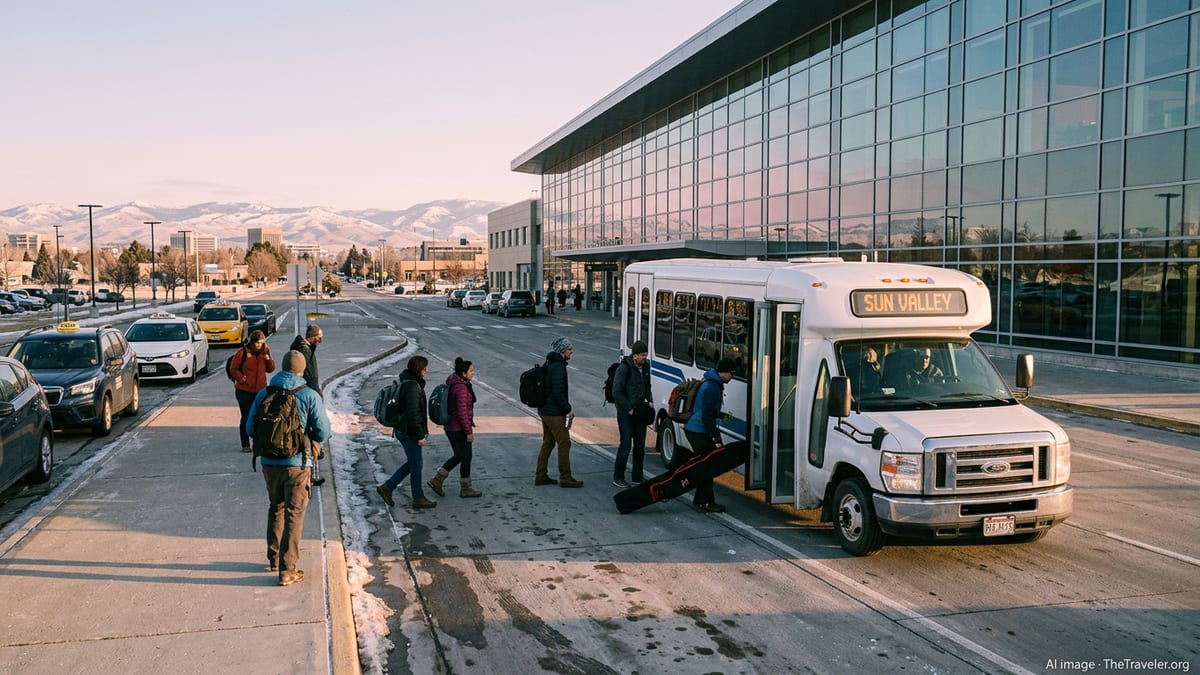
In resort-oriented areas, airport shuttles are often integrated with tourism. Operators in and around Sun Valley, McCall, and the Teton Valley, for example, run scheduled services that connect regional airports with ski lodges, rental homes, and town centers during peak seasons. These services tend to be most frequent in winter and summer tourism periods, and they can sell out on major travel days, so booking early is wise. Because weather can affect both flights and mountain road conditions, travelers should allow generous transfer times and monitor operator alerts when connection windows are tight.
City and Regional Buses: Getting Around Without a Car
Within Idaho’s cities and larger towns, fixed-route bus systems provide the backbone of local public transportation. In the Boise metropolitan area, Valley Regional Transit oversees ValleyRide-branded services, including routes through Boise, Garden City, Meridian, Nampa, and Caldwell. The agency has been gradually updating its system, experimenting with new fare collection technology and revising routes to connect major employment centers, colleges, and residential areas. Service frequencies tend to be highest on weekdays during commuter hours, with somewhat reduced timetables on evenings and weekends.
Outside the Treasure Valley, several non-profit providers run local buses tailored to their regions. Treasure Valley Transit, for instance, operates community routes in rural southwestern Idaho, including Mountain Home and other towns that benefit from connections to larger cities. In northern Idaho around Coeur d’Alene and Post Falls, the Citylink system provides bus routes within Kootenai County free of charge, serving tribal lands, shopping districts, and park-and-ride locations. These community buses can be especially helpful for travelers staying with family or in vacation rentals outside standard visitor districts.
In many smaller communities, bus services are modest in scale but carefully targeted. Some run circulator routes around town centers, while others prioritize key destinations such as hospitals, social service offices, or grocery stores. Paso-like timetables, where buses come a few times per day, are common in such areas, which makes advance planning important. For visitors who have flexible schedules, riding local buses can be a rewarding way to see everyday Idaho life, but those with tight appointment times may prefer point-to-point shuttles or car rentals.
Local bus systems often coordinate with regional and intercity operators, even when they are run by separate agencies or companies. Transit hubs may double as intercity bus stops, allowing people to move between a city route and a long-distance coach with a short walk across a parking lot. In some cases, local transit offices also sell tickets or provide information for regional bus services to simplify trip planning for riders who are not familiar with Idaho’s geography.
Intercity Bus and Long-Distance Links
For moving between Idaho’s cities and crossing into neighboring states without driving, intercity buses are the main alternative. Statewide planning documents identify two primary brands that operate scheduled service on Idaho’s long-distance corridors, connecting communities along routes such as Boise to Idaho Falls, Boise to the Magic Valley, and north–south through the Panhandle. These operators typically run highway coaches with luggage bays and onboard restrooms, offering a more traditional bus travel experience between towns and regional hubs.
One company focuses on linking Idaho to major hubs in Utah, Montana, Wyoming, Nevada, and Arizona, with routes that pass through cities like Pocatello, Idaho Falls, and Rexburg. Another emphasizes connections across the Inland Northwest, including Spokane, the Palouse, and communities in northern Idaho. Together, these carriers form the spine of Idaho’s non-driving long-distance network, providing options for students, workers, and visitors who need to travel between college towns, job centers, and airports without a personal vehicle.
Because Idaho’s population is relatively small and spread out, intercity bus schedules are not as frequent as those seen in more densely populated regions. Some corridors may see only one or two buses per day in each direction, and certain segments operate only on specific days of the week. Weather, road construction, and seasonal demand can also influence departure times. Passengers are encouraged to review timetables carefully, pay attention to any advance reservation requirements, and arrive early at pick-up points that may be as simple as a shared gas station parking lot or a small-town main street stop.
Intercity buses also play a role in connecting Idaho residents to national bus and rail networks. Terminals in Spokane, Salt Lake City, and other large regional cities provide onward travel options, whether on continuing bus routes or long-distance trains. For cross-country travelers, Idaho’s intercity buses often function as feeder services that bridge the gap between remote communities and these larger national nodes. This is particularly important for rural residents who may not have regular access to air travel but still need to reach distant medical specialists, families, or educational institutions.
Community Shuttles, Rural Transit, and Demand-Response Services
Beyond fixed bus routes and long-distance coaches, Idaho relies heavily on community shuttles and demand-response services, especially across its vast rural areas. These programs often operate with smaller vehicles and flexible routing, allowing them to reach scattered homes and small town centers that would be impractical to serve with full-size buses. The Idaho Transportation Department funnels grant funding to local agencies and non-profits, which then tailor services to their communities. The result is a mosaic of options that may look different from county to county but share similar goals of connecting people to jobs, healthcare, and essential services.
Examples include free or low-cost county shuttles that make daily or weekday loops between small towns and regional hubs. In northern Idaho’s Silver Valley, for instance, a publicly funded shuttle runs a fixed route through a string of mining towns and unincorporated communities, offering residents a no-fare ride to schools, stores, and medical appointments. Elsewhere, rural transit providers run vans that pick up riders who book trips in advance, sometimes a day or two before travel, and group trips together to make the most of limited resources.
These rural services can be invaluable for travelers who find themselves without a car in smaller Idaho towns, but they operate under constraints that visitors must respect. Reservation windows may be strict, service hours often end earlier than urban transit, and some programs prioritize seniors, people with disabilities, or veterans. Visitors are typically welcome when space is available, yet they may be asked to adjust their plans to fit existing schedules. Contacting the provider ahead of time is the best way to confirm whether casual travelers can ride and what fares will apply.
In addition to publicly funded programs, local employers, colleges, and social service agencies sometimes sponsor their own shuttles. These may connect farmworkers with fields, students with campuses, or shift workers with industrial sites located far from housing. While such routes are usually closed to the general public, they highlight the degree to which ground transportation in Idaho is a community-wide effort. Travelers who are staying with friends or attending events linked to a particular institution should ask whether any member-only shuttle options exist that could complement public transit.
Mountain Towns, Resort Shuttles, and Seasonal Services
Idaho’s mountain towns and resort areas add another layer of complexity to the state’s transportation picture. Destinations such as Sun Valley, Ketchum, McCall, Stanley, and the Tetons area attract visitors for skiing, hiking, rafting, and lakeside vacations. In many of these places, private shuttle companies and resort-operated buses fill the gaps left by limited public transit, particularly in peak winter and summer seasons. Operators run scheduled vans between airports and resorts, in-town circulators that hop between lodges and lifts, and charter services for groups heading into trailheads or river put-ins.
One private operator based in central Idaho, for example, advertises year-round ground transportation between Boise, Stanley, Sun Valley, McCall, Salmon, and several smaller communities, with a focus on airport and hotel connections. These services are often lifelines for travelers who prefer not to rent a car for winter driving or for those planning linear river trips that start and end in different valleys. Some companies used to offer vehicle shuttles, where staff would move a customer’s car from one trailhead to another, and although not all of those programs continue today, referral networks still exist to connect visitors with specialized local providers.
Within resort towns themselves, local transit often becomes more robust than one might expect for their population. Free town shuttles circulate in places like Ketchum and Sun Valley, especially during the ski season, making it easy to move among lodges, restaurants, and mountain bases without driving. Similar patterns can be seen in the McCall area during busy winter weekends and summer lake season, where a combination of local transit and private shuttles reduces congestion and parking demand around popular recreation sites.
The seasonal nature of these services is both a benefit and a challenge. In winter and high summer, visitors enjoy frequent shuttles and extended hours, but during shoulder seasons like late fall and early spring, schedules may be trimmed back or suspended between major holidays. Reservations that are straightforward in January might be impossible in October if a shuttle has paused operations. Travelers should always verify season dates and daily timetables, and they should be prepared for winter weather delays, chain requirements on mountain roads, and occasional road closures over high passes.
Planning, Tickets, and Practical Tips for Travelers
Navigating Idaho’s ground transportation system successfully comes down to preparation. Unlike in major metropolitan regions where a single trip-planning app can handle daily urban and long-distance travel, Idaho’s patchwork of providers means that travelers may need to consult several sources, from transit agency websites to private shuttle operators and local visitor centers. Printing or saving key schedules offline can be wise in areas where cell coverage is unreliable, particularly in canyons and over high mountain passes.
Ticketing practices vary by provider. Urban and regional bus systems typically accept cash on board and may offer day passes or stored-value cards, sometimes supported by mobile payment apps. Intercity bus companies are more likely to require or strongly encourage advance purchase, either online or through partner outlets. Some community and rural shuttles are free to ride thanks to grant funding, while others charge modest fares that can usually be paid in cash. Because exact change is sometimes required on smaller systems, carrying small bills can prevent boarding delays.
Travelers should also think through timing and contingencies. Transfers between local buses and intercity coaches often rely on tight windows, especially in smaller towns where services operate only a few times a day. Allowing extra time for late buses, slow baggage handling at airports, or winter driving conditions can prevent missed connections. In rural areas it is generally safer to plan earlier departures rather than the last run of the day, since options after a missed connection may be limited or nonexistent.
For those who require accessible transportation, Idaho’s providers commonly offer paratransit or dial-a-ride services that complement fixed routes. These services generally require advance registration and trip booking periods, but they can be crucial for travelers with mobility impairments. Visitors who rely on wheelchairs, walkers, or service animals should contact local transit agencies or shuttle companies before arrival to discuss vehicle features, boarding procedures, and any documentation requirements so that accommodations can be arranged smoothly.
The Takeaway
Ground transportation in Idaho reflects the state itself: expansive, rugged, and quietly resourceful. While it lacks the dense networks of major coastal cities, Idaho offers a surprising array of options for travelers willing to plan ahead. Airport shuttles and local buses handle movements within urban areas, intercity coaches link far-flung communities, and a patchwork of rural transit, resort shuttles, and community programs fill in the spaces in between.
For visitors, the key is to match expectations to reality. Most trips will involve fewer daily departures, more advance reservations, and closer attention to weather than in more urbanized regions. Those who take the time to study routes, confirm seasonal services, and build generous buffers into their itineraries can move around Idaho comfortably without driving. Along the way, they often gain a deeper appreciation for the landscapes and communities they pass through, from small-town main streets to high-mountain valleys that would be easy to miss from behind the wheel.
As Idaho continues to grow, local agencies and private operators are testing new connections and upgrading equipment to better serve both residents and visitors. For now, though, anyone considering a car-free or car-light trip across the Gem State should approach ground transportation as a puzzle: one that requires a bit of effort to assemble but rewards the patient traveler with a genuine sense of place.
FAQ
Q1. Can I travel around Idaho without renting a car?
Yes, it is possible, especially between major cities and resort areas, but options are limited and usually require careful planning and flexibility.
Q2. Does Idaho have a statewide public transit system?
No single statewide system exists. Instead, Idaho relies on a mix of local transit agencies, intercity bus companies, and private shuttles.
Q3. How do I get from Boise Airport to downtown without a car?
You can use taxis, app-based ride services, hotel shuttles offered by many nearby hotels, or connect to local bus routes a short distance from the airport.
Q4. Are there buses between Boise and other Idaho cities?
Yes. Intercity bus companies operate scheduled routes linking Boise with cities such as Twin Falls, Pocatello, Idaho Falls, and some smaller communities.
Q5. Is public transportation in Idaho generally free?
Some systems, such as certain county shuttles or specific local routes, are free, but many city buses and intercity coaches charge regular fares.
Q6. How far in advance should I book an intercity bus or shuttle?
Booking at least several days ahead is wise, and earlier is better around holidays, ski season, major events, and periods of severe winter weather.
Q7. Are there airport shuttles to Idaho’s ski resorts?
Yes. Several private operators run seasonal and year-round shuttles connecting airports with ski areas and resort towns like Sun Valley and McCall.
Q8. What should I do if my rural town has no fixed-route bus?
Check for county transit, demand-response vans, or community shuttles funded by local agencies, and call ahead to ask about eligibility and schedules.
Q9. Is Idaho’s ground transportation accessible for travelers with disabilities?
Most public transit providers and many shuttles offer accessible vehicles or paratransit, but advance notice and registration are often required.
Q10. How does winter weather affect ground transportation in Idaho?
Snow and ice can slow buses, close mountain passes, and delay shuttles, so travelers should monitor forecasts, allow extra time, and keep backup plans.