

More news on this day
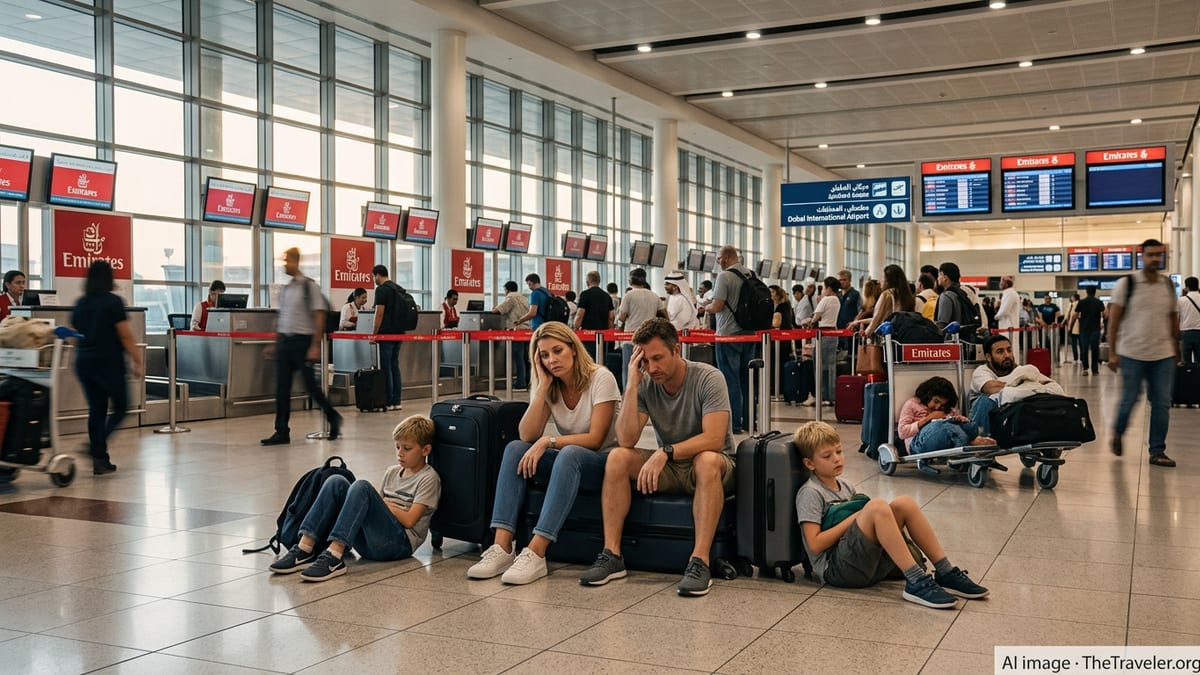
What began as a dream family holiday in Dubai ended in a days-long ordeal for a British couple and their two children, who say they were left “grounded by Emirates” amid mass flight cancellations, confusing rebookings and scarce information at one of the world’s busiest airports.
Get the latest news straight to your inbox!
From Holiday High to Sudden Standstill
Pete Williams, his partner and their two school-age children were due to fly home to Newcastle on 1 March after a week in Dubai, joining thousands of tourists transiting through the city as regional tensions escalated and airspace closures rippled across the Gulf. They say they only learned their Emirates flight had been cancelled while they were already en route to Dubai International Airport, leaving them scrambling for answers at check-in counters suddenly swamped with equally confused passengers.
At the same time, Emirates was forced to suspend or sharply curtail flights to and from its Dubai hub after multiple neighboring airspaces were closed. Official updates acknowledged widespread disruption and a reduced schedule, but many passengers reported that they were still receiving automated reminders to check in for flights that no longer existed, or discovering cancellations only when their booking apps unexpectedly refreshed.
For the Williams family, what should have been a straightforward overnight journey home turned into nine days of uncertainty as seats on limited repatriation services were snapped up and rebooked itineraries appeared and disappeared with little warning. With school and work commitments back in the United Kingdom, every additional day in Dubai compounded the pressure.
“It felt like we were stuck in limbo,” Mr Williams told local media. “We could see some flights leaving, but none of the information we were getting from Emirates matched what we were seeing on the boards.”
Scrambling for Beds and Answers in Dubai
Dubai authorities have pledged to fund hotel stays and meals for tourists stranded by the unprecedented wave of cancellations, a move widely praised by travel advocates. Yet families such as the Williamses say the reality on the ground has been far more complicated, with long queues at service desks and inconsistent guidance on how to access that support.
On social media and passenger forums, stranded travelers have described spending hours trying to reach Emirates call centers, only to be cut off or told to “wait to be contacted” for rebooking. Some claim they were advised against going to the airport until they had a confirmed new flight, only to later discover that scarce seats on outbound services were being given to those who showed up at the terminal in person.
In one widely shared account, a young family stranded in Dubai reported “lies and chaos” as they attempted to secure onward travel, alleging that repeated promises of priority rebooking were not honored and that ticket offices at the airport were closed at crucial times. Other passengers have recounted similar experiences of abrupt gate changes, last-minute cancellations and ground staff struggling to interpret evolving operational instructions.
The Williams family say they were able to secure basic hotel accommodation but had to pay upfront for meals, taxis and extended stays while they waited to see whether Emirates would offer either a refund or compensation. “Every conversation ended with ‘fill in the online complaint form’,” they said. “But we needed practical help that day, not in 30 days’ time.”
Denied Boarding, Overbooking and Passenger Rights
Emirates has long maintained that in cases of denied boarding or cancellations it adheres to the regulations of the country of departure, as well as its own internal policies that provide meal vouchers, hotel stays and alternative routing where available. In practice, consumer advocates say, that framework leaves significant gray areas for customers departing Dubai, which is not covered by European-style compensation rules.
Travel rights specialists note that in the current crisis, with more than ten thousand flights reportedly cancelled or rescheduled across the region in a matter of days, overbooking and denied boarding issues have collided with large-scale operational shutdowns. Passengers whose original flights never took off are being treated differently from those who arrived in Dubai mid-journey and then found their onward segments oversold or removed from the system.
Families, particularly those traveling with young children or elderly relatives, have voiced frustration that they were not prioritized for the earliest available repatriation seats. Online, several parents have described being bumped from flights at the gate despite holding confirmed reservations, or being told to seek compensation under standard denied boarding rules even though their main concern was simply getting home.
Legal experts caution that while some travelers may ultimately be eligible for reimbursement of reasonable expenses, the burden typically falls on passengers to document hotel bills, meal receipts and transport costs, then navigate airline complaint processes that can stretch for weeks. For families whose travel budgets are already stretched, that delay can be painful.
Emirates Under Pressure as Complaints Mount
The scale of the disruption has put Emirates, one of the world’s most recognisable long-haul carriers, under intense scrutiny. Aviation analysts point out that the airline is operating in an unusually constrained environment, juggling regional security concerns, airspace restrictions and limited runway slots as Dubai International and Al Maktoum International attempt a phased restart of operations.
Still, passenger complaints have mounted in recent days, focusing less on the fact of cancellations and more on communication, transparency and perceived inequities in how stranded travelers are being handled. On message boards dedicated to Emirates, threads titled “stuck in Dubai” and “no way to get out” have attracted hundreds of comments, with some users sharing strategies such as calling overseas Emirates offices or booking premium cabins on less popular routes to improve their chances of boarding.
Consumer groups argue that airlines have had years of experience managing large-scale disruptions and should be better prepared to deploy clear digital tools, proactive messaging and on-the-ground triage for families, solo travelers and those with urgent medical or visa issues. “These events may be triggered by forces beyond an airline’s control, but the customer experience is not,” one travel industry consultant said.
Emirates has urged affected passengers to monitor official travel updates and to use its online complaint and feedback channels, where cases are typically reviewed within 30 working days. The carrier has also highlighted cooperation with Dubai authorities on welfare measures for stranded tourists, although many families say they are still waiting to see how that support will translate into concrete reimbursements.
Families Rethink Routing Through Mega-Hubs
The Williams family eventually secured seats on an alternative routing home, but only after days of uncertainty, repeated calls and what they describe as a patchwork of contradictory advice. They say the experience has shaken their confidence in relying on a single mega-hub for long-haul travel, particularly during periods of geopolitical tension.
Travel agents report a similar sentiment among clients now asking about itineraries that avoid the busiest regional hubs, even if that means longer journey times or higher fares. Some families are requesting more flexible tickets, insisting on travel insurance policies that explicitly cover airspace closures and seeking written confirmation of what support an airline will offer in the event of extended disruption.
Aviation experts suggest that hub-based carriers like Emirates will need to rebuild trust by demonstrating that lessons have been learned from the current crisis. That may include clearer escalation channels for vulnerable travelers, dedicated hotlines for those already stranded and more transparent criteria for how repatriation seats are allocated when capacity is severely constrained.
For now, the stories emerging from Dubai paint a mixed picture of efficiency and frustration, with some passengers praising individual staff members who “went the extra mile” and others, like the Williams family, feeling that they were left grounded when they most needed help. As flight schedules slowly stabilize, their ordeal has become a cautionary tale for travelers worldwide about the risks of relying on a single airline and hub, no matter how polished the brand.