

More news on this day
China’s southern gateway of Guangzhou has emerged as one of the standout winners of the 2025 Spring Festival travel rush, with its railway system safely and efficiently handling a record surge in passengers as hundreds of millions journeyed across the country for family reunions and holiday travel.
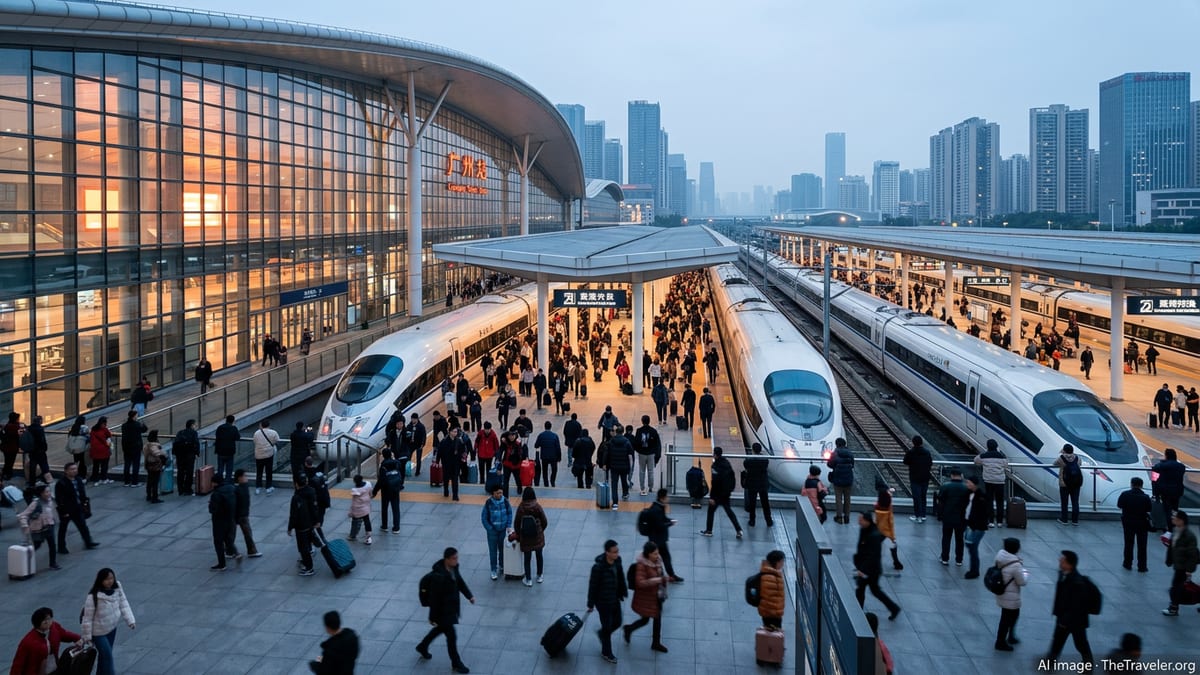
Record-Breaking Flows in a Nationwide Travel Boom
The 40-day Spring Festival travel rush, or chunyun, which ran from January 14 to February 22, 2025, once again underscored the scale of China’s annual holiday migration, with railways nationwide moving an unprecedented 513 million passengers. Within this vast movement, Guangzhou’s rail network stood out as a major engine of mobility, funnelling tens of millions of travelers through one of the country’s most densely populated and economically dynamic regions.
China Railway Guangzhou Group reported a total of 145 million passenger arrivals and departures across its network during the period, setting a new all-time record for the Spring Festival rush in South China. Of these, 75.01 million were departing passengers, a year-on-year rise of 4.9 percent, while 70.08 million were arrivals, up 2.4 percent. The figures highlight how the Pearl River Delta, anchored by Guangzhou and Shenzhen, remains one of the busiest corridors in the country during peak travel seasons.
Nationally, daily railway trips averaged around 12.75 million, with major hubs such as Beijing, Shanghai, Guangzhou and Shenzhen experiencing sustained heavy flows. The surge reflected both pent-up demand for family visits and a growing appetite for domestic tourism, reinforced by an eight-day Spring Festival holiday and strong confidence in the reliability of China’s high-speed rail network.
Guangzhou South Leads as Stations Smash Passenger Records
At the heart of the travel surge was Guangzhou South Railway Station, one of the world’s largest high-speed rail terminals. During the 2025 chunyun period, the station handled 10.66 million passengers, reinforcing its role as a primary gateway for high-speed services radiating across central and southern China. Nearby Shenzhen North Station also saw record volumes, transporting 7.72 million passengers as flows intensified between Guangdong’s technology powerhouse and the rest of the country.
Across Guangdong Province as a whole, 47.40 million passengers were transported by rail during the rush, up 5.1 percent year-on-year. Twenty stations under the China Railway Guangzhou Group, including Shenzhen North and Zhanjiang West, repeatedly set new historical highs in passenger throughput as demand climbed and operations adapted to the heavier loads. The sustained growth over multiple days, especially in Guangzhou and Shenzhen, pointed to a structural shift in how travelers are using rail for both long-distance returns home and shorter leisure trips within the region.
Railway officials noted that passenger flows into Guangzhou and Shenzhen remained elevated for at least 10 consecutive days, a sign that the cities are not just departure points but also increasingly attractive holiday destinations. The blend of migrant workers returning to factory belts, students commuting between campuses and hometowns, and families taking advantage of high-speed connections for tourism placed complex, round-the-clock demands on station management.
Strategic Capacity Enhancements Keep Trains Moving
The impressive performance of Guangzhou’s railway system during the festival rush was underpinned by months of planning and significant capacity enhancements. Across the 40-day period, China Railway Guangzhou Group dispatched extra services to match shifting flows, coordinating schedules with national operators to ease pressure on peak routes and time slots. This followed a broader national strategy that saw railways operate an average of more than 11,000 passenger trains per day in the first two months of 2025.
On key days of the rush, additional high-speed trains and late-night services were introduced to spread passenger loads more evenly throughout the day and reduce platform congestion. In the 2025 holiday week itself, the group ran more than 25,000 trains, with hundreds of daily high-speed services added compared with the previous year. Night-time high-speed trains became an important pressure valve, allowing passengers with flexible schedules to travel outside daytime peaks.
Infrastructure improvements also played a role. Newly expanded and renovated stations in the region, along with the relatively recent opening of the Meizhou–Longchuan high-speed line, provided extra routing options and increased resilience in the face of surging demand. Enhanced signaling and scheduling systems helped operators fine-tune headways and turnarounds, keeping punctuality high despite crowded tracks and platforms.
Digital Tools, Service Upgrades and Cross-Border Links
Behind the scenes, technology was central to maintaining order as millions passed through Guangzhou’s rail network. China’s nationwide 12306 digital ticketing platform, which had already sold more than 120 million tickets early in the chunyun period, offered real-time capacity information, flexible rebooking and mobile QR code boarding, reducing the need for physical queues and manual ticket checks. Big-data analysis allowed operators to anticipate sudden spikes in demand and add trains or carriages on popular routes at short notice.
Passenger-facing services were also upgraded. Many major stations in the Guangzhou system expanded self-service check-in gates, improved wayfinding signage and increased multilingual announcements to assist the growing number of tourists and cross-border travelers. Additional staff and volunteers were deployed at transfer points to help passengers navigate complex station layouts and make tight connections during peak hours.
Cross-border rail links added another layer of complexity and opportunity. The Guangzhou–Shenzhen–Hong Kong high-speed line saw around 4 million passengers during the broader Spring Festival travel period, marking a sharp increase from the previous year and underscoring the line’s role as a key connector between the Chinese mainland and Hong Kong. Coordinated timetables and streamlined customs procedures helped these trains operate smoothly even as domestic services neared capacity.
Guangzhou’s Role in China’s Evolving Travel Landscape
The 2025 figures confirm Guangzhou’s status as a linchpin in China’s modern travel ecosystem, where high-speed rail has become the backbone of long-distance mobility. As the national transportation network continues to expand and integrate, the city’s rail system is expected to shoulder an even greater share of flows during future Spring Festival rushes, including the 2026 season, which authorities forecast will see record highs again.
For travelers, the experience of moving through Guangzhou’s rail hubs this year offered a glimpse of what large-scale, data-driven mobility can look like when infrastructure, staffing and technology are aligned. Shorter waiting times, more frequent departures and smoother connections showed how incremental operational changes can translate into tangible benefits during the world’s largest annual human migration.
For the wider tourism and hospitality sectors, the massive throughput handled by Guangzhou’s rail system during the Spring Festival rush is a positive indicator. Strong passenger numbers point to resilient domestic travel demand and suggest that, despite economic headwinds, Chinese travelers remain willing to spend on journeys that connect them with both family and new destinations. As future holiday periods approach, all eyes will again be on how Guangzhou’s railways manage the next wave of travelers seeking to crisscross a country on the move.