

More news on this day
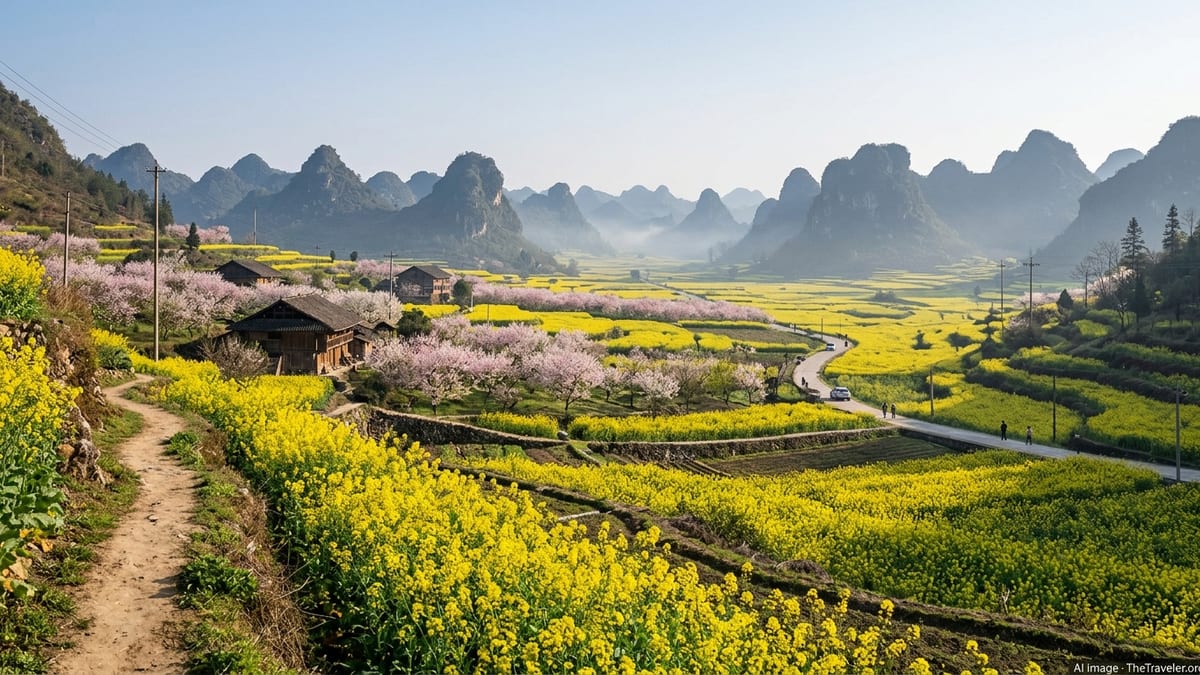
In the space of little more than a decade, Guizhou has gone from being one of China’s most fragile, rock‑scarred provinces to a rising “blossom kingdom,” using vast seas of cherry, rapeseed and wildflowers to power an ambitious new chapter in mountain tourism and rural revitalization.
Get the latest news straight to your inbox!
From Karst Hardship to Tourism Laboratory
Guizhou sits at the heart of one of the world’s largest karst plateaus, a landscape long associated with rocky desertification, thin soils and widespread poverty. Development reports describe the province as once having some of China’s most degraded limestone terrain, where water drained quickly underground and farmland yields remained stubbornly low. For decades, this geology limited both agriculture and industry, pushing many communities to the margins of the country’s growth story.
That narrative has begun to shift. Environmental and tourism studies highlight how, by the early 2020s, Guizhou had started to reposition its rugged topography as an asset rather than a burden, leaning into mountain tourism, national parks and ethnic culture experiences. Newly compiled data for 2023 show the province receiving hundreds of millions of tourist visits and generating substantial tourism revenue, reflecting how travel has become a key pillar in the regional economy.
Crucially, this transition is not just about sightseeing. Policy papers point to a combined approach that pairs ecological restoration with tourism development, including reforestation of rocky hillsides, protection of karst springs and conversion of marginal plots into flower fields, tea terraces and eco‑resorts. The result is a landscape that is still unmistakably wild but increasingly shaped around seasonal color and visitor access.
Guizhou’s experiment is now being watched as a case study in how a province once defined by scarcity can use natural assets, targeted infrastructure and cultural branding to compete with more established destinations along China’s coast and river plains.
The Rise of the Spring Blossom Economy
Blossom tourism has become one of Guizhou’s most visible success stories. Official tourism portals for Guiyang, the provincial capital, now promote “flower‑viewing season” from February to May as a core product, listing dozens of prime viewing spots across the city and nearby Gui’an New Area. These sites range from plum and peach orchards to tulip beds and daffodil gardens, threaded together by new scenic drives and themed festivals.
Gui’an Cherry Blossom Park illustrates the scale of the transformation. Local information describes it as spanning around 24,000 mu and hosting some 700,000 cherry trees, making it one of the largest cherry blossom viewing areas in the country. During March and April, the park turns into a sweeping mosaic of pink and white, with aerial photography widely published by Chinese media to showcase a spectacle that rivals better‑known sites in eastern China and Japan.
Beyond cherry trees, rapeseed flowers have become another signature of Guizhou’s spring. Reports from Bijie, Tongzi and Qianxi describe vast fields turning golden each March, sometimes covering tens of thousands of hectares in highland basins framed by jagged karst peaks. Local coverage notes that counties such as Tongzi welcomed more than 16 million tourists in 2024, with rapeseed bloom festivals, photography contests and rural cultural performances helping to drive tourism revenue into the billions of yuan.
National outlets increasingly include Pingba’s “Sea of Cherry Blossoms,” Tongren’s rapeseed valleys and Bijie’s rhododendron belts in lists of China’s top spring flower destinations. This visibility is reinforcing Guizhou’s new reputation among domestic travelers as a place where wild mountain scenery and carefully curated floral displays coexist in a single itinerary.
Rural Revitalization Rooted in Flowers
Flower tourism is also being woven directly into rural revitalization programs. Coverage from People’s Daily and other outlets highlights how townships in Zunyi, Tongzi and Renhuai have combined tea plantations, forestry and agriculture with flower tours, rural homestays and folk events. The model aims to transform villages from out‑migration zones into micro‑destinations where farmers can earn from both crops and visitor spending.
In practice, this has meant carving walking paths through rapeseed fields, converting ancestral wooden houses into guest lodges, and organizing “village galas” during peak bloom, when stages, food stalls and handicraft markets line the edges of flower terraces. Publicly available information indicates that in some counties, blossom tourism has become a leading source of seasonal employment for women and older residents who might otherwise struggle to access formal city jobs.
The flower economy is also reshaping land use. In areas once dominated by patchy corn or fallow slopes, farmers are planting high‑value ornamentals, fruit trees and under‑story crops tailored to visitor seasons. Agritourism packages increasingly bundle flower viewing with tea picking, honey tasting and short hiking routes, lengthening stays and encouraging repeat visits across different blooming periods from plum to rhododendron.
While challenges remain, including uneven infrastructure and the need to protect fragile karst ecosystems from overdevelopment, observers note that the link between blossoms and livelihoods is now firmly established in local planning. Tourism, in this context, is not a stand‑alone industry but a framework for reimagining rural space and income streams.
Big Data, Branding and the New Guizhou Image
Guizhou’s tourism reinvention is unfolding alongside a broader technological pivot. Gui’an New Area, which sits between Guiyang and Anshun, is being marketed as both a flower tourism hub and a big data innovation cluster. Public information points to rapid growth in data centers, cloud computing facilities and new energy projects, with cherry blossom season used as a backdrop for investment conferences and promotional events.
This convergence of nature and technology is central to Guizhou’s new image strategy. Official English‑language portals emphasize the province’s cool climate, stable geology for data storage and relatively low land costs, while travel promotion materials foreground waterfalls, terraced villages and endless spring blossoms. Together, they present Guizhou as a modern, connected mountain destination rather than an isolated backwater.
Digital tools are increasingly embedded in the visitor experience. Mini‑programs and online maps steer travelers to up‑to‑date blossom forecasts, shuttle services and photo viewpoints, while social media campaigns encourage user‑generated images of Guizhou’s flower seas. This content is helping carry the province’s transformed landscapes far beyond China, feeding growing international curiosity about less familiar interior regions.
For local communities, the hope is that this branding will translate into longer seasons and more diversified visitor flows. By tying flower tourism to conferences, outdoor sports and cultural events throughout the year, planners aim to reduce the boom‑and‑bust cycle that can accompany short‑lived natural spectacles.
Managing the Next Phase of the Transformation
As Guizhou’s blossom kingdom reputation solidifies, questions are emerging about how to manage growth. Environmental analysts point out that karst ecosystems are acutely sensitive to soil erosion, water contamination and overpumping, making careful control of visitor numbers, parking lots and new construction essential. Several tourism plans stress the importance of zoning, shuttle‑only core areas and strict limits on building heights in scenic basins.
There is also a push to broaden the story beyond a single season. Tourism researchers note that Guizhou’s long‑term strength lies in its diversity, from UNESCO‑listed karst sites and deep caves to rice terraces, waterfalls such as Huangguoshu and ethnic Miao and Dong villages. Blossom tourism has given the province new visibility, but many in the sector argue that the next step is to use that attention to introduce travelers to hiking, canyoning, cave exploration and winter hot spring routes.
What is clear is that the old image of Guizhou as a rocky wasteland is steadily being replaced. Flower festivals, marathon routes through rapeseed fields, and cherry blossom parks the size of small cities are now central to how the province presents itself at home and abroad. For visitors arriving by high‑speed rail or new expressways, the first impression is less of hardship than of hillsides erupting in pink, white and gold.
From the perspective of travel trends, Guizhou’s transformation encapsulates a broader shift in China’s domestic tourism, where second‑tier and interior regions are using distinctive landscapes and seasonal experiences to draw travelers away from overcrowded coastal hotspots. In that sense, the province’s blossom kingdom is not only a spectacle of nature, but also a signal of how mountain regions can rewrite their futures through careful, flower‑framed reinvention.