

More news on this day
Gulf Air has begun operating special daily return flights from Dammam to London, Mumbai and Bangkok, a move that leverages Saudi Arabia’s transit visa offerings while strengthening the Eastern Province’s role as a regional aviation hub amid wider Gulf airspace disruption.
Get the latest news straight to your inbox!
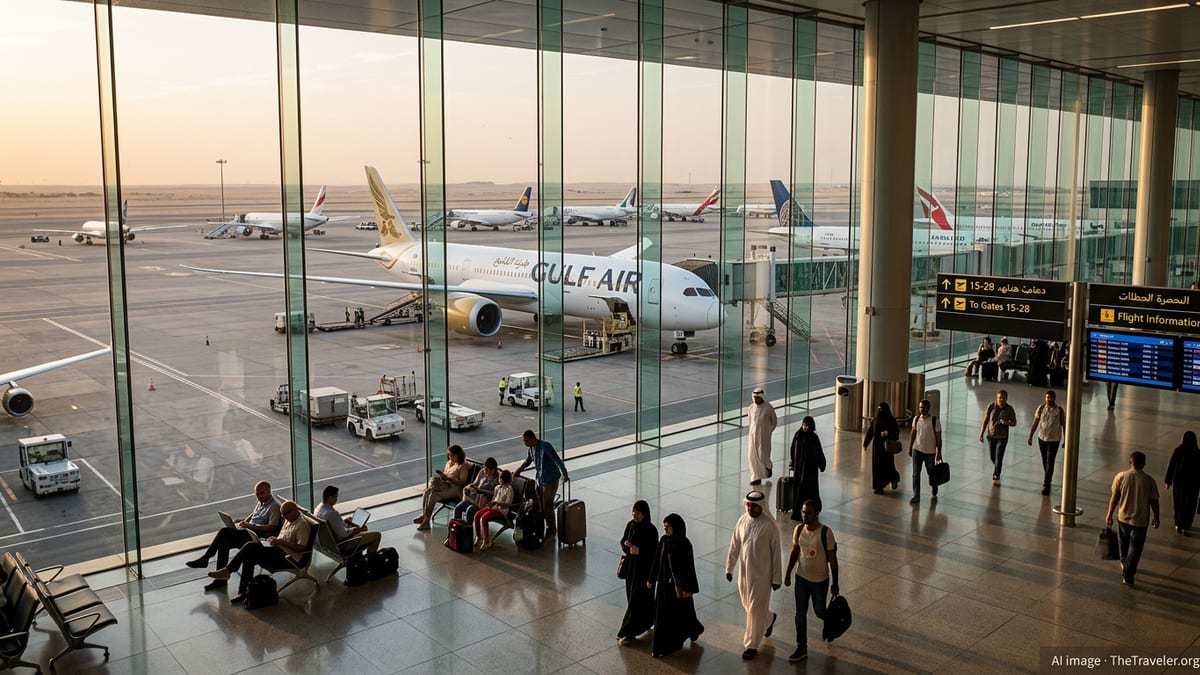
New Dammam Services Link Saudi Arabia to Key Global Gateways
According to recent industry coverage, Gulf Air introduced temporary daily return services from King Fahd International Airport in Dammam to London, Mumbai and Bangkok from 11 March 2026, as carriers across the region adjust networks in response to ongoing airspace restrictions. The extra-capacity operation is designed to maintain connectivity between Asia, the Gulf and Europe while many flights via Bahrain remain suspended.
Publicly available information indicates that these flights effectively shift parts of Gulf Air’s long-haul and high-demand regional network across the causeway into Saudi Arabia, giving Dammam a direct role in sustaining flows that would typically pass through Bahrain International Airport. For travelers in the Eastern Province, the new services add rare nonstop or one-stop options to three of the region’s most strategic markets: the United Kingdom, India and Thailand.
While the schedule has been introduced in response to a crisis, the pattern of flying underscores Dammam’s emerging importance in regional aviation. Recent years have already seen a build-up of international services from the city, with other Gulf and Saudi carriers adding routes as part of broader connectivity strategies linked to Saudi Arabia’s National Transport and Logistics Strategy.
Gulf Air’s move places King Fahd International Airport in a more prominent position on long-haul routings, particularly for passengers seeking alternatives to congested hubs or disrupted corridors. Industry analysts note that such tactical deployments can pave the way for more permanent adjustments if sustained demand is demonstrated.
Saudi Transit Visa Options Enhance Dammam’s Appeal
Saudi Arabia has positioned streamlined transit access as a core element of its aviation and tourism drive, with a widely reported 96-hour stopover visa available to eligible travelers booking through selected Saudi-based airlines. Although the current Dammam operation is run by Bahrain’s Gulf Air, the existence of a maturing stopover-visa framework around the kingdom increases the attractiveness of routings that touch Saudi territory, including through Dammam.
Public information from travel advisories and airline channels indicates that the 96-hour transit visa is primarily tied to tickets issued on certain Saudi carriers, allowing travelers to exit the airport, visit cities or perform religious activities during a layover. Even where the product is not directly embedded in a Gulf Air ticket, the broader policy environment signals that Saudi authorities are intent on simplifying short stays and transfers as part of their long-term connectivity strategy.
For passengers moving between London, Mumbai, Bangkok and onward destinations, Dammam’s position in Saudi Arabia’s Eastern Province offers potential for future integration with transit products if airline partnerships evolve. Travel industry observers point out that, as the stopover program matures, more carriers and itineraries could be structured to take advantage of Saudi Arabia’s liberalizing entry regime, turning passing connections into short visits.
The visibility of transit visa options also supports Saudi Arabia’s branding as an accessible gateway rather than simply a fly-over state. In that context, Gulf Air’s temporary deployment into Dammam aligns with a broader regional shift toward using flexible visa policies and multi-airport networks to absorb shocks and keep passengers moving.
Strengthening Regional Connectivity Amid Airspace Disruptions
Reports on Gulf operations describe a challenging environment for airlines, with temporary closures or restrictions in sections of regional airspace prompting widespread schedule changes. Gulf Air’s Dammam initiative is one example of how carriers are redistributing capacity to alternative gateways to preserve key corridors linking South Asia, the Gulf and Europe.
By operating daily return flights from Dammam to London, Mumbai and Bangkok, Gulf Air helps maintain an important lifeline for travelers who might otherwise face lengthier detours or cancellations. The airline’s choice of Dammam reflects the city’s proximity to Bahrain and its ability to serve as a practical replacement hub, supported by existing ground infrastructure and links to nearby population centers.
Aviation analysts note that such emergency-driven patterns often accelerate long-discussed connectivity trends. Dammam, which already serves the energy sector and a growing expatriate community, benefits from the additional international exposure and potential follow-on demand once regular operations in the region normalize.
The Dammam services also highlight the strategic interplay between Gulf Cooperation Council states, where carriers can, in some cases, pivot into neighboring markets to safeguard traffic flows. For travelers, this can translate into new routings and airport experiences that may remain appealing even when crisis conditions ease.
Dammam’s Growing Role in Saudi Arabia’s Aviation Vision
Saudi Arabia has been investing heavily in aviation as part of its broader economic diversification agenda, with plans to grow passenger volumes, attract new airlines and position multiple cities as international gateways. Dammam, on the kingdom’s eastern seaboard, has been steadily integrated into that vision alongside Riyadh and Jeddah.
Recent route announcements by regional carriers illustrate how King Fahd International Airport is being drawn more firmly into global networks, including new services to European and Asian destinations. The temporary presence of Gulf Air’s long-haul and regional flights from Dammam adds another layer to that story, emphasizing the airport’s ability to accommodate large widebody aircraft and handle complex transfer flows.
Travel industry coverage frequently references Dammam’s advantages, including its catchment area across Saudi Arabia’s industrial heartland and its relative proximity to Bahrain via the King Fahd Causeway. Those attributes make it a natural candidate for expanded roles during both normal operations and periods of disruption.
If current patterns of demand hold, aviation observers suggest that airlines may increasingly view Dammam not only as a contingency gateway but as a complementary node in their long-term network planning. This aligns with Saudi Arabia’s ambitions to distribute traffic more evenly across its major airports and support tourism and business development in multiple regions.
Implications for Travelers and Future Network Growth
For passengers, the new Dammam links to London, Mumbai and Bangkok provide additional options at a time of uncertainty across parts of the Middle East’s skies. Travelers with flexible plans may find that routings via Dammam offer shorter travel times than more distant detours, as well as the prospect of future integration with Saudi stopover experiences as policy and partnerships evolve.
Travel agencies and corporate travel managers are watching the development closely, evaluating how reliably Dammam can function as an alternative hub and how the new pattern of services interacts with visa requirements, ground transport and accommodation availability in the Eastern Province. The presence of a defined, if still evolving, Saudi transit visa framework forms part of that calculation.
From an industry perspective, Gulf Air’s pivot into Dammam illustrates how fast-growing Gulf and Saudi aviation systems can provide redundancy in times of stress. By combining flexible airport infrastructure, supportive regulatory frameworks and regionally coordinated scheduling decisions, airlines and authorities aim to safeguard connectivity even when traditional hubs are temporarily constrained.
As airspace conditions and network strategies continue to evolve in 2026, Dammam’s enhanced links with London, Mumbai and Bangkok are likely to remain a focus for both travelers and aviation planners. The episode offers a real-time case study in how regional carriers use neighboring gateways and emerging visa tools to keep the global travel system moving.