

More news on this day
Gulf Air is adding Dammam to a short list of emergency gateways alongside London, Mumbai and Bangkok, as the shutdown of Bahrain’s airspace continues to force unprecedented changes to travel across the Gulf and beyond.
Get the latest news straight to your inbox!
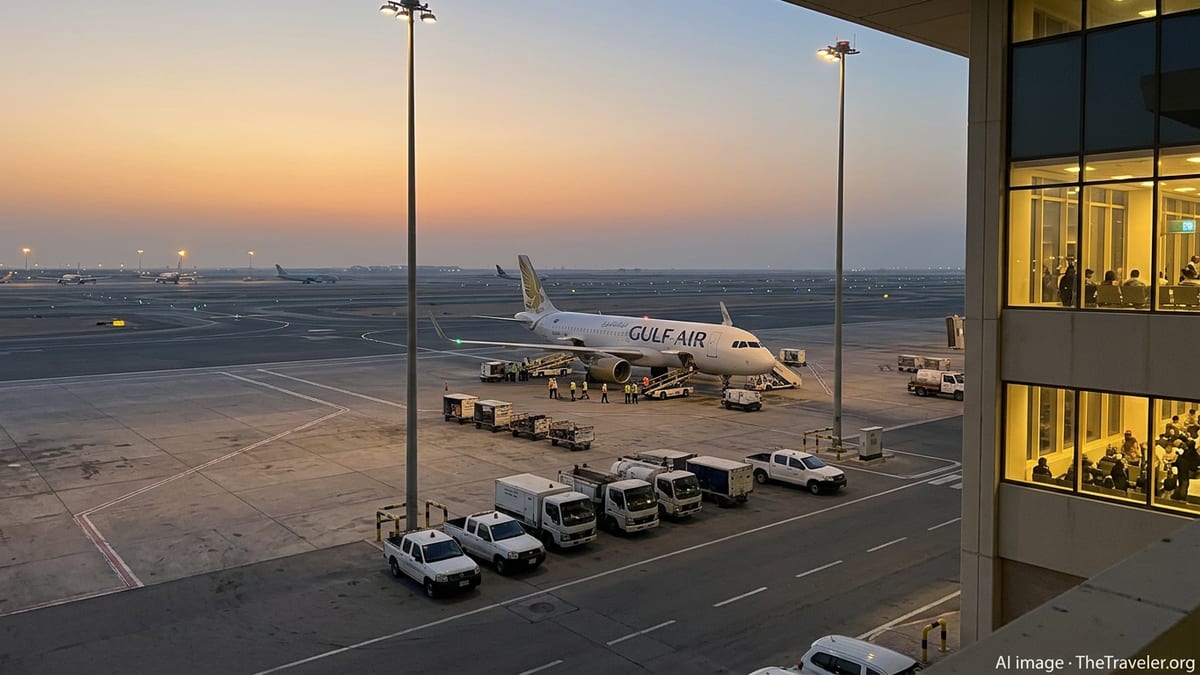
Gulf Carrier Repositions Operations Amid Prolonged Disruption
Publicly available aviation and security updates indicate that Bahrain’s airspace remains effectively closed to routine commercial traffic following strikes and rising regional tensions linked to the 2026 Iran war. With its home hub in Manama largely sidelined, Gulf Air has shifted into a contingency mode that prioritises evacuation and essential connectivity over regular schedules.
Industry trackers and passenger reports describe Gulf Air as operating on a skeleton basis through special services, even as many of its regular flights stay cancelled. The airline has been under particular strain because it relies more heavily on Bahrain International Airport than larger Gulf rivals that can redistribute traffic across multiple hubs.
The wider Middle East aviation network has been heavily affected, with airspace restrictions across several Gulf states obliging airlines to cancel or reroute thousands of flights. In this environment, any newly approved corridor or alternate airport has quickly taken on outsized importance for stranded travellers.
Against this backdrop, Gulf Air’s decision to lean on Dammam and a handful of long haul cities as part of a limited emergency network signals a pragmatic, if temporary, reconfiguration of its route map.
Dammam Emerges as a Critical Temporary Gateway
Operational notices referenced by regional logistics and security advisories show that while Bahrain’s skies remain restricted, airports in neighbouring Saudi Arabia continue to function under tighter Gulf facing controls. King Fahd International Airport in Dammam, located just across the causeway from Bahrain, has become a logical staging point for diversion and relief operations.
Passenger anecdotes on travel forums over the past week describe Gulf Air teams redeploying to Dammam to support repatriation efforts and monitor movements for affected customers. These accounts align with corporate and government briefings that note Dammam among the Saudi airports handling redirected flows as Bahrain based traffic is curtailed.
By adding Dammam to its emergency network, Gulf Air gains access to an alternative runway and terminal infrastructure without completely severing the physical link to Bahrain’s catchment area. For many residents and expatriates who would ordinarily board in Manama, the overland journey to Dammam is emerging as the most realistic path to a flight out of the region.
The arrangement remains constrained, with capacity limited by both regulatory approvals and airspace routing around the most sensitive zones. Nevertheless, Dammam’s new role provides a partial outlet for the backlog of passengers left in limbo by the Bahrain shutdown.
London, Mumbai and Bangkok Anchor Long Haul Emergency Links
Alongside Dammam, publicly available passenger communications and scheduling fragments point to London, Mumbai and Bangkok as key end points in Gulf Air’s emergency operations plan. Each city represents a major regional or intercontinental hub, chosen for their ability to connect onward to a wide web of destinations.
London serves as a primary gateway for Europe and North America, and has already featured prominently in evacuation and relief schedules for other Gulf based airlines affected by the crisis. Mumbai provides essential connectivity for the large South Asian workforce that normally travels through Bahrain, while Bangkok offers an anchor in Southeast Asia as carriers adjust their networks around the Gulf.
Reports shared by affected travellers in recent days describe Gulf Air rebooking disrupted itineraries onto special services touching these cities, sometimes combining surface segments to Dammam with long haul flights where slots and safe corridors are available. In many cases, these journeys take considerably longer and involve more uncertainty than pre crisis routings.
Despite the hardship, these limited links are functioning as lifelines for students, migrant workers and residents seeking to return home or reach family. The focus remains on outbound and repatriation style flows rather than the two way business and leisure traffic that normally underpins Gulf Air’s network.
Stranded Passengers Face Complex Choices and Crowded Alternatives
The Bahrain airspace crisis has left tens of thousands of travellers across the region navigating cancellations, rolling schedule changes and lengthy customer service queues. Travel forums and social media feeds are filled with accounts of passengers holding Gulf Air tickets for Bahrain centered itineraries who are now weighing whether to wait for an emergency rebooking or pursue refunds and alternative routes.
Some travellers report being offered new dates later in March, reflecting expectations in parts of the aviation community that restrictions may gradually ease if security conditions stabilise. Others are opting to self reroute via airlines still operating through airports such as Muscat or Riyadh, though capacity on these alternatives is limited and fares have risen under pressure.
Consumer advocates note that the combination of closed airspace and high regional demand has reduced options for budget conscious passengers in particular. The emergence of Dammam, London, Mumbai and Bangkok as focal points for emergency flights helps, but does not fully compensate for the loss of Bahrain as an unconstrained hub.
With information changing rapidly, published guidance continues to emphasise that passengers monitor airline channels and airport notices closely, and remain prepared for last minute alterations even after reaching a departure terminal.
Regional Aviation Outlook Remains Uncertain
Analysts tracking the economic impact of the 2026 Iran war highlight aviation as one of the sectors most exposed to prolonged instability in the Gulf. Airspace closures in multiple states, physical damage to select airports and the rerouting of long haul traffic away from traditional corridors are collectively reshaping flight patterns between Europe, Asia and Africa.
Oil market observers also point to the dual effect of constrained passenger flights and disrupted air freight, which complicates supply chains and can add costs for both airlines and shippers. Limited emergency services like those now involving Dammam, London, Mumbai and Bangkok provide some relief, but are not designed to support full commercial demand.
For Gulf Air, the present strategy appears focused on preserving core connectivity, maintaining brand visibility in key markets and moving stranded customers while waiting for clearer signals on when Bahrain’s airspace can safely reopen at scale. Industry commentary suggests that, once restrictions ease, the carrier will still face the challenge of rebuilding schedules, regaining passenger confidence and potentially redesigning contingency plans based on lessons from this crisis.
Until then, the airline’s pivot to Dammam and select long haul destinations stands as a case study in how a single hub dependent carrier adapts when its home skies abruptly close, and how travellers recalibrate their own journeys in response.