

More news on this day
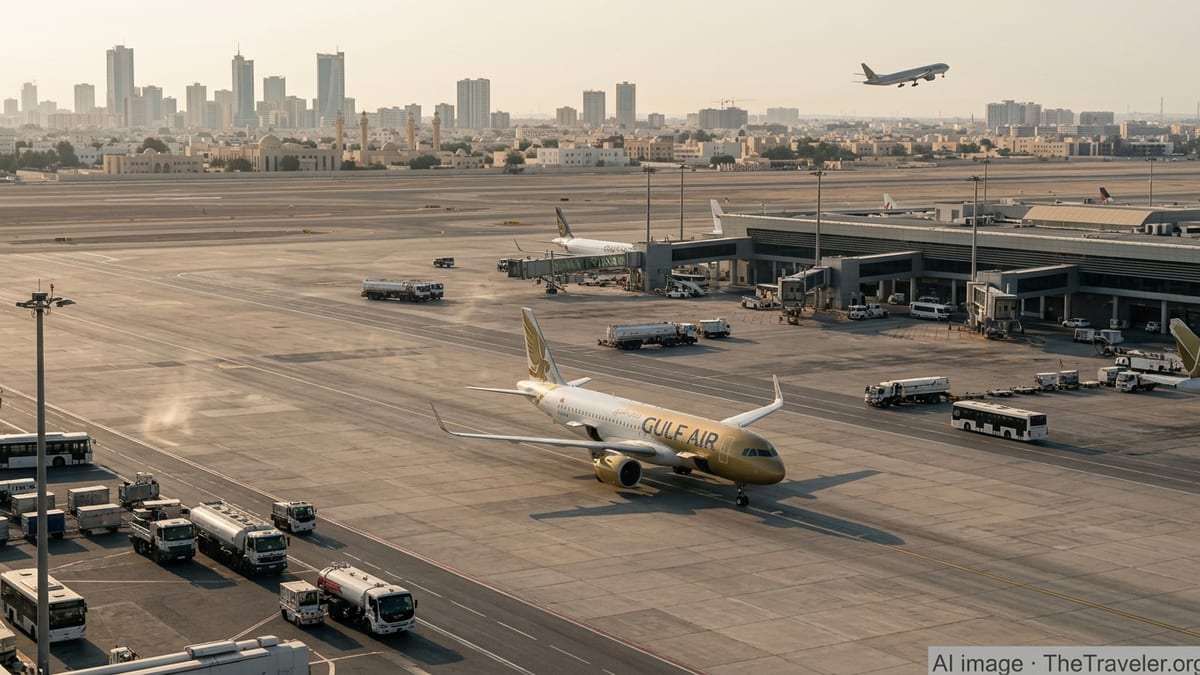
Gulf Air is pressing ahead with an ambitious network strategy that keeps Bahrain plugged into Europe and East Africa, as the airline’s growing services to Frankfurt and Nairobi take shape against a backdrop of recurring Gulf airspace closures and regional security concerns.
Get the latest news straight to your inbox!
New Nairobi Link Restores a Long-Dormant African Corridor
Publicly available schedules show that Gulf Air reinstated nonstop flights between Bahrain and Nairobi in June 2025, reviving a connection that had been absent from its network for more than a decade. The Bahrain–Nairobi route operates five times a week with Airbus A320neo aircraft, creating a direct bridge between the Gulf kingdom and one of East Africa’s most important aviation and commercial hubs.
The restored service strengthens Bahrain’s position as a transfer point for passengers traveling between East Africa, the Middle East, India and parts of Asia. Airline timetable data indicates that Nairobi-bound passengers can access onward links to destinations such as Riyadh, Jeddah, Dubai, Mumbai and Bangkok via coordinated connections in Bahrain. The move aligns with a wider industry trend of Gulf carriers deepening their presence in Africa to capture both growing business travel and a resilient diaspora market.
Kenyan aviation and tourism observers have highlighted Nairobi’s ambitions to consolidate its role as a regional hub, with Jomo Kenyatta International Airport undergoing multibillion-dollar upgrade plans. Gulf Air’s return to the Kenyan capital adds competitive pressure and more choice on eastbound routes, complementing established services from African and Gulf rivals. For Bahrain, the route reinforces commercial and diplomatic ties with one of sub-Saharan Africa’s fastest-growing economies.
The Nairobi resumption also provides redundancy for travelers affected whenever nearby hubs experience disruption, offering an alternative Gulf gateway and additional connectivity options into East Africa. While demand patterns remain sensitive to regional security headlines, booking and schedule data suggest that the route has quickly integrated into Gulf Air’s broader network plan.
Frankfurt Strengthens Bahrain’s European Connectivity
Gulf Air’s focus on Frankfurt underlines its strategy to maintain a visible footprint in continental Europe even as Middle East airspace remains volatile. Frankfurt is one of Europe’s largest intercontinental hubs, and Gulf Air’s Bahrain–Frankfurt operation is designed to feed both point-to-point traffic and interline flows onto wider European and North American networks via partner carriers.
Timetable services in early 2026 show Bahrain–Frankfurt flights structured to support overnight departures from Asia and India into Bahrain, followed by daylight onward travel into Germany. This pattern caters to corporate travelers and international students while also appealing to leisure passengers heading to central Europe. In the opposite direction, Frankfurt-originating travelers gain one-stop access to Gulf Air’s destinations across the Middle East, South Asia and Africa.
The German market remains strategically important for Gulf carriers despite intense competition and regulatory scrutiny. By maintaining a presence in Frankfurt, Gulf Air ensures that Bahrain is not sidelined in the contest for Europe–Asia traffic flows, especially at a time when routings avoiding sensitive airspace are reshaping flight paths. The connection also supports inbound tourism to Bahrain, positioning the kingdom as a stopover or short-stay destination for European visitors seeking winter sun or cultural breaks.
As carriers constantly recalibrate their European portfolios, the Frankfurt link signals Gulf Air’s intention to defend its access to a major aviation crossroads, even when regional events complicate operations closer to home.
Operating Through Repeated Gulf Airspace Disruptions
The expansion into Frankfurt and Nairobi has unfolded during a period of exceptional airspace volatility across the Gulf. Since mid-2025, a series of military incidents and missile strikes involving Iran and regional states have triggered waves of temporary airspace closures from Bahrain and Qatar to Kuwait and the United Arab Emirates. Aviation advisories and government notices have repeatedly urged airlines to avoid swathes of regional sky due to perceived risks from air defense systems and interception activity.
In late February 2026, joint strikes on Iran intensified the disruption, prompting multiple Gulf states to close their airspace entirely or impose severe restrictions. News agency coverage and flight tracking data reported hundreds of thousands of travelers stranded or rerouted as key hubs in Doha, Dubai and Abu Dhabi curtailed operations. Bahrain’s airspace and Bahrain International Airport were drawn into this wider shutdown, with Gulf Air temporarily suspending regular operations while relocating parts of its fleet to safer airports in neighboring countries.
Despite these setbacks, subsequent industry and advisory updates indicate that Gulf governments have moved to reopen airspace in phases whenever security assessments allow. In practice, this has left airlines navigating a patchwork of restrictions, reroutes and schedule changes, often at short notice. For a single-hub carrier such as Gulf Air, the challenge has been particularly acute, as Bahrain sits close to several of the military flashpoints shaping overflight risk assessments.
Within this turbulent context, the decision to maintain and build routes such as Frankfurt and Nairobi suggests a long-term bet that demand will rebound and that corridors connecting Europe, the Gulf and Africa will remain commercially resilient once airspace stabilizes. While short-term disruptions can wipe out weeks of planning, network data and public advisories show that carriers are increasingly designing flexible flight plans and contingency routings to keep strategic city pairs viable.
Strategic Positioning for a Post-Crisis Network
Analysts tracking Middle East aviation have noted that episodes of regional airspace closure often accelerate structural changes rather than reversing them. When skies reopen, airlines that already hold traffic rights, airport slots and local partnerships are typically better placed to restore capacity and capture pent-up demand. Gulf Air’s investment in reconnecting Nairobi and reinforcing Frankfurt appears to follow this logic, positioning Bahrain as a nimble connector between continents once flight patterns normalize.
By diversifying its long-haul and regional portfolio, the carrier reduces its dependence on any single corridor or neighboring hub. Routes into East Africa help spread exposure beyond traditional Gulf–Europe and Gulf–South Asia flows, while Frankfurt anchors Bahrain into a major European network at a time when some carriers are consolidating operations into fewer gateways. This combination provides multiple recovery pathways if particular regions remain constrained by security alerts or regulatory advisories.
Published data on port and airspace conditions across the Gulf in March 2026 show that governments and aviation authorities continue to review restrictions frequently, with closures and partial reopenings occurring within days of each other. That environment forces airlines to make difficult choices between near-term cost control and long-term market presence. Gulf Air’s current trajectory indicates a preference for safeguarding its global footprint, even at the price of complex operational workarounds.
For travelers, the outcome is a mixed picture of short-term uncertainty and longer-term opportunity. Disruptions linked to the latest crisis have created delays, cancellations and extended detours, but they have not halted the broader trend of new city pairs emerging between Europe, the Gulf and Africa. As security conditions evolve, Bahrain’s flag carrier appears intent on ensuring that links to Frankfurt and Nairobi remain central pillars of its promise to keep the kingdom globally connected.