

More news on this day
Middle East air travel disruption intensified this weekend as Gulf Air cancelled at least 20 flights across its network, compounding ongoing regional airspace closures and leaving passengers stranded or rerouted in Bahrain, Dubai, Kuwait and other hubs already struggling with heavy operational strain.
Get the latest news straight to your inbox!
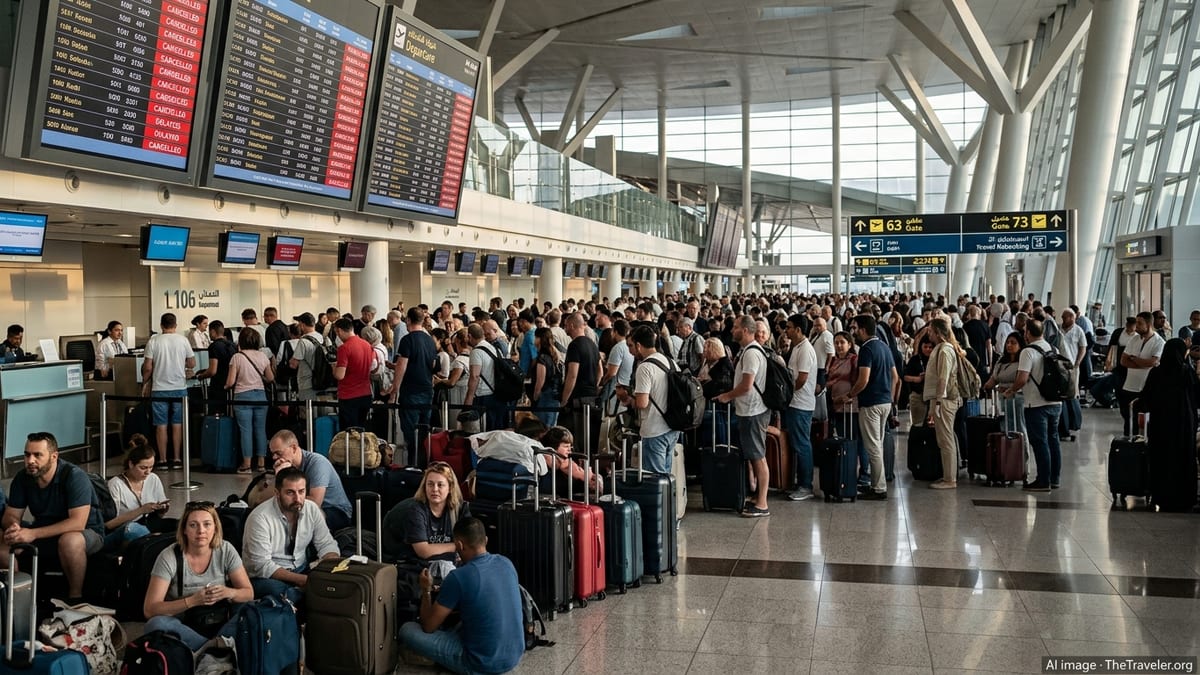
Wave of Gulf Air Cancellations Hits Regional Hub Network
Publicly available schedules and traveler reports indicate that Gulf Air has withdrawn around 20 flights over recent days, primarily affecting services that route through its Bahrain base and onward to major Gulf gateways such as Dubai, Kuwait City, Muscat and Riyadh. The reductions come on top of a broader collapse in regional connectivity since late February, when multiple Middle East states introduced full or partial airspace closures in response to the escalating conflict involving Iran, Israel and United States forces.
Flight tracking data and airline advisories show that Bahrain’s airspace has been subject to repeated restrictions, severely limiting movements in and out of Bahrain International Airport. Gulf Air, which relies heavily on Bahrain as a transfer hub linking Europe and Asia with Gulf destinations, has been forced to cut a swath of short- and medium-haul services that depend on smooth regional overflight permissions. Services touching Dubai and Kuwait have been among the most affected, with additional knock-on cancellations on connecting routes to South Asia and Europe.
Regional aviation bulletins describe thousands of flights cancelled or rerouted across the wider Middle East and North Africa since the latest crisis began, with the Gulf’s tightly interconnected networks particularly exposed. Gulf Air’s decision to pare back at least 20 flights highlights how even mid-sized carriers are being pushed to continually rework schedules as airspace availability changes from day to day.
Passengers Stranded and Rerouted via Alternative Gateways
Reports from travelers indicate that the latest Gulf Air cancellations have left passengers stranded in Bahrain and Dubai, with some rebooked days later or shifted to alternative departure points in Saudi Arabia. Shared accounts describe itineraries that initially routed via Bahrain being reissued to depart instead from Dammam’s King Fahd International Airport, requiring unexpected overland transfers across the causeway between Saudi Arabia and Bahrain.
In Dubai, passengers booked on Gulf Air connections to Bahrain and onward destinations have reported receiving last-minute cancellation notices, followed by long waits for rebooking or refunds as call centers and airport desks absorb a surge in requests. Some travelers describe being advised to secure seats on other carriers operating limited services out of the United Arab Emirates, often at higher last-minute fares and with extended layovers.
Similar disruption is reported in Kuwait, where airspace limitations and security concerns have periodically curtailed operations. With Gulf Air cancelling a series of flights touching Kuwait City, passengers with multi-leg journeys across the Gulf have faced broken connections, unexpected hotel stays, or long detours via airports that retain partial connectivity, such as Riyadh, Jeddah or Istanbul.
Travel forums and social media posts suggest that many affected customers are still navigating refund policies and schedule change rules, with some airlines in the region extending free-change windows and waiving penalties for departures through late March. Gulf Air-specific discussions point to rolling updates that progressively expand the eligibility period for no-fee cancellations as operational challenges persist.
Regional Airspace Closures Keep Middle East Skies Constrained
The ongoing Gulf Air disruption is unfolding against a backdrop of unusually tight airspace controls across the region. Advisories from security and risk consultancies describe full or partial closures in Iran, Iraq, Israel, Jordan, Kuwait, Qatar, Bahrain, Syria and the United Arab Emirates in recent weeks, significantly constraining available corridors for commercial jets and forcing airlines to stack more aircraft into limited alternative routes.
Major airports that normally act as highly efficient transfer hubs, including Dubai, Abu Dhabi and Doha, have been heavily affected by waves of cancellations and diversions. Although some services have resumed on reduced schedules as militaries coordinate safe corridors, the pattern remains volatile, with sudden restrictions triggering last-minute schedule changes across multiple carriers.
Analysts note that the present disruption represents one of the most severe shocks to Middle East aviation since the height of the pandemic, with tens of thousands of flights cancelled regionally and tourism flows into Gulf states sharply curtailed. In this environment, Gulf Air’s cancellation of 20 flights is one visible symptom of a system under sustained operational and security stress, rather than an isolated airline decision.
Industry commentary suggests that until airspace regimes stabilize and missile and drone attack risks subside, carriers will continue to operate conservative schedules, with spare capacity kept on the ground to accommodate rapid retimings or route changes. This is likely to prolong uncertainty for passengers planning trips through Bahrain and other Gulf hubs.
Financial and Operational Pressures on Gulf Carriers
While Gulf mega-carriers such as Emirates and Qatar Airways have attracted much of the attention for large-scale cancellations, mid-sized regional airlines including Gulf Air also face significant financial and operational pressures. Reduced frequencies on core trunk routes to Dubai, Kuwait and other Gulf cities threaten to erode feeder traffic that would normally support long-haul services, weakening network efficiency.
Publicly accessible industry analyses emphasize that airlines in the Gulf typically operate high utilization models, relying on swift turnarounds and dense schedules through central hubs. Widespread cancellations, including Gulf Air’s latest 20-flight reduction, disrupt this model by creating gaps in aircraft rotations, complicating crew planning and increasing the risk of aircraft being stranded away from their home base.
At the same time, higher insurance premiums, longer diversion routes around closed or high-risk airspace, and elevated fuel costs associated with extended flight times add to the economic strain. For airlines already contending with the lingering financial impact of the pandemic, the current security-driven downturn in demand and capacity poses a renewed challenge to balance sheet stability.
Sector observers caution that even when airspace begins to reopen more consistently, carriers may be slow to restore full schedules if demand remains subdued and security conditions uncertain. Gulf Air’s incremental approach to cancellations and schedule adjustments reflects a broader regional pattern of cautious capacity management in the face of shifting risk assessments.
What Travelers Should Expect in the Coming Days
Travel advisories and corporate mobility alerts recommend that passengers with upcoming journeys involving Bahrain, Dubai, Kuwait or other Gulf transit points monitor their bookings closely in the days leading up to departure. Given the pattern of short-notice cancellations, including Gulf Air’s recent decision to cut 20 flights, travelers are being urged to verify flight status repeatedly rather than relying on schedules booked weeks in advance.
Several large employers and international organizations are advising staff to allow extra time for connections, to consider routings that avoid the most heavily affected airspace where possible, and to maintain flexible onward arrangements for accommodation and ground transport. Travel managers also highlight the importance of understanding each airline’s current waiver, refund and rebooking policies, which can change quickly as the situation develops.
For leisure travelers, the continuing instability may mean postponing non-essential trips to or through the region, or opting for more direct routings that limit exposure to multiple Gulf stops. Those who proceed are likely to encounter longer queues, busier service desks and a higher risk of unplanned stopovers, particularly if connecting through Bahrain on Gulf Air or using codeshare itineraries that depend on the carrier’s regional legs.
Industry watchers suggest that while a sudden normalization remains unlikely in the immediate term, incremental improvements could emerge if ceasefire efforts gain traction and more predictable airspace management regimes are introduced. Until then, Gulf Air’s cancellations and the wider Middle East travel chaos serve as a stark reminder of how quickly geopolitical tensions can ripple through global mobility and tourism networks.