

More news on this day
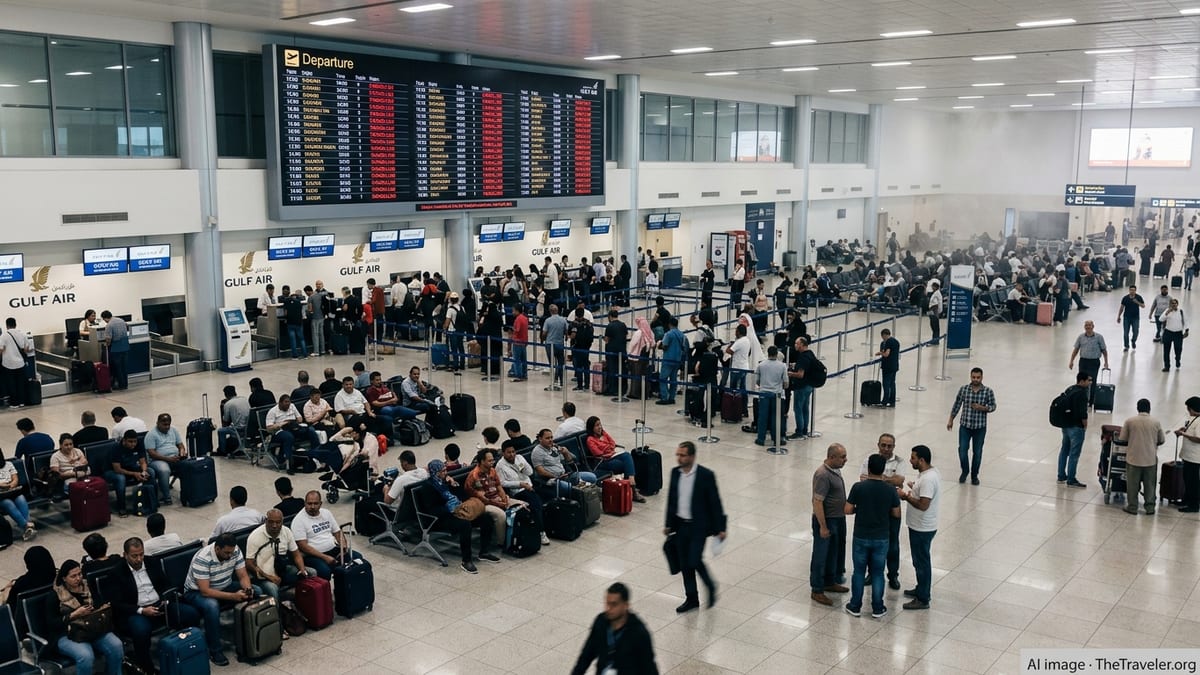
Hundreds of travelers were left stranded at Bahrain International Airport today after Gulf Air cancelled 99 flights in a single day, triggering widespread disruption across its network and severing links to major destinations including Dubai, London, Paris, Frankfurt, Singapore, Riyadh, Doha and Kuwait City.
Get the latest news straight to your inbox!
Mass Cancellations Paralyze Bahrain Hub
Publicly available flight data and regional aviation trackers show an abrupt collapse in Gulf Air operations from Manama, with 99 scheduled services cancelled over the course of the day. Departures and arrivals to nearby Gulf gateways as well as long haul routes into Europe and Asia were among the hardest hit, effectively turning Bahrain International Airport into a holding area for stranded passengers.
Operational notices and airport information boards indicated that services to Dubai, Abu Dhabi and Doha were either cancelled outright or left without confirmed departure times, cutting Bahrain off from some of the region’s busiest connecting hubs. Flights to Riyadh and Kuwait City also disappeared from departure boards, further constraining options for passengers attempting to rebook via neighboring states.
The wave of cancellations meant that, for much of the day, Gulf Air’s normal schedule was reduced to a handful of movements, primarily repositioning and limited regional services. Reports from travelers and aviation forums described crowded terminals, long queues at transfer and ticketing desks and difficulty securing alternative onward journeys.
Aviation analysts note that the scale of disruption is highly unusual for a midsize carrier concentrated around a single hub, particularly when core regional routes and multiple European services are removed from the schedule at once.
Key International Routes to Europe and Asia Severely Disrupted
The impact was felt far beyond the Gulf as a series of long haul flights between Bahrain and major European cities failed to operate. Publicly accessible schedules showed cancellations affecting services to London, Paris and Frankfurt, wiping out a full day of Gulf Air connectivity between Manama and three of Europe’s primary aviation hubs.
Passengers booked on connections via Bahrain to and from these cities reported being unable to complete itineraries that spanned multiple continents. With London and Frankfurt acting as gateways to North America and wider Europe, and Paris providing important links into francophone Africa, the knock-on effects of the cancellations extended well beyond the airline’s immediate network.
Asian routes were also hit. Travel boards and itinerary snapshots circulating online pointed to disruption on services linking Bahrain to Singapore and other Asian destinations, eroding one of the carrier’s key selling points as a connector between Europe, the Middle East and Southeast Asia. Some travelers attempting to reach Asia via Bahrain were left searching for scarce seats on alternative carriers operating through airports in Saudi Arabia or Oman.
Industry observers say these route-level disruptions underscore the fragility of tightly banked hub schedules. When a critical mass of key long haul flights is withdrawn, the viability of associated feeder services quickly deteriorates, prompting further cancellations and compounding passenger disruption.
Regional Instability and Airspace Restrictions Form the Backdrop
The Gulf Air meltdown comes against the backdrop of severe regional instability and airspace closures that have affected multiple carriers across the Middle East since late February. Publicly available information on the broader conflict environment describes repeated missile and drone strikes on infrastructure in Gulf states and temporary shutdowns of airspace that have forced airlines to suspend or drastically curtail services.
Economic and security assessments of the ongoing Iran war indicate that Bahrain, Kuwait, Qatar, Saudi Arabia and the United Arab Emirates have all experienced intermittent airspace restrictions in recent weeks. These closures have led to thousands of daily flight cancellations across the region, as airlines worked to reroute aircraft, reposition crews and adjust schedules to evolving safety constraints.
In Bahrain’s case, the national carrier is uniquely exposed because of its reliance on a single hub and its close integration with the airport operator under a common holding structure. When regional airspace becomes constrained and neighboring hubs reduce their own operations, the options for rerouting Gulf Air services shrink rapidly, increasing the likelihood of large blocks of cancellations such as those seen today.
Travel advisories from independent security briefings have consistently warned that aviation schedules in the Gulf are likely to remain unstable while the conflict continues and that even previously unaffected airports may see sudden disruptions as flight paths are redrawn or new restrictions are introduced.
Stranded Passengers Scramble for Alternatives
For passengers on the ground in Bahrain, today’s cancellations translated into long hours in terminal halls and an urgent search for alternate routes. Accounts shared on travel forums and social media described families sleeping in seating areas, business travelers attempting to rebook through call centers with overwhelmed phone lines and tourists trying to secure hotel rooms as unexpected overnight stays became inevitable.
Neighboring airports, particularly in Saudi Arabia, appeared to serve as pressure valves for some displaced passengers. Public posts referenced attempts to reach Dammam by road or sea in order to access flights operated by other carriers, although the availability of seats on these services was limited and subject to rapid change.
Reports also pointed to confusion among travelers about their rights to refunds, rebooking and accommodation. With Gulf Air’s schedule changing rapidly and different fare types carrying different levels of flexibility, many passengers reported uncertainty over whether they would be reprotected on other airlines or required to purchase entirely new tickets at short notice.
Consumer advocates emphasize that large scale disruptions of this kind often expose gaps between the expectations of travelers and the contractual terms of carriage, particularly in jurisdictions without a single, comprehensive passenger rights regime covering all carriers and itineraries.
What Travelers Need to Know in the Days Ahead
Travel experts advising via open platforms are urging anyone booked to fly into or out of Bahrain with Gulf Air over the coming days to treat their itinerary as fluid rather than fixed. Public guidance circulating among travel communities recommends checking bookings multiple times per day, monitoring airline and airport information channels closely and avoiding nonessential travel through the most heavily affected hubs.
Prospective passengers are being encouraged to build in extra buffers for critical journeys, consider alternative routings through less affected regional airports where possible and keep accommodation plans flexible. For those already holding complex itineraries that rely on a Bahrain connection, independent commentators suggest exploring whether tickets can be reissued on other carriers without additional fare collection, particularly where disruptions are linked to broader airspace issues rather than individual passenger decisions.
Aviation analysts caution that, given the wider regional context, today’s 99 cancellations may not be an isolated event. With airspace restrictions and security considerations changing quickly, schedules across the Gulf are expected to remain volatile, and further large scale adjustments by Gulf Air and other airlines remain possible with limited notice.
For now, Bahrain’s status as a convenient connecting point between Europe, the Middle East and Asia has been sharply undermined, and travelers planning routes through the region are being advised to follow developments closely as airlines, airports and regulators continue to recalibrate operations in real time.