

More news on this day
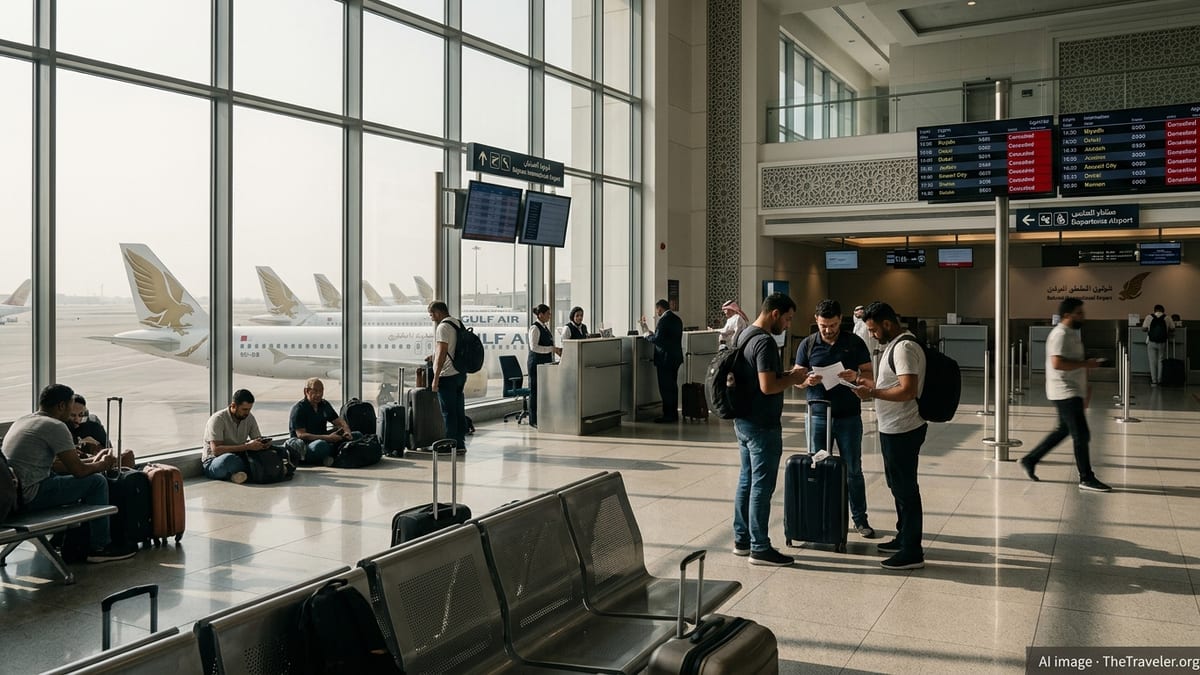
Hundreds of passengers were left stranded at Bahrain International Airport after Gulf Air cancelled 98 flights amid an ongoing closure of Bahraini airspace, disrupting connections across key Gulf routes and leaving travelers scrambling for alternatives to and from cities such as Riyadh, Dubai, Jeddah and Kuwait City.
Get the latest news straight to your inbox!
Grounded Schedules Ripple Across Gulf Air Network
Publicly available operational notices and industry briefings indicate that Gulf Air has cancelled 98 flights in its latest schedule adjustment, following weeks of disruption linked to the continued closure of Bahrain’s airspace. The airline, which uses Bahrain International Airport as its primary hub, has sharply reduced movements in and out of the kingdom, triggering widespread knock-on effects for regional and long-haul services.
The cancellations are understood to span a mix of short- and medium-haul routes, including high-frequency links between Bahrain and major Gulf cities such as Riyadh, Dubai, Jeddah and Kuwait City. With Bahrain acting as a connecting point for onward travel to Asia, Europe and the Indian subcontinent, the reduction in services has had an outsized impact on transit passengers who now face missed connections and unplanned overnight stays.
Operational summaries tracking Middle East airspace conditions describe Bahrain’s skies as effectively closed, with airlines forced either to reroute around the kingdom or halt services entirely. For Gulf Air, whose network is built around its Bahrain base, this has translated into a rare near-standstill at its home airport, with departure boards showing long blocks of cancellations in recent days.
While some regional carriers have been able to maintain limited frequencies by skirting affected airspace, the scale of Gulf Air’s reliance on Bahrain International Airport has left fewer options for maintaining its usual pattern of flights. The 98 cancelled services reported for the current operational window are part of a broader sequence of suspensions that began in late February and have rolled forward through March.
Passengers Face Overnight Delays, Missed Events and Changing Plans
Reports from travelers stuck in Bahrain describe crowded terminals, rapidly changing departure information and long waits at airline counters as Gulf Air works through rebooking and refund requests. Some passengers transiting through the kingdom en route to South and Southeast Asia have found themselves unexpectedly grounded, with alternative routings via other Gulf hubs in short supply due to wider regional disruption.
Travel forums and social media posts suggest that passengers bound for Riyadh, Dubai, Jeddah and Kuwait City have been particularly affected, as these are normally among the most frequent and heavily utilized routes in the airline’s network. With multiple daily services abruptly removed from the schedule, travelers report limited options to rebook on the same carrier, especially on peak travel days.
The disruption has also coincided with major events in Bahrain and nearby destinations, including sporting fixtures and business conferences that typically draw international visitors. Some travelers who had flown in for such events now face uncertainty about when they will be able to leave, while others have seen their trips cancelled before departure as flights were removed from the system.
For many, the most immediate challenge has been securing accommodation and updated travel plans at short notice. Accounts shared online describe families and solo travelers weighing whether to remain in Bahrain and await rescheduled flights or attempt complex overland and multi-airline routings through neighboring countries.
Workarounds via Saudi Arabia and Alternative Hubs
In response to the prolonged airspace closure, Gulf Air has begun operating a limited number of special services via King Fahd International Airport in Dammam, Saudi Arabia, according to airline advisories circulated to travel agents. These flights, mainly linking Dammam with London and other long-haul destinations, are being marketed to passengers whose journeys originate or end in Bahrain, with ground transportation arranged across the King Fahd Causeway in some cases.
Eligibility rules published in these advisories state that travelers must meet all entry and transit requirements for both Bahrain and Saudi Arabia, including any necessary visas. Ticket prices on the special services have been packaged to include transit permissions and ground transfers when passengers use Gulf Air’s arranged buses, although those traveling independently are responsible for securing their own documentation.
The workaround has offered a partial lifeline to some stranded travelers, particularly those needing to reach or depart from Europe. However, capacity remains limited compared with Gulf Air’s normal schedule out of Bahrain, and places on the Dammam services have been in high demand. Passengers are generally required to register interest in the special flights and wait for confirmation from the carrier before travel can be finalized.
Other airlines in the region have adjusted their own networks in light of the continuing airspace restrictions, with some long-haul services rerouted and others temporarily paused. Industry briefings note that flight paths over the northern Gulf and adjacent territories have been significantly constrained, contributing to a tight market for replacement seats for passengers affected by Gulf Air’s cancellations.
Refunds, Rebooking Windows and Passenger Rights
Gulf Air has issued updated guidance to travel partners detailing rebooking and refund options for those whose plans have been disrupted by the closure of Bahrain’s airspace. Circulars shared within the trade reference tickets issued on or before late February for travel dates extending from 28 February through early March, specifying that passengers are permitted to change their journeys without penalties or additional fare differences within defined rebooking windows.
The same advisories outline refund possibilities for fully unused and partially used tickets on cancelled flights, including provisions for full refunds to the original form of payment for some passengers. Travel agents have been instructed to include specific remarks in booking records indicating that changes or refunds are due to the airspace closure, helping distinguish these cases from voluntary itinerary changes.
Despite the formal policies, traveler accounts suggest that processing times for refunds and alternative arrangements have varied. Some passengers report waiting several days or longer for confirmation of refunds or reissued tickets, particularly when bookings were originally made through online travel agencies rather than directly with the airline. These experiences reflect wider industry patterns during large-scale operational disruptions, where back-office systems and call centers often become congested.
Consumer advocates generally advise affected passengers to retain documentation of cancellation notices, receipts for additional expenses such as accommodation, and any correspondence with airlines or travel agents. In many jurisdictions, regulatory frameworks provide for compensation or reimbursement when flights are cancelled for reasons within an airline’s control, though large-scale airspace closures and security-related restrictions can fall into more complex categories.
Outlook for Bahrain International Airport and Regional Connectivity
Security and aviation analyses published in recent weeks describe Bahrain’s airspace as among several in the region subject to continuing restrictions linked to the broader Middle East security environment. These assessments highlight that airspace closures by Bahrain and neighboring states have forced airlines to review overflight permissions, adjust routings and in some cases suspend routes entirely.
For Bahrain International Airport, the impact goes beyond immediate passenger disruption to broader questions about connectivity and confidence in the hub’s reliability. With Gulf Air’s network sharply curtailed, the airport has seen a substantial reduction in international frequencies at a time when regional travel demand had been steadily rebounding.
Industry observers note that the longer the airspace restrictions persist, the more challenging the recovery could become. Airlines typically rebuild capacity in phases, and network planners may be cautious about restoring frequencies until there is clarity and stability in regional airspace management. This, in turn, could affect tourism flows and business travel links between Bahrain and major Gulf cities such as Riyadh, Dubai, Jeddah and Kuwait City, as well as onward connections to Europe and Asia.
For now, travelers with upcoming itineraries involving Bahrain International Airport and Gulf Air are being urged, in public guidance and media coverage, to monitor their bookings closely, check airline and airport channels for schedule updates, and explore flexible alternatives where possible. With 98 Gulf Air flights already cancelled in the current cycle and further changes possible, the situation remains fluid for passengers across the region.