

More news on this day
Passengers across Bahrain, Dubai, Abu Dhabi, Jeddah and Istanbul are facing extended delays and last minute itinerary changes as Gulf Air cancels around 20 flights in response to ongoing airspace restrictions and regional security concerns in the Middle East.
Get the latest news straight to your inbox!
Airspace Closures Ripple Through Gulf Air’s Network
Publicly available aviation updates indicate that Bahrain’s continuing airspace closure has forced Gulf Air to pare back its schedule and ground a significant share of its fleet. Bahrain International Airport, the airline’s home hub, remains at the center of the disruption, limiting the carrier’s ability to operate its normal connecting-bank structure across the Middle East and beyond.
These constraints are unfolding against the backdrop of a broader regional crisis that has seen portions of airspace in the Gulf and wider Middle East intermittently shut or heavily restricted. Analyses by aviation and risk consultancies in early March 2026 describe widespread cancellations and diversions at major airports in the United Arab Emirates, including Dubai and Abu Dhabi, as well as in neighboring states, following a sharp escalation in regional tensions.
Within this environment, Gulf Air has concentrated on protecting a reduced core schedule while cancelling or consolidating other services. The result is a rolling wave of disruption at key transit points, particularly for passengers whose itineraries rely on smooth connections through Bahrain.
Although some Gulf-based and international carriers have begun operating limited repatriation or ad hoc services to move stranded travelers, available schedules show that Gulf Air’s operations remain significantly constrained, magnifying the impact on its own customers.
Key Routes Affected and Approximate Scale of Cancellations
Based on published schedules and airport information for the current week, roughly 20 Gulf Air flights across the region are understood to have been cancelled or removed from sale, with a concentration on services linking Bahrain to major Gulf and regional hubs. These include flights touching Dubai, Abu Dhabi, Jeddah and Istanbul, all of which normally function as important origin, destination or secondary transit points for the carrier’s network.
The most heavily affected segment appears to be Bahrain originating and arriving services. Typical daily rotations between Bahrain and Dubai, Abu Dhabi and Jeddah have seen multiple cancellations, leading to gaps in what is usually a dense schedule. Istanbul, which serves as both a point-to-point market and a connecting gateway to Europe, has also seen Gulf Air frequencies curtailed as the airline prioritizes limited airspace slots and aircraft availability.
In some cases, airport departure boards and third party flight tracking platforms show last minute cancellations announced only a few hours before departure. This pattern has particularly impacted passengers in transit, who arrive from an earlier sector only to find their onward Bahrain flight withdrawn or retimed, leaving them stranded airside or forced to seek overnight accommodation at short notice.
While the precise list of cancelled flight numbers continues to evolve as the situation develops day by day, the affected portfolio spans both short haul regional links and selected longer haul connections that rely on Bahrain as a central hub. Travelers booked on Gulf Air routes touching Bahrain, Dubai, Abu Dhabi, Jeddah or Istanbul this week are therefore being advised in public advisories and airline communications to assume a high risk of timetable changes.
Conditions on the Ground at Bahrain, Dubai, Abu Dhabi, Jeddah and Istanbul
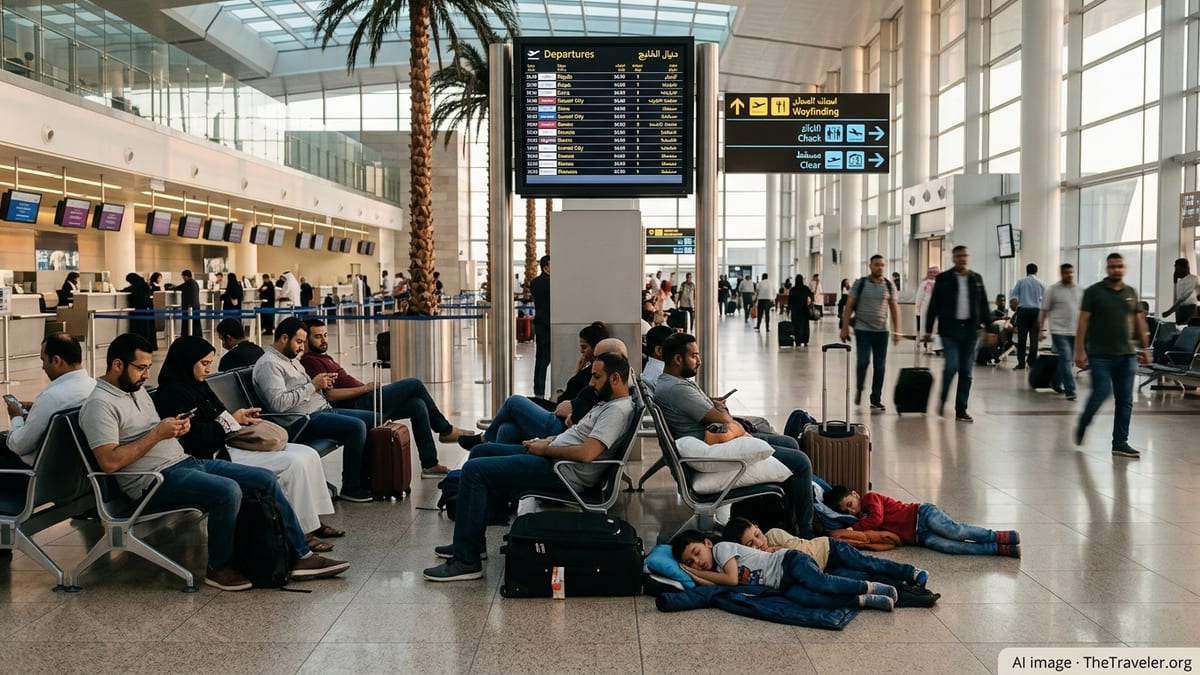
Scenes from social media posts, airport webcams and local news photography show crowded terminal halls at major Gulf and regional hubs, with passengers queuing at transfer desks and airline counters in search of rebooking options. In Bahrain, where regular Gulf Air operations have been the most directly hit by the airspace closure, travelers report extended waits for information and limited same day alternatives.
At Dubai International Airport and the new Abu Dhabi hub, the knock on effects of the Bahrain disruption are compounded by broader regional airspace issues. Some carriers have mounted special repatriation and relief flights, but many of these services are either fully booked or prioritized for passengers whose flights have already been cancelled earlier in the disruption, leaving limited room for those affected by the latest Gulf Air schedule changes.
In Jeddah, the impact is most visible among passengers using the city as a departure point or connection for religious travel or onward links to South and Southeast Asia. Cancellations on Bahrain legs can break entire long haul itineraries, forcing travelers to either wait for Gulf Air to offer an alternative routing or to purchase new tickets on other airlines where capacity allows.
Istanbul’s role as a major European and regional hub means that any Gulf Air cancellations there can quickly snowball into bottlenecks, particularly for passengers attempting to connect between Europe and South Asia or the Indian Ocean region via Bahrain. Airport information screens have shown gaps where Gulf Air flights would normally appear, and local travel agents report a rush for remaining seats on other carriers serving Gulf destinations.
What Stranded Gulf Air Passengers Can Do Now
Given the fluid nature of the disruption, travel industry guidance consistently emphasizes the importance of monitoring booking status directly through the airline or the issuing travel agency before heading to the airport. For Gulf Air passengers, this means checking the most recent flight status on the carrier’s digital channels and keeping contact details updated so schedule changes or cancellations can be communicated promptly.
Where a flight has already been cancelled, publicly available policy summaries for similar regional disruptions suggest that passengers are typically offered a choice between free rebooking on a later date, rerouting via an alternative station where feasible, or a refund of the unused portion of the ticket. In the current situation, rerouting options may be limited due to broader airspace restrictions, so many travelers are opting for date changes or refunds and securing new itineraries on carriers that are currently operating.
Passengers who are already at the airport or in transit and find their Gulf Air segment cancelled are generally advised by travel experts to approach a transfer desk or service counter inside the secure area as soon as possible, as same day alternatives are often allocated on a first come, first served basis. Retaining boarding passes, cancellation notifications and any receipts related to meals or accommodation may also be helpful for later claims, depending on the final form of the airline’s disruption policy.
Those who booked through online travel agencies or third party platforms may need to work through those channels rather than directly with Gulf Air for changes or refunds. In such cases, customer service wait times can be significant, and some passengers are turning to chatbot functions or messaging apps where available to avoid long telephone queues.
Planning Upcoming Trips Amid Ongoing Uncertainty
For travelers with Gulf Air tickets in the coming days and weeks, especially on routes involving Bahrain, Dubai, Abu Dhabi, Jeddah or Istanbul, travel planners are recommending a cautious approach. Public guidance from aviation and consumer organizations stresses that airspace closures and security related restrictions can change rapidly, and schedules may be adjusted with limited notice.
One commonly suggested strategy is to build in additional buffer time for critical journeys, such as onward long haul connections or events with fixed dates, and to avoid tightly timed self planned transfers between separate tickets. Where possible, choosing routings that offer alternative same day options on other airlines or via different hubs can also provide a degree of resilience if a Gulf Air sector is cancelled.
Travel insurance with robust trip interruption and cancellation benefits is emerging as another key consideration. Policies differ, but some products may cover additional expenses associated with hotel stays, meals or new tickets when disruption is linked to security incidents or government mandated airspace closures. Travelers are being encouraged to review policy wording carefully to understand what is and is not covered in the current context.
With regional experts forecasting that air travel across parts of the Middle East may remain volatile for several weeks, passengers booked on Gulf Air are likely to face a prolonged period of uncertainty. Staying informed through official airline updates, monitoring airport advisories and considering flexible travel arrangements can help mitigate the impact of any further wave of cancellations affecting Bahrain and its connected hubs.