

More news on this day
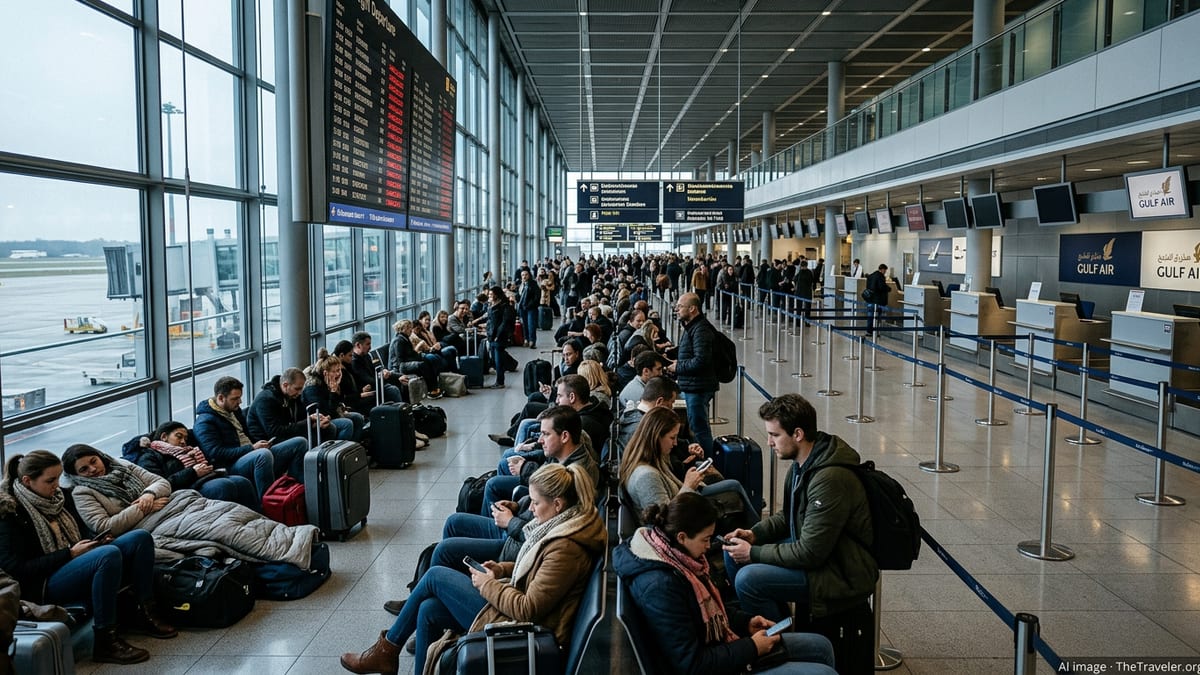
Thousands of passengers were left sleeping on terminal floors and queuing for scarce rebooking options this weekend as widespread Gulf Air cancellations and ongoing Middle East airspace restrictions rippled through major European hubs, stranding travelers at airports in Frankfurt, Paris, London and Manchester and disrupting journeys across Germany.
Gulf Air Scraps 97 Flights as Bahrain Airspace Stays Shut
Gulf Air has cancelled at least 97 flights in recent days after Bahrain kept its airspace effectively closed amid heightened regional security concerns, forcing the Bahraini flag carrier to ground much of its network and triggering knock-on disruption across Europe. Airline and airport officials said the cancellations were concentrated on services linking the Gulf to major European gateways, including Frankfurt, Paris Charles de Gaulle, London Heathrow and Manchester, where thousands of transit passengers had been relying on connections to reach long haul destinations.
With Bahrain International Airport operating only emergency and limited repositioning services, Gulf Air has focused on ad hoc repatriation efforts, using aircraft routed via alternative Gulf airports such as Dammam and Riyadh to move stranded travelers onward to cities including Cairo, Larnaca, Mumbai and Delhi. These irregular operations have helped clear a fraction of the backlog but have done little to ease mounting crowds at European hubs where passengers report long queues at transfer desks and scarce information about when normal schedules will resume.
Travel industry analysts say the airline faces a complex restart once restrictions ease, as it must reposition aircraft and crews, renegotiate slots and rebuild connecting banks, all while honoring rebooking obligations and refund requests from customers whose trips were cancelled at short notice. That process is expected to take days rather than hours, raising the prospect of continued patchy service on core routes into Germany, France and the United Kingdom.
Frankfurt, Paris, London and Manchester Hubs Under Strain
Frankfurt Airport, one of Europe’s busiest long haul transfer hubs, has emerged as a focal point of the disruption. Grounded or delayed Gulf Air services have coincided with reduced operations from other Gulf carriers, leaving departure boards punctuated with cancellations and sending passengers in search of scarce seats on remaining flights to the Middle East, Asia and Africa. Airport staff have set up additional assistance points in transfer zones, but queues for rebooking often stretch across concourses as airlines work through complex multi leg itineraries.
In Paris, Charles de Gaulle has seen a similar squeeze, with disrupted flights to Bahrain, Doha and Dubai feeding into congested security lanes and crowded gate areas. Air France and several partner airlines have trimmed or rerouted services that would normally overfly affected airspace, adding to the operational stress. Travelers arriving from North America and Africa have found onward connections to the Gulf overbooked or cancelled entirely, forcing many to accept overnight accommodation or multi stop reroutes through less affected hubs.
London Heathrow and Manchester have also been hit hard. Heathrow, a key departure point for Gulf bound corporate and leisure travelers, has experienced clusters of cancellations to Bahrain and other regional destinations, while some flights that did operate were heavily oversold with displaced passengers from earlier days. At Manchester, which serves as an important secondary gateway for northern England and Scotland, the loss of direct Gulf Air capacity has disrupted holidaymakers and migrant workers heading to South Asia via the Gulf, with many forced to travel by rail to London or Frankfurt to pick up alternative flights.
German Cities Beyond Frankfurt Feel the Shockwaves
The disruption has not been confined to Frankfurt. Secondary German cities with strong Gulf links, notably Munich and Berlin, are also feeling the impact as airlines adjust schedules and redeploy capacity in response to the Bahrain shutdown and wider airspace constraints. Passengers connecting through Munich to reach Gulf Air and partner services have reported last minute schedule changes, with some flights retimed or rerouted to avoid congested corridors, resulting in missed connections and extended layovers.
In Berlin, where long haul connectivity has historically been more limited, Gulf related cancellations have highlighted the city’s reliance on a small number of key routes to the Middle East. Travel agents said clients booked on itineraries involving Bahrain were being shifted onto alternative carriers via Istanbul, Cairo or Riyadh, often at inconvenient times and with longer total journey durations. Hoteliers near both Munich and Berlin airports reported an uptick in last minute bookings from stranded passengers provided with vouchers by airlines struggling to clear backlogs.
German business groups have voiced concern about the ripple effects on trade and investment travel, noting that Gulf hubs play an outsized role in linking German exporters to markets in South and Southeast Asia. While many urgent corporate trips are being rebooked onto alternative routings, companies warn that continued uncertainty could dampen attendance at trade fairs and delay site visits in the coming weeks.
Regional Airspace Crisis Fuels Global Travel Turmoil
The immediate trigger for Gulf Air’s mass cancellations has been the closure or restriction of key airspace corridors across the Gulf region in response to recent military escalations involving Iran, Israel and Western forces. Aviation authorities in Bahrain and neighboring states introduced sweeping flight bans and routing limitations at the end of February, effectively severing many of the high traffic paths used by long haul carriers to connect Europe, Asia and Africa. While some Gulf airlines, including Emirates, Etihad and Qatar Airways, have begun operating limited repatriation and relief flights along newly designated safe corridors, their schedules remain heavily curtailed.
This partial restart has created a patchwork of capacity that favors a small number of primary hubs and priority passengers, leaving many travelers with existing bookings still stranded. Qatar Airways has announced targeted flights from Doha to European cities such as London, Paris and Frankfurt, prioritizing families, elderly travelers and those with medical or humanitarian needs. Emirates and Etihad have resumed reduced schedules to select European destinations, but have warned that seats will be allocated first to customers whose earlier flights were cancelled, with very limited availability for new bookings.
For Gulf Air, without the same scale of fleet and route flexibility, the combination of airspace closures and competitive pressure from larger regional rivals has left little room to operate anything beyond sporadic repatriation services. Industry observers say the airline will likely have to rely on interline agreements and alliances to move stranded passengers via partner hubs until Bahrain can fully reopen its skies.
Passengers Face Long Queues, Patchy Communication and Limited Options
At airports in Frankfurt, Paris, London and Manchester, stranded passengers have described a familiar pattern of disruption: long queues at service desks, rapidly changing departure boards and limited communication from airlines stretched thin across time zones. Many travelers said they first learned of cancellations via app notifications or third party booking platforms only after arriving at the airport, leaving them scrambling to secure accommodation or alternative transport during already busy travel periods.
Consumer advocates in Germany, France and the United Kingdom have urged airlines to proactively inform passengers of schedule changes and to honor obligations under regional passenger rights rules, including duty of care provisions for meals and lodging. However, they acknowledged that the cross border nature of many Gulf itineraries, which combine European and non European carriers on a single ticket, can make enforcement complex and leave passengers uncertain about which airline bears responsibility.
Travel agents and online booking platforms reported a surge in calls from customers asking whether future trips via Gulf hubs should be rerouted or postponed. While many carriers are offering flexible rebooking and waiver policies, inventory on alternative routings is tightening, particularly on routes linking Europe with India, Pakistan and Southeast Asia ahead of peak holiday periods. Experts advise travelers with imminent departures to monitor airline updates closely, confirm flights before heading to the airport and consider routing through less affected hubs where possible.