

More news on this day
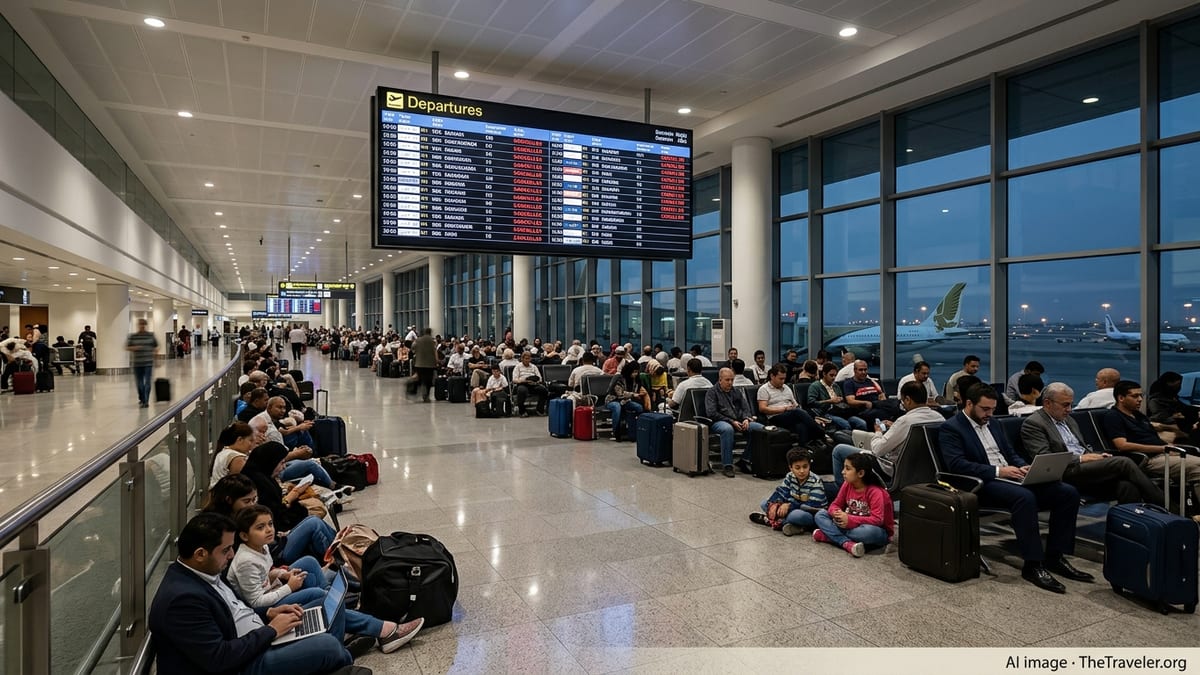
Gulf Air’s decision to cancel 93 flights in recent days, as regional tensions curtail airspace across the Gulf, has left hundreds of passengers stranded at Bahrain International Airport and major transit hubs including Dubai International and Riyadh’s King Khalid International, adding fresh disruption to an already fragile Middle East aviation network.
Get the latest news straight to your inbox!
Rapid Escalation of Disruptions Across the Gulf
The latest wave of cancellations by Gulf Air comes against the backdrop of intensified conflict involving Iran and several Gulf states, which has triggered repeated airspace closures, air-defense activity and heightened security restrictions across the region. Publicly available information shows that Bahrain has been among the states targeted by Iranian missile and drone attacks, prompting precautionary measures that have sharply constrained commercial flying.
According to published coverage on the broader aviation impact, multiple Gulf airspaces, including parts of Bahrain, the United Arab Emirates, Qatar and Kuwait, have at times been restricted or closed to routine traffic, diverting or grounding thousands of flights. Within this environment, Gulf Air has curtailed large portions of its schedule, including at least 93 flights in a short window, in order to keep aircraft and crews out of potential risk corridors.
The result has been an abrupt thinning of connections through Bahrain International Airport, traditionally positioned as a regional transfer point between Asia, the Indian subcontinent and Europe. With neighboring hubs such as Dubai and Doha also operating strongly reduced schedules due to war-related limitations, options for rerouting have become severely constrained for many travelers.
Reports from passenger forums and regional media describe scenes of confusion as departure boards fill with red cancellations, staffed check-in counters sit idle for suspended routes, and travelers queue at service desks for scarce rebooking options. While airports in the Gulf remain technically open in many cases, the usable network of flights has shrunk dramatically, especially for itineraries that previously relied on Bahrain as a midway stop.
Where Travelers Are Stranded and Which Routes Are Hit
Passengers affected by Gulf Air’s cancellations are concentrated at several key airports: Bahrain International, Dubai International, Riyadh’s King Khalid International, and to a lesser extent other regional gateways such as Dammam’s King Fahd International. Bahrain, as Gulf Air’s home hub, has seen the steepest immediate impact, with large portions of the carrier’s short- and medium-haul network temporarily dropped from the schedule.
Travelers connecting between India, Pakistan and European cities via Bahrain appear particularly exposed. Publicly available passenger accounts describe itineraries from Mumbai and other South Asian origins to European destinations being disrupted when the Bahrain leg was removed, leaving few same-day alternatives. Some travelers have been advised to consider itineraries via Saudi airports or to postpone travel entirely until conditions stabilize.
In the United Arab Emirates, Dubai International has already been operating at a fraction of its normal volume because of conflict-related damage and airspace restrictions reported in recent weeks. With Gulf Air cancelling additional flights into and out of Dubai, passengers who might previously have shifted to or from Bahrain via Dubai have found that workaround eroded. At Riyadh’s King Khalid International, disruptions have been less visible on departure boards but are still significant for those relying on Gulf Air as a connector between Saudi Arabia and other Gulf or European markets.
Routes most affected include Bahrain links to Dubai, Riyadh, Dammam and key South Asian and European cities. Regional reports and traveler discussions also point to knock-on effects for codeshare or interline journeys, where a Gulf Air sector is just one leg of a multi-airline ticket. When that single leg disappears, the entire itinerary can become unusable, adding complexity for passengers trying to rebook or seek refunds across several carriers at once.
How Gulf Air Is Adjusting Operations and Fleet Positioning
According to publicly available information on the airline’s response, Gulf Air has repositioned portions of its fleet away from Bahrain to airports in neighboring Saudi Arabia as a protective measure and to keep aircraft available for limited services. This kind of temporary basing shift allows the carrier to operate select routes that avoid the most heavily restricted airspace, even while routine schedules from Bahrain remain largely suspended.
Passenger reports indicate that the airline has explored limited operations via Dammam’s King Fahd International, using the Saudi airport as a temporary staging point for flights to long-haul destinations such as London or major Indian cities. These flights are reported to operate at far lower frequencies than pre-crisis schedules and are subject to rapid change as the regional security picture evolves.
At the same time, Gulf Air has introduced more flexible commercial policies to cope with the scale of disruption. Information shared with customers shows that the airline is allowing free date changes and, in many cases, cancellations for travel originally scheduled during March, reflecting the uncertainty around when normal flying patterns might resume. For many passengers, this policy window has become a critical tool for deciding whether to wait out the disruption or abandon trips altogether.
Even with these measures, the airline’s timetable remains highly volatile. Schedules that appear active several days ahead can still be withdrawn at short notice if airspace conditions deteriorate or if neighboring states tighten restrictions. Travelers are therefore finding that planning around Gulf Air currently involves monitoring flight status repeatedly in the days and hours before departure.
What Affected Passengers Can Do Right Now
For travelers whose Gulf Air flights have been cancelled, the primary immediate steps involve confirming eligibility for rebooking or refunds and identifying alternative routes that avoid the most restricted airspace. Publicly available traveler guidance suggests checking booking status directly through the airline’s digital channels or with the travel agency that issued the ticket, as some itineraries can be reprotected on later Gulf Air services or rerouted via different gateways.
Given the wider regional turmoil, however, straightforward like-for-like rebooking within a day or two is increasingly uncommon. Many passengers are instead opting to postpone travel by several weeks, taking advantage of fee waivers, or to seek refunds and book fresh itineraries with carriers operating from less affected regions. Where overland options exist, such as transiting by road between Bahrain and Saudi Arabia to reach alternative airports, travelers have reported using these as bridges to functioning parts of the global network.
Travel specialists note that anyone with essential travel in or out of the Gulf should build in significant buffers, prepare for last-minute cancellations, and keep documentation of all airline communications and receipts. With multiple carriers across the region revising schedules every few days, flexibility on dates, departure points and even final destinations is becoming a crucial factor in successfully completing journeys.
At the airport level, passengers are advised in publicly available advisories to arrive with extra time, prepare for limited amenities in some terminals, and ensure access to reliable digital communication where possible, given that call centers and in-person desks are heavily burdened. Many travelers stranded by the Gulf Air cancellations have turned to social media and online forums for real-time updates on which routes and airports are actually functioning on a given day.
Outlook for Gulf Air and Regional Aviation
The longer-term outlook for Gulf Air and Middle East aviation hinges on how quickly regional tensions ease and airspace restrictions are lifted. Economic analyses of the conflict’s impact indicate that Gulf airspace closures have already caused thousands of daily cancellations and disruptions on a scale not seen since the early months of the COVID-19 pandemic, affecting not only point-to-point travel but also the intricate web of connections that make Gulf hubs central to global aviation.
For Gulf Air, the immediate priority appears to be safeguarding its fleet, maintaining a skeleton network where safe and viable, and honoring obligations to passengers through flexible policies. If security conditions improve and air defenses can scale back intensive operations around key airports, the airline could, in time, rebuild a more typical schedule through Bahrain and neighboring hubs.
Yet publicly available commentary from aviation analysts suggests that war-risk insurance costs, infrastructure damage at some regional airports and lingering traveler hesitancy may weigh on recovery even after missile and drone activity subsides. Airlines may be cautious about restoring high-frequency operations into certain corridors, and passengers may continue to favor routes that bypass conflict-adjacent airspace.
In the near term, travelers booked on Gulf Air in March and potentially into April should expect further adjustments and monitor their reservations continuously. Until broader regional stability returns, the 93 cancelled flights are likely to be only one chapter in a longer period of unsettled schedules across Bahrain, Dubai, Riyadh and much of the wider Middle East.