

More news on this day
Air travel across the Gulf lurched into chaos overnight as sudden airspace closures forced Dubai, Doha and other key regional hubs to suspend flights, leaving aircraft diverted mid-route and thousands of passengers stranded in airports worldwide.
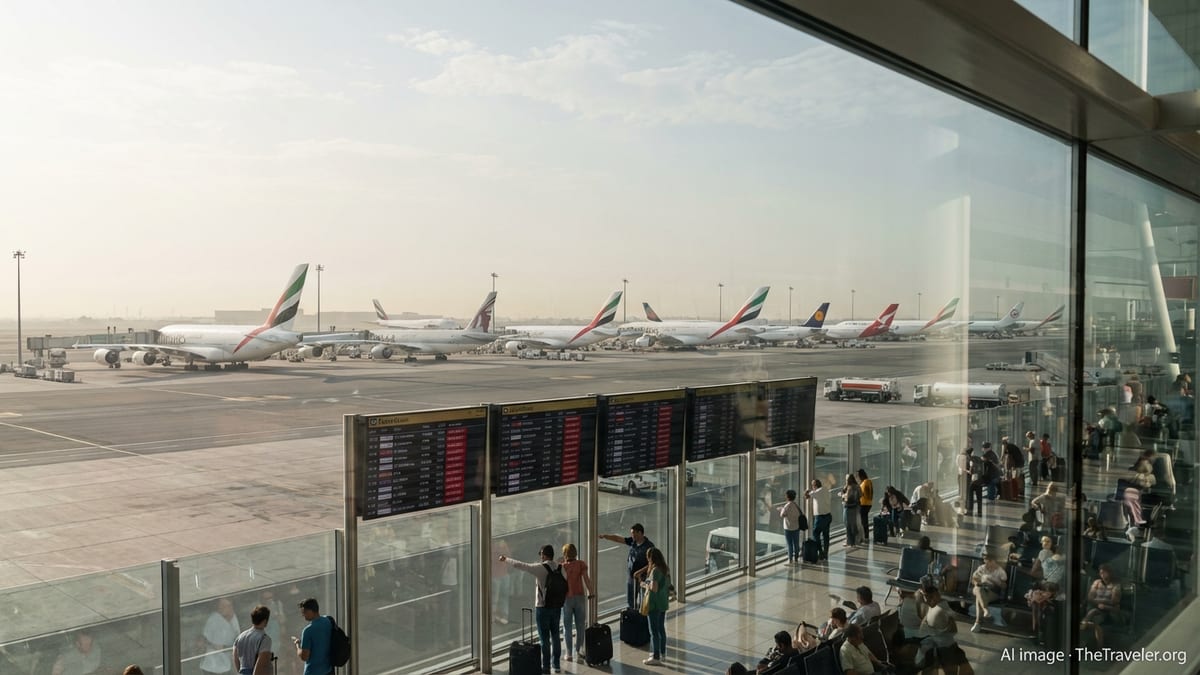
Sudden Airspace Shutdown Paralyzes Gulf Hubs
Authorities in the United Arab Emirates, Qatar and several neighboring states ordered sweeping airspace restrictions in the early hours of Saturday, February 28, following coordinated U.S.-Israeli strikes on Iran and subsequent missile launches across the region. Within hours, flight-tracking maps showed vast, uncharacteristic gaps over some of the world’s busiest corridors for long-haul travel between Europe, Asia and Africa.
Dubai International Airport and Dubai World Central Al Maktoum, which together normally handle hundreds of thousands of passengers a day, suspended all departures and arrivals until further notice as the UAE’s aviation regulator moved to partially close national airspace. Airport operators urged travelers not to come to the terminals and instead seek updates directly from their airlines as terminal concourses began filling with stranded passengers.
In Doha, Qatar Airways halted operations to and from Hamad International Airport after Qatari authorities imposed a full airspace closure as a precaution amid active military operations and missile interception activity. Bahrain, Kuwait, Iraq and Iran also enacted full or near-total closures, effectively sealing off large sections of the Gulf and northern Middle East to civil aviation.
Regional aviation officials have stressed that the measures are temporary and framed as safety-first responses to the risk of misidentification, falling debris or further strikes. However, with no clear timeline for a full reopening, the shutdown has already triggered one of the most significant single-day disruptions to Gulf aviation in years.
Emirates, Qatar Airways and Global Carriers Forced to Reroute
Home carriers Emirates and flydubai confirmed they had suspended all operations to and from Dubai, freezing the world’s busiest international hub at a standstill. Abu Dhabi-based Etihad Airways reported widespread disruption at Zayed International Airport, cancelling or delaying departures and turning back inbound aircraft where necessary after the UAE’s partial airspace closure took effect.
Qatar Airways announced a temporary suspension of flights to and from Doha, saying it was working closely with state authorities and deploying additional staff to assist passengers at Hamad International. The airline warned that once restrictions ease, initial flights would likely depart off-schedule and that knock-on delays could persist for days as aircraft and crews are repositioned.
The shockwaves spread quickly to European and Asian carriers that rely on Gulf hubs as connecting waypoints. Lufthansa, Air France, KLM, British Airways and Virgin Atlantic all reported cancellations or suspensions on routes touching the region, with several airlines extending pauses on flights to Tel Aviv, Beirut, Muscat and Dubai into the coming days. Low-cost and leisure operators have also begun scrubbing services or plotting lengthy detours to avoid closed skies.
Budget and regional airlines are not immune. Turkish carriers confirmed cancellations to the UAE, Qatar, Kuwait, Oman and multiple Levant destinations through the weekend, while other operators based in Istanbul, Cairo and Jeddah scrambled to rework schedules. Industry analysts say the concentration of global capacity through Gulf hubs means that even short-lived closures can ripple across networks on multiple continents.
Passengers Stranded as Journeys Lengthen and Plans Unravel
For travelers, the abrupt shutdown translated into scenes of uncertainty from Sydney to London. Long-haul flights already en route to Dubai and Doha were diverted to alternate airports or ordered to return to their points of origin, leaving passengers facing unplanned stopovers, missed onward connections and last-minute hotel scrambles.
At Gulf hubs, terminals quickly filled with travelers sleeping on benches or slumped over luggage trolleys as departure boards flicked from delayed to cancelled. Airport authorities in Dubai and Doha advised passengers to stay away from the terminals unless specifically instructed to travel, citing limited capacity and the need to prioritize those already airside or in transit.
Airlines have begun rolling out flexible rebooking and refund policies, waiving change fees and urging customers to manage disrupted itineraries through apps and call centers. However, with aircraft and crew displaced around the globe and spare seats at a premium on unaffected routes, many passengers are being warned that alternative options may be days away.
Travel advisories from governments in Europe, North America and Asia are also shifting rapidly. Several foreign ministries have urged citizens to defer non-essential travel to the Gulf and surrounding region and to register their details if already on the ground. Insurance companies are advising policyholders to check coverage terms related to war risks and airspace closures as they navigate cancellation costs.
Operational Headaches and Rising Costs for Airlines
Behind the scenes, operations control centers are grappling with a complex puzzle of safety restrictions, crew duty limits and fuel planning. With Iran, Iraq and large sections of Gulf airspace effectively off-limits, many Europe to Asia flights are being forced to detour south over the Arabian Sea or north via the Caucasus and Central Asia, adding hours of flying time and significantly higher fuel burn.
The disruption comes at a time when many carriers were already contending with long detours around Russian airspace due to the ongoing Ukraine conflict. Aviation consultants warn that the loss of Middle East shortcuts further squeezes already thin margins for long-haul operations, with airlines facing higher insurance premiums, extra crew costs and greater exposure to delays.
Industry analysts note that while a short, sharp disruption may be financially manageable, a prolonged period of restricted airspace around the Gulf would challenge route economics and aircraft utilization for both regional giants and foreign carriers. Cargo operations, heavily reliant on Gulf hubs for east west trade flows, are likely to feel the strain quickly, particularly for time-sensitive shipments.
Airlines are trying to balance safety and regulatory obligations with protecting their networks from cascading delays. Schedulers are trimming frequencies, consolidating services and, in some cases, temporarily withdrawing widebody aircraft from affected routes until a clearer picture emerges of how long the restrictions will last.
Uncertain Timeline as Regulators Warn of High Risk
European and international safety regulators have issued fresh conflict-zone advisories for the Middle East and Gulf, warning of elevated risk to civil aviation due to active military operations and the potential for miscalculation. Operators are being urged to avoid affected skies entirely or to fly only with heightened caution and contingency fuel reserves where limited corridors remain open.
Gulf governments have not specified when full normal operations might resume. Officials in the UAE and Qatar have characterized the closures as precautionary and subject to continuous review in coordination with defense and aviation agencies, but have stopped short of offering firm timelines. Airlines are planning on a rolling, day-by-day basis, updating schedules as regulatory notices are issued.
For now, the region’s glittering mega-hubs stand in stark contrast to their usual around-the-clock bustle, with rows of grounded widebody jets parked at remote stands and unusually quiet skies overhead. Travel experts say that once airspace gradually reopens, the recovery will be uneven, with priority given to repatriation flights, high-demand trunk routes and repositioning of aircraft and crew.
Until that happens, passengers booked to transit through Dubai, Doha or other Gulf gateways are being urged to closely monitor airline communications, keep plans flexible and prepare for the possibility that journeys which once relied on the Gulf’s seamless connectivity may involve longer, more complicated routings in the days ahead.