

More news on this day
Hundreds of passengers across the Gulf are stranded after Gulf Air cancelled 121 flights this week, compounding a wider Middle East aviation shutdown triggered by regional conflict and rolling airspace restrictions.
Get the latest news straight to your inbox!
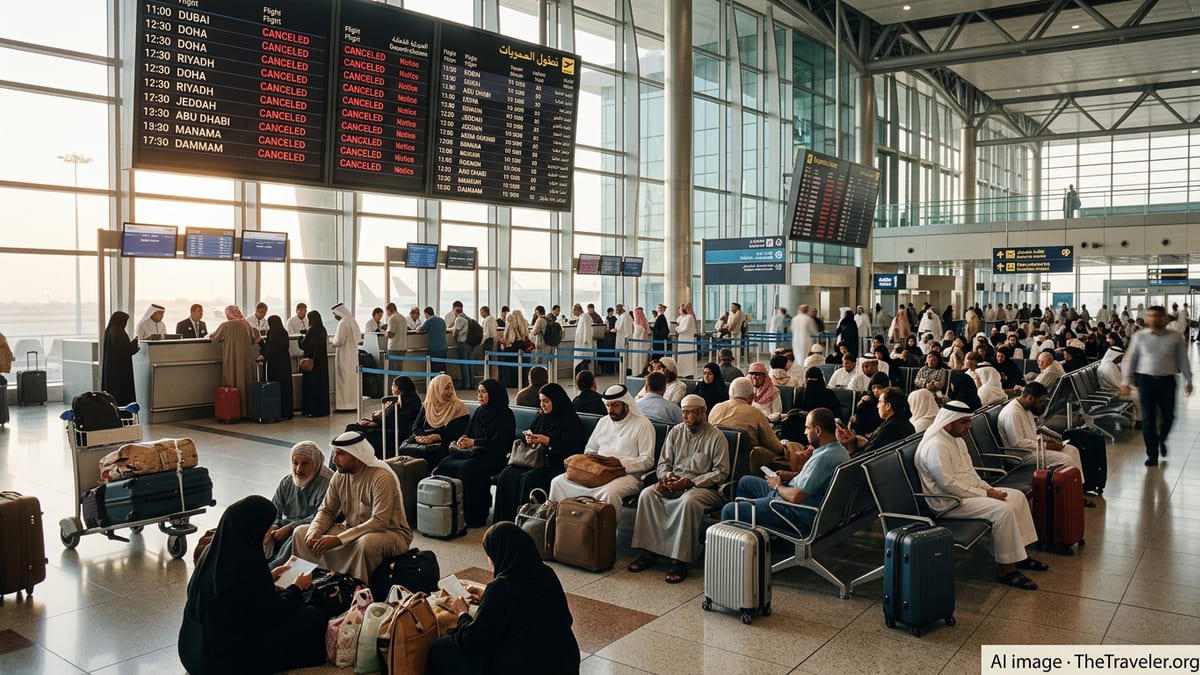
Mass Cancellations Hit Gulf Air Network
Gulf Air’s latest disruption has cascaded across its core network, with cancellations affecting flights in and out of Dubai, Doha, Riyadh, Jeddah, Abu Dhabi, Manama and Dammam. The Bahrain based carrier has scrubbed 121 services over several days, according to regional aviation bulletins and airline updates, choking off key corridors used by business travelers, expatriate workers and tourists.
Operational notices indicate that many of the cancelled flights were short haul regional hops that normally operate multiple times daily, meaning passengers lost not just one departure but several onward options. With airport access tightly controlled in several Gulf states, many travelers discovered their cancellations only after long waits in terminals or via last minute notifications on airline apps.
While Gulf Air has pledged to rebook affected customers “at the earliest opportunity” and to offer refunds or travel vouchers in some cases, overstretched call centers and limited spare capacity mean that many travelers remain in limbo. Stranded passengers at Bahrain International Airport and other hubs have reported long queues at service desks and difficulty securing clear information about when normal operations might resume.
The cancellations come at a time of peak demand for regional travel, with school holidays and business events still drawing heavy traffic. Industry analysts say the sudden loss of more than a hundred Gulf Air rotations in a matter of days has had an outsized impact on connectivity across Bahrain, Saudi Arabia, Qatar, the United Arab Emirates and beyond.
Passengers Stuck at Dubai, Doha and Saudi Gateways
Nowhere are the disruptions more visible than at the region’s mega hubs. At Dubai International Airport, where Gulf Air normally feeds traffic into a dense web of onward connections, departure boards have shown repeated Bahrain bound services marked as cancelled, leaving travelers to scramble for seats on the few operating flights run by other carriers. Airport authorities have urged people not to come to the terminal unless they have confirmed, operational bookings, in an effort to prevent overcrowding.
In Doha, a limited schedule of repatriation and special flights has done little to ease congestion for passengers whose Gulf Air itineraries have collapsed. With Qatar Airways also operating on a reduced timetable and prioritizing citizens and residents on many routes, foreign visitors and transit passengers report being pushed onto waiting lists or told to monitor availability day by day.
Saudi Arabia’s main gateways in Riyadh, Jeddah and Dammam have meanwhile become bottlenecks for those trying to reach or leave the kingdom. Local authorities and airport staff are contending with a patchwork of cancellations by multiple airlines, including Gulf Air, while national carriers adjust their own schedules in response to evolving airspace restrictions. Travelers arriving from outlying cities are often finding that their connecting flights to Gulf hubs no longer exist, forcing unplanned overnight stays and additional costs.
At Abu Dhabi’s Zayed International Airport, which has already seen extensive suspensions by European and Asian airlines, Gulf Air’s pullback further reduces options for onward travel. Some passengers have reported being routed on circuitous journeys via South Asia or Europe, adding many hours to trips that would ordinarily be short direct hops across the Gulf.
Regional Conflict and Airspace Closures Fuel Ongoing Chaos
The latest wave of disruption is rooted in the broader security crisis engulfing the region. Since late February, a series of military escalations and cross border attacks involving Iran, Gulf states and Western allies has prompted aviation regulators to impose partial or full closures of key air corridors across the Middle East. Airlines have been forced either to cancel flights outright or to send aircraft on long detours that strain crews, raise fuel costs and disrupt aircraft rotations.
Carriers in the United Arab Emirates, Qatar, Bahrain, Kuwait, Oman and Saudi Arabia have all issued rolling advisories over the past two weeks, suspending or limiting services to multiple cities. Gulf Air, whose network is heavily concentrated in the affected zone, has been particularly exposed, with several of its most important routes crossing or bordering restricted airspace.
While some airlines have been able to mount limited repatriation and relief flights, the operating environment remains volatile. Airport closures, air defense activity and short notice regulatory changes mean that flight plans approved one day can be rendered unusable the next. Airline executives privately acknowledge that, for now, they are planning schedules in 24 to 48 hour blocks rather than weeks ahead, making it difficult to give stranded customers firm commitments.
Aviation experts warn that even if airspace gradually reopens, the recovery of regular commercial schedules will lag behind. Aircraft and crew have been displaced across multiple continents, maintenance cycles disrupted and slots at congested airports forfeited. For Gulf Air and its regional peers, restoring the intricate web of short haul connections that underpin Gulf mobility is likely to take far longer than simply lifting a no fly notice.
Knock On Effects Across Qatar, Saudi Arabia, Oman and Kuwait
The impact of Gulf Air’s cancellations and the wider air travel shutdown extends far beyond the airports where flights are grounded. In Qatar and Saudi Arabia, travelers reliant on regional link flights for medical care, education and business are facing missed appointments and lost income. Travel agents in Doha and Riyadh say corporate clients are postponing site visits and contract negotiations because staff cannot reliably get in and out of the region.
In Oman and Kuwait, where direct links to Gulf hubs are a lifeline for onward travel to Europe and Asia, the thinning of services has left many residents effectively cut off from usual routes. Some are turning to far flung alternatives, piecing together itineraries via South Asian or African cities that still have open corridors, often at much higher prices and with long layovers.
Tourism boards across the Gulf are also bracing for a wave of cancellations as visitors abandon plans rather than navigate the uncertainty. Hotels near airports in Dubai, Abu Dhabi and Manama report that their guests are increasingly transient and unplanned: travelers booked for one night while they wait for a standby seat or a confirmed repatriation flight, rather than vacationers with weeklong stays.
The disruption to passenger traffic has knock on effects for cargo as well, since much freight in the region moves in the belly of passenger aircraft. Logistics firms say rerouted or cancelled flights are delaying shipments of everything from auto parts to perishables, adding a supply chain headache to the region’s security concerns.
Airlines Race to Repatriate and Rebook
As stranded passengers grow more vocal, airlines across the Gulf are scrambling to demonstrate that they are doing everything possible to get people moving again. Gulf Air has announced that it is working with partner carriers to place passengers on alternative services where seats are available, and has signaled that additional special flights may be added once security clearances are secured.
Other regional and international airlines have already stepped in with repatriation operations focused on key hubs such as Dubai, Abu Dhabi and Jeddah. Extra sections are being mounted on routes to India, Europe and Southeast Asia, though demand continues to outstrip the limited capacity on offer. Priority is often being given to families with children, elderly travelers and those with urgent medical or humanitarian needs.
Consumer advocates across the Gulf say that while the security driven nature of the crisis complicates compensation claims, airlines still have a responsibility to communicate clearly, offer realistic rebooking options and provide basic care at airports. They are urging travelers to use official airline channels and verified travel agents rather than turning to social media rumors or informal intermediaries, which can leave passengers vulnerable to fraud or misinformation.
For now, the message from airlines and aviation authorities is consistent: travelers with flights in or through the Gulf should expect continued disruption in the coming days, monitor their bookings closely and avoid heading to the airport unless they have a confirmed, operating flight. With Gulf Air’s 121 cancellations rippling across the region, the restoration of normal air mobility in the Middle East remains a distant prospect.