

More news on this day
Thousands of passengers remain stranded across the Gulf after a wave of cancellations by Gulf Air and EgyptAir left Bahrain International Airport effectively cut off and triggered knock-on disruption at major hubs in Dubai, Riyadh, Dammam, Jeddah and Kuwait City.
Get the latest news straight to your inbox!
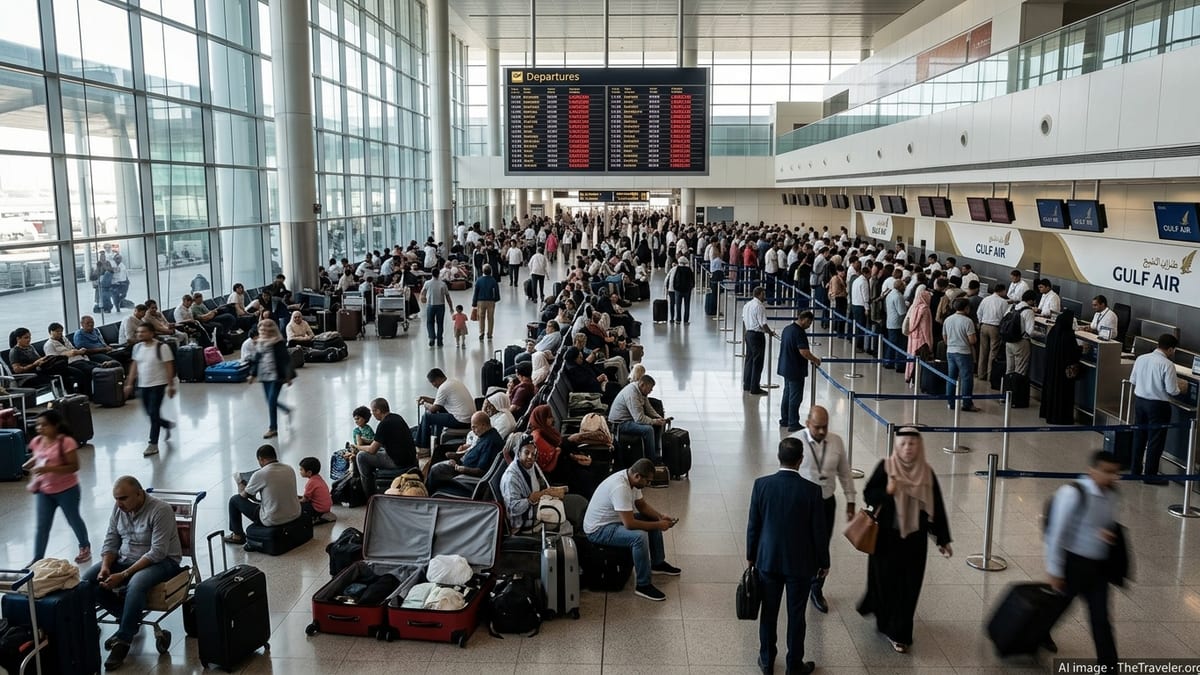
Regional Airspace Turmoil Leaves Bahrain Hub Isolated
Travel disruption across the Middle East intensified this month as Bahrain’s airspace closure halted regular operations at Bahrain International Airport, a key transfer point for traffic between Europe, Asia and the Indian subcontinent. Publicly available aviation data and travel-industry updates indicate that more than 100 flights operated by Gulf Air and EgyptAir have been canceled or rerouted in recent days, with at least 104 individual services scrubbed on certain peak days as carriers respond to rapidly shifting airspace restrictions.
The shutdown of Bahrain’s skies forms part of a wider pattern of partial and full airspace closures affecting several Middle East and North Africa states following a sharp escalation in regional tensions. Analysis by aviation consultants and mobility advisories shows thousands of flights canceled across the region since the start of March, with Bahrain among the most severely affected due to its role as Gulf Air’s home base and its positioning on some of the busiest east-west corridors.
With Bahrain International Airport’s normal schedule largely suspended, stranded passengers have reported crowded terminals, limited rebooking options and mounting uncertainty over when regular services will resume. Social media posts and passenger accounts describe long queues at airline desks, overbooked hotels in Manama and rising demand for alternative routes out of the country via neighboring states.
Gulf Air Grounding and EgyptAir Cuts Trigger Cascade of Cancellations
Gulf Air, Bahrain’s national carrier, has been among the hardest hit by the disruption. Passenger communications and airline advisories circulating online state that the airline has temporarily suspended the bulk of its scheduled network while Bahrain’s airspace remains restricted, effectively grounding regular services to and from its home hub. Flight-tracking snapshots from recent days show large blocks of Gulf Air departures and arrivals listed as canceled, including key links to Dubai, Riyadh, Jeddah, Dammam and Kuwait City.
EgyptAir has also pared back operations on select Middle Eastern routes, trimming services to Gulf destinations as carriers adjust to changing flight paths and overflight permissions. Mobility alerts and corporate travel guidance note that Egypt’s airspace itself remains open, but the airline has canceled multiple regional rotations that normally rely on now-disrupted corridors over parts of the Gulf and wider Middle East.
The combined effect of these changes is a notable reduction in capacity across some of the region’s busiest point-to-point and connecting markets. Analysts tracking schedule data report waves of cancellations grouped around specific days, with some tallies pointing to 104 or more flights axed by Gulf Air and EgyptAir across a short period as airlines react in near real time to evolving safety and regulatory assessments.
For passengers, the pattern often translates into repeated last-minute cancellations and rebookings. Travelers connecting through Bahrain have reported receiving multiple itinerary changes, only to see subsequent replacement flights also removed from the schedule, compounding delays and complicating onward travel planning.
Major Gulf Hubs Feel the Strain as Passengers Seek Alternate Routes
While Bahrain International Airport bears the brunt of the immediate impact, the knock-on effects are being felt at larger regional hubs. Operational updates, schedule data and on-the-ground accounts indicate that airports in Dubai, Riyadh, Dammam, Jeddah and Kuwait City have all experienced waves of cancellations, diversions or sudden surges in demand as passengers attempt to reroute.
Dubai International, one of the world’s busiest international airports, has seen a patchwork of service resumptions alongside continued cancellations on certain routes. Limited operations by major carriers have resumed on select days, but the airport continues to handle a backlog of stranded travelers from neighboring states, including Bahrain, as well as passengers whose flights were canceled mid-journey.
In Saudi Arabia, Riyadh and Dammam have emerged as critical alternatives for passengers seeking to bypass Bahrain. Travel forums and airline communications reference special or temporary services operating via King Fahd International Airport in Dammam, which is connected to Bahrain by the King Fahd Causeway, allowing some travelers to complete part of their journey by road before flying onward.
Jeddah and Kuwait City have also reported irregular schedules, with cancellations linked both to their own airspace constraints and to the broader rerouting of long-haul traffic across the region. The result is a complex and shifting route map in which traditional nonstops are sometimes replaced by multi-leg itineraries that rely on pockets of open airspace, often at short notice.
Stranded Travellers Face Accommodation, Visa and Cost Challenges
For thousands of travelers, the operational complexity translates into very personal challenges. Reports from passengers across social media, online forums and local news coverage describe uncertain waits at Bahrain International Airport and other Gulf hubs as travelers scramble for information on their rights, rebooking options and access to basic services such as accommodation.
In Bahrain, travelers whose connecting flights have been canceled are often left to navigate hotel availability in Manama, which has tightened considerably during peak disruption days. Some travelers describe being advised to seek overland routes to Saudi Arabia in order to access flights from Dammam or Riyadh, a strategy that may require last-minute visa arrangements and additional transport costs.
Elsewhere in the region, passengers transiting through Dubai, Jeddah or Kuwait City have faced the prospect of extended stays in airport hotels or temporary accommodation while awaiting seats on reduced schedules. Travel advisories issued to corporate clients recommend that travelers build in flexibility, remain prepared for multi-day delays and retain documentation of expenses for potential reimbursement under airline policies or travel insurance.
The situation is particularly acute for travelers with limited-entry visas, expiring residence permits or urgent personal commitments. In some cases, passengers describe being separated from checked baggage during rapid rebookings, adding an extra layer of logistical pressure to already strained journeys.
What Travellers Can Do as Disruptions Continue
With regional airspace conditions still fluid, travel experts and industry observers advise that passengers treat schedules across Bahrain and neighboring hubs as subject to change at short notice. Publicly available guidance from airlines, airports and corporate mobility providers encourages travelers to monitor flight status tools closely and to avoid traveling to airports without a confirmed, operating departure.
Passengers booked on Gulf Air or EgyptAir services are being urged by various travel advisories to check for eligibility for refunds, alternative routing or future travel credits, depending on fare conditions and the nature of the cancellation. Many airlines in the region have activated flexible rebooking policies, although availability is constrained by the reduced number of operating flights.
Travel-management firms recommend that those with imminent travel to or through Bahrain, Dubai, Riyadh, Dammam, Jeddah or Kuwait City review their itineraries with airlines or agents and consider contingency plans, including travel via alternative hubs where feasible. For essential trips, travelers are advised to allow extra time for security checks, possible diversions and longer, more circuitous routings required to avoid restricted airspace.
As regional authorities and aviation regulators continue to reassess risk and gradually reopen certain corridors, industry commentary suggests that schedules may stabilize in phases rather than in a single step. Until then, passengers moving through the Gulf’s major airports are likely to face an extended period of disruption, with Bahrain International Airport remaining at the center of one of the most significant aviation interruptions the region has seen in recent years.