

More news on this day
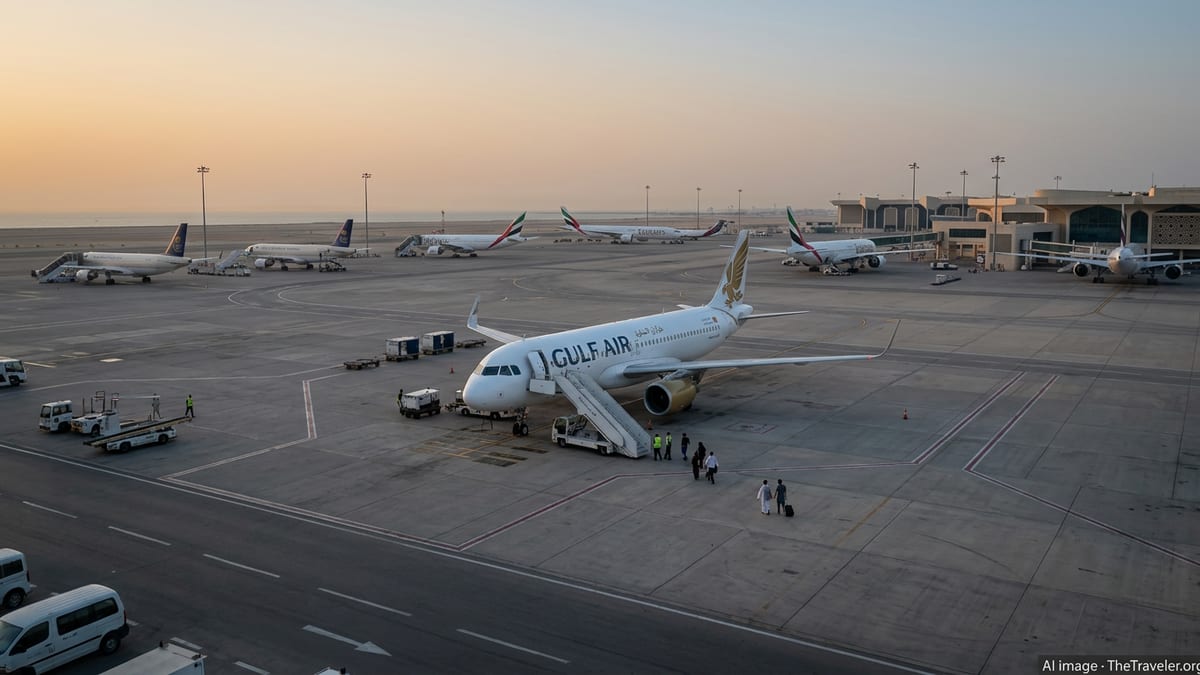
Gulf Air is extending a patchwork network of special flights from Dammam in Saudi Arabia as Bahrain’s airspace remains closed in March 2026, creating an improvised lifeline for stranded travelers across the Gulf and beyond.
Get the latest news straight to your inbox!
Bahrain Airspace Closure Reshapes Gulf Air’s Network
The ongoing closure of Bahrain’s airspace in early March 2026 has effectively frozen normal operations at Bahrain International Airport, the home hub of Gulf Air. Publicly available aviation advisories indicate that the Bahrain Flight Information Region remains restricted to civilian traffic, with notices extended until further notice as regional tensions continue.
According to industry coverage and operational updates from logistics and aviation trackers, Gulf Air initially grounded the bulk of its schedule as the airspace restrictions took hold. The airline repositioned much of its fleet out of Bahrain to airports in neighboring Saudi Arabia, including Dammam and Riyadh, to safeguard aircraft and preserve options for limited services once alternative routings became viable.
The wider regional picture remains volatile. Briefings from regulators and risk-assessment platforms describe multiple Gulf airspaces operating under severe constraints or full closure, following missile and drone activity that has affected civilian infrastructure. Against this backdrop, the continuation of any commercial passenger services requires careful route planning, use of open corridors, and close coordination with air navigation authorities.
For Gulf Air, the loss of Bahrain as an operational hub has forced a rapid pivot from a centralized model to a dispersed, contingency-based approach. Dammam has emerged as the most practical staging point for selected flights, particularly those serving high-demand South Asian markets where large numbers of passengers were left in transit.
Dammam Emerges as a Temporary Gateway for Gulf Air
As Bahrain’s skies remain off-limits, Gulf Air has increasingly relied on King Fahd International Airport in Dammam as a temporary operating base. Aviation data services and regional business media report that the airline has mounted a series of limited services from Dammam, designed primarily to move passengers already holding Gulf Air tickets rather than to reopen full commercial sales.
Among the most visible examples has been the operation of special flights between Dammam and Karachi. Coverage in regional business outlets in early March highlighted a dedicated Dammam–Karachi rotation, framed as an exceptional option for travelers whose original itineraries via Bahrain had been disrupted. Subsequent social media reports and passenger accounts suggest that similar one-off or short-series flights to other destinations, including major South Asian and European points, have been organized as capacity and airspace constraints allow.
Industry intelligence platforms that track aircraft movements indicate that a small subset of Gulf Air’s narrowbody fleet has been reactivated from storage locations to operate these Dammam-based services. Flight-tracking data shows patterns of rotation from Dammam to select cities before aircraft reposition to other Saudi airports or remain on the ground awaiting further deployment, underscoring how fluid and tactical the operation has become.
For travelers, the shift has turned Dammam into an unexpected hub. While Saudi airports are themselves operating under restrictions in certain sectors of national airspace, public advisories describe Dammam as open to limited international services, making it one of the few viable launch points for Gulf Air in the current environment.
Extended Operations Aim to Support Stranded Passengers
The main objective of Gulf Air’s extended Dammam operations is to provide relief for passengers stranded by the Bahrain shutdown, rather than to restore a full commercial timetable. According to published coverage from aviation and business news outlets, the airline has prioritized repatriation-style flights and onward connectivity for those with pre-existing bookings, particularly travelers who began their journeys before the escalation of the regional crisis.
Reports from travel forums and social media channels indicate that some passengers are being moved by road from Bahrain to Dammam to access these special flights, under tightly managed arrangements. Accounts from individuals describing their journeys mention coordinated transfers, dedicated check-in arrangements at Dammam, and a strong emphasis on flexibility, with routing and departure times subject to last-minute change.
Public statements and advisories shared through airline-facing bulletins point to a range of customer options for affected travelers, including rebooking within specified windows and refund eligibility for those unable or unwilling to use the Dammam services. Travel agents and corporate travel managers in the region have been advising clients to monitor their booking status closely, as seat availability on the special flights remains limited.
While the scale of operations from Dammam is modest compared with Gulf Air’s pre-closure schedule from Bahrain, the continuation and extension of these flights into mid-March represent a notable attempt to maintain a minimal network presence. For many passengers, a seat on a Dammam-operated service may be the only near-term route out of the region using their existing Gulf Air ticket.
Regional Airspace Constraints Continue to Limit Options
The viability of extended Dammam operations is tightly linked to the wider airspace picture across the Gulf. Safety bulletins issued by European and international aviation regulators describe complex restrictions affecting multiple Flight Information Regions, including Bahrain and several neighboring states. These documents advise operators to avoid affected zones at all altitudes, reflecting concerns about potential conflict-related hazards.
Logistics advisories published for freight and supply-chain customers also underline the scale of disruption. Several note that Bahrain’s airspace and main airport remain effectively closed to regular commercial travel, while Saudi Arabia’s airports, including Dammam, are characterized as open but constrained. Airlines across the region, from full-service carriers to low-cost operators, have announced suspensions or severe reductions of services to a range of Gulf destinations as a result.
In this context, each Gulf Air flight that departs from Dammam represents the outcome of complex, case-by-case routing decisions. Carriers must ensure compliance with evolving notices to air missions, balance safety considerations with operational feasibility, and navigate increasingly congested alternative corridors as traffic is funneled away from closed or high-risk airspace.
The uncertainty also makes long-term planning difficult. Between shifting security assessments and the possibility of additional airspace adjustments, airlines have been cautious about scheduling beyond short horizons. Gulf Air’s decision to extend, rather than permanently schedule, Dammam operations reflects this environment, allowing the carrier to ramp activity up or down depending on how the situation develops.
What Travelers Should Know Before Flying via Dammam
For passengers considering travel that involves Gulf Air and Dammam in March 2026, publicly available guidance from airlines, airports, and travel advisories underlines the importance of real-time information. With schedules changing frequently, travelers are being encouraged to rely on official airline channels, airport notices, and recognized flight-tracking tools to verify whether their flights are operating.
Reports from recent travelers highlight several practical realities. Road transfers from Bahrain to Dammam can be arranged but may involve lengthy processing times at the border and variable journey durations, depending on traffic and security measures. Once at Dammam, airport operations are described as orderly but busy, with queues at check-in and security reflecting the concentration of displaced passengers from across the region.
Travel industry commentary suggests that passengers should plan for additional contingency time, carry essential documents in both digital and paper form, and be prepared for last-minute changes in routing or departure time. Those with imminent travel dates are widely advised to maintain close contact with their airline or travel agent, as options such as rebooking on alternative carriers or postponing travel may become available as policies evolve.
While Gulf Air’s extended Dammam operations do not yet restore the connectivity that Bahrain once provided, they offer a critical, if limited, bridge for travelers seeking to leave or reach the region during an exceptional disruption. How long these stopgap measures remain necessary will depend on developments in the regional security situation and the eventual reopening of Bahrain’s airspace to normal traffic.