

More news on this day
Gulf Air has extended its temporary ex-Dammam flight network until April 30, 2026, maintaining a limited but critical lifeline for passengers affected by the ongoing closure of Bahrain’s airspace.
Get the latest news straight to your inbox!
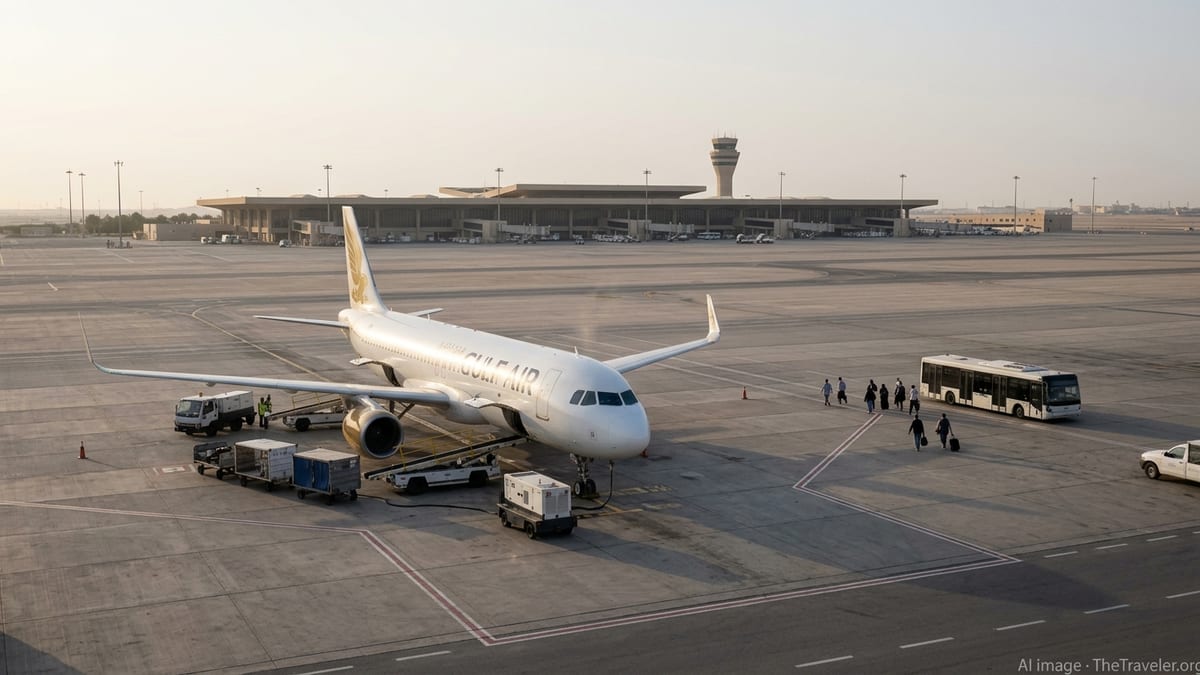
Extension Underscores Ongoing Bahrain Airspace Disruption
The decision to keep ex-Dammam operations in place through the end of April reflects the continuing uncertainty around when Bahrain’s airspace will fully reopen. Since late February 2026, the regional security situation has triggered sweeping airspace restrictions across parts of the Gulf, forcing airlines to redesign networks and find interim gateways.
Publicly available information shows that Gulf Air shifted a portion of its activity to King Fahd International Airport in Dammam in March 2026, initially as a short-term response intended to move stranded passengers and reposition aircraft. As the closure persisted, those flights evolved into a modest commercial schedule linking Dammam with select destinations in the Middle East and South Asia.
Reports indicate that the extension to April 30 effectively prolongs this contingency network for another month, giving travelers more options while regular services to and from Bahrain remain suspended. The move highlights how regional carriers are balancing safety considerations with mounting pressure to restore connectivity for residents, expatriate workers, and transfer passengers.
Industry observers note that the Dammam arrangement remains a workaround rather than a substitute for Gulf Air’s hub in Bahrain, but the additional operating window provides some predictability in an otherwise fluid environment.
What the Extended Ex-Dammam Schedule Means for Travelers
For passengers, the extension to April 30, 2026 means that existing booking and rebooking strategies centered on Dammam are likely to remain valid for several more weeks. Travelers who had been re-routed via King Fahd International Airport can continue to plan around these flights rather than face yet another round of abrupt itinerary changes.
According to published coverage, Gulf Air has been focusing its ex-Dammam flying on routes with strong demand from labor, family, and transit traffic, including select cities in Pakistan, the wider Gulf, and key regional hubs. Limited-capacity special services, such as flights between Dammam and Karachi, have provided alternatives for passengers who would otherwise have had no direct path back to their original itineraries.
The extended window also gives travelers holding flexible tickets more time to decide whether to proceed with journeys in March and April or opt for refunds and future travel credits, depending on each fare’s conditions. With schedules across the region still in flux, many passengers are weighing whether to travel now on longer, more complex routings or postpone trips until airspace patterns stabilize.
Travel advisors suggest that even with the extension, it remains essential for passengers to monitor their booking status right up to departure, as aircraft types, flight numbers, and timings out of Dammam can change on short notice as airlines respond to shifting operational constraints.
Operational Challenges at King Fahd International Airport
The continued ex-Dammam operations also place King Fahd International Airport at the center of a broader regional rerouting effort. In recent weeks, the airport has accommodated a mix of special, rescue, and temporary commercial flights as carriers adjust to closed or restricted airspace elsewhere in the Gulf.
Reports on current operations describe a complex traffic pattern at Dammam, with airlines juggling altered routings, additional ground handling requirements, and evolving slot times. For Gulf Air, extending flights from Dammam until April 30 requires ongoing coordination around crew positioning, maintenance support, and passenger handling in a location that was not originally designed to serve as the airline’s primary operational base.
Airport stakeholders have been working to absorb the additional demand, but capacity remains finite. Travelers passing through Dammam during this period may encounter longer queues at check-in and security, along with busier transfer facilities, particularly during peak departure banks when multiple airlines concentrate operations.
Despite these constraints, continuing to use Dammam as a temporary platform enables Gulf Air to maintain a tangible presence in the market, keep some aircraft and crews productively deployed, and support customers whose travel plans depend on the airline’s regional network.
Regional Airlines Adapt as Airspace Restrictions Persist
Gulf Air’s extension of ex-Dammam flights through April 30, 2026 fits into a wider pattern of Middle Eastern and international airlines revising schedules, cancelling certain routes, and opening temporary gateways in response to the evolving airspace picture. Carriers across the Gulf have adjusted frequencies, re-routed long-haul services, and in some cases suspended flying to select destinations into late April.
Publicly available airline and airport advisories show that many operators are using a combination of limited special services and flexible booking policies to manage customer disruption. Airlines have offered date changes and refunds over extended travel windows, reflecting expectations that irregular operations may persist for several more weeks.
Within this context, Gulf Air’s Dammam initiative is one of several improvised solutions aimed at maintaining at least partial connectivity for key origin and destination markets. By locking in the current arrangement until the end of April, the airline signals that it expects a gradual, rather than immediate, return to normal hub operations in Bahrain.
Analysts note that the situation remains dynamic, and any improvement in the security environment or airspace access could prompt further schedule adjustments. For now, however, the extension provides a clearer time frame for passengers and partners planning travel through the Gulf in late March and April.
Guidance for Passengers Planning to Use Ex-Dammam Flights
For travelers considering itineraries on Gulf Air during this period, publicly available guidance from airlines, airports, and travel platforms stresses the importance of verifying every segment of a journey before departure. With the temporary network structured around Dammam, connections that once flowed smoothly through Bahrain may now involve additional stops or extended transit times.
Passengers are being encouraged to pay close attention to departure terminals, local check-in deadlines in Dammam, and any transit visa or entry requirements that could apply if schedules shift. Even when a ticket appears confirmed, last-minute operational changes remain possible, particularly in a region where airspace conditions can evolve quickly.
Travel information sources also highlight the value of allowing extra time between connecting flights, choosing routings with fewer critical connections where possible, and keeping contact details updated in airline booking profiles so that schedule changes can be communicated promptly.
As Gulf Air keeps its ex-Dammam flights in place until April 30, 2026, passengers who stay informed and build flexibility into their plans are likely to be best positioned to take advantage of the limited but vital connectivity that this temporary network continues to provide.