

More news on this day
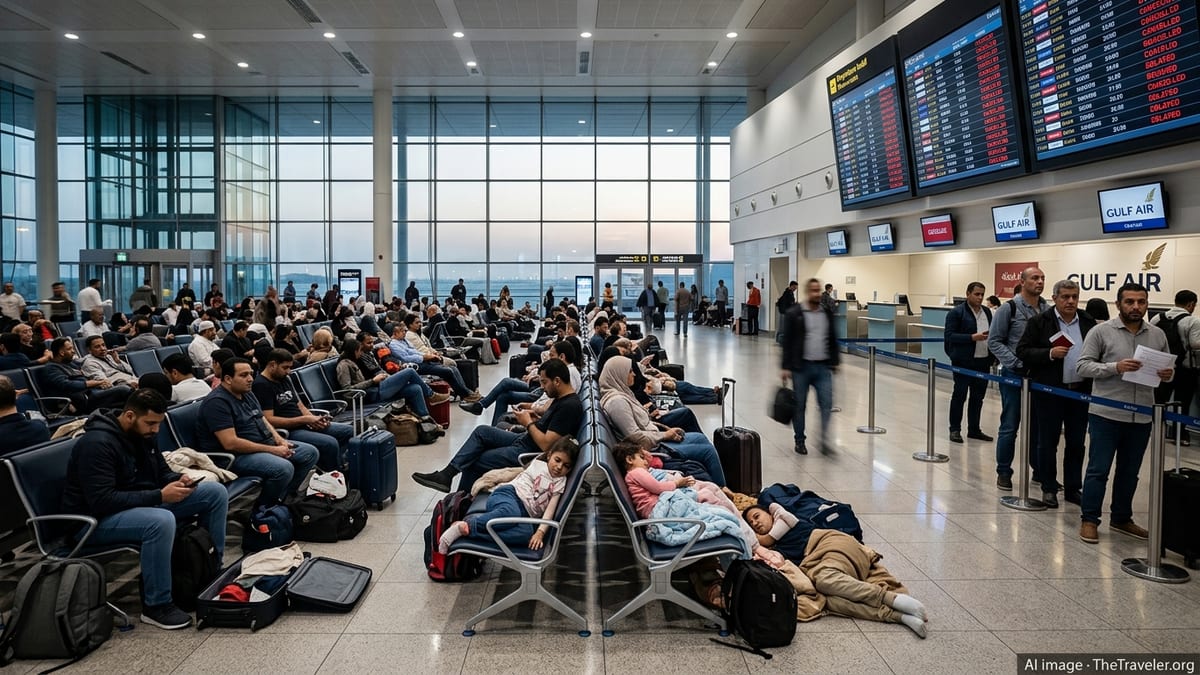
Passengers across the Gulf are facing extended delays and sudden itinerary changes after Gulf Air suspended 96 flights centered on Bahrain International Airport, disrupting key routes to Dubai, Riyadh, Doha, Kuwait City, Abu Dhabi and other regional hubs.
Get the latest news straight to your inbox!
Major Schedule Cut Hits Bahrain Hub
Publicly available flight information for late March 2026 shows Gulf Air operating a sharply reduced schedule at its Bahrain International Airport hub, with 96 flights withdrawn from service over a compressed period. The cuts span short and medium-haul routes that normally connect Bahrain with major Gulf capitals, as well as onward links to South Asia, Europe and the Caucasus.
Published coverage and aviation tracking data indicate that the suspensions are concentrated on services that would usually route through Bahrain as a primary transit point. This has disrupted itineraries not only for passengers starting or ending their journeys in Bahrain, but also for travelers using Gulf Air for one-stop connections between cities such as Dubai and Tbilisi, Mumbai and the Caucasus, and various South Asian origins and European destinations.
Online travel forums and social media posts from March 2026 describe Bahrain International Airport as open but operating under significant constraints, with far fewer departures than normal and a heavy reliance on other carriers or routings. For many travelers, that has meant last-minute cancellations, unexpected overnight stays, and rebookings on already crowded alternative flights across the region.
The disruption comes at a time when several Gulf airspaces and airports have faced intermittent closures and security-related constraints since late February 2026, creating knock-on effects for airlines that depend on dense regional connectivity.
Key Gulf Routes Severely Disrupted
Among the 96 suspended Gulf Air flights, a large share are understood to be on staple regional routes linking Bahrain with Dubai, Riyadh, Doha, Kuwait City and Abu Dhabi. These corridors typically see multiple daily frequencies and serve as vital feeders into the airline’s broader network, especially for South and Southeast Asian passengers connecting to Europe and vice versa.
Route data and booking system availability show that many Bahrain–Dubai and Bahrain–Abu Dhabi flights, in particular, have been temporarily removed or zeroed out for sale through the end of March. Travelers who had already booked these routes report receiving reissued tickets involving lengthy detours, in some cases adding an extra stop in a third country or pushing departure dates weeks into the future.
Connections to Riyadh, Doha and Kuwait City have also been thinned, reducing options for those attempting to reposition within the Gulf in order to access functioning long-haul services. Some passengers have turned to road links, including crossing the King Fahd Causeway to Saudi Arabia, to reach airports with more robust flight schedules.
These suspensions have further tightened capacity on remaining services operated by other Gulf carriers. Reports from passengers describe fully booked flights, higher last-minute fares and difficulty finding seats out of the region, especially for larger family groups and those traveling on non-flexible tickets.
Stranded Passengers Seek Alternative Exit Routes
Travelers caught in the disruption have shared accounts of being stranded in Bahrain and nearby Gulf cities for days or even weeks while waiting for replacement flights. Discussion threads on aviation and regional forums suggest that rebooking options have often involved long waiting times, partial refunds, or complex multi-leg itineraries via third-country hubs.
Some Gulf Air customers connecting through Bahrain have reported being rerouted via alternative carriers in Doha, Muscat, Jeddah or Istanbul when seats could be found, while others have been advised to wait for additional temporary services to be added. In a number of cases, passengers describe self-rebooking on competing airlines at their own expense in order to reach workplaces, schools or family commitments on time.
Limited local accommodation capacity has added to the strain. With multiple airlines in the region trimming schedules or consolidating flights, hotel rooms near major airports have become harder to secure at short notice. Travelers have reported resorting to longer-term stays with friends or relatives, or shifting to less central districts to find available rooms at affordable rates.
Consumer advocates and travel advisers following the situation online are encouraging affected passengers to keep detailed records of cancellations, communications and out-of-pocket expenses, given that policies on refunds, vouchers and duty of care can vary significantly depending on the point of sale and applicable regulations.
Temporary Operations via Dammam Highlight Regional Workarounds
As the disruption has continued, publicly accessible airline updates and passenger reports point to Gulf Air testing workarounds using neighboring airports. In mid-March 2026, multiple forum posts noted that the carrier had begun operating a limited number of services via King Fahd International Airport in Dammam, just across the causeway from Bahrain, to help move stranded travelers.
These temporary flights have primarily focused on high-demand routes, offering a partial lifeline for passengers able to travel overland between Bahrain and Saudi Arabia. However, capacity remains significantly below normal hub operations. Many journeys that would traditionally be completed in a single day through Bahrain now involve ground transfers, longer layovers and greater uncertainty around last-minute schedule changes.
The situation has underlined how tightly interconnected Gulf aviation networks are, with a disruption at one busy hub quickly spilling over into neighboring states. Published analysis of the wider Middle East airspace restrictions since late February suggests that it may take weeks or months for schedules across the region to fully stabilize, even as airlines experiment with temporary hubs and adjusted routings.
For travelers planning future trips that would normally connect through Bahrain, travel experts are advising flexible bookings, careful scrutiny of connection times, and consideration of alternative routings that avoid single points of failure wherever possible.
What Affected Travelers Should Monitor Next
With the suspension of 96 Gulf Air flights and the broader regional aviation disruption still unfolding, passengers are being urged by travel industry commentators to closely monitor airline channels and airport advisories in the coming days. Schedules for the remainder of March and early April remain fluid, and additional adjustments are possible as conditions evolve.
Publicly available information indicates that some carriers are gradually restoring select routes as operational conditions permit, while others extend cancellations on a rolling basis. Gulf Air has updated its booking policies to make certain March departures cancellable or changeable without standard penalties, according to passenger communications shared online, although terms can differ based on the original fare.
Travel planners note that those with imminent departures involving Bahrain should verify not only their Gulf Air segments, but also any codeshares or onward connections ticketed on partner airlines. Because many itineraries involve mixed carriers, a change on one leg can have cascading effects on the rest of the journey, including minimum connection times and eligibility for assistance.
As the situation develops, aviation analysts expect airlines across the Gulf to continue fine-tuning schedules, shifting capacity between regional hubs, and using temporary operational bases where feasible. For now, however, the suspension of dozens of Gulf Air flights remains a stark reminder of the fragility of tightly timed hub-and-spoke networks when geopolitical tensions and airspace constraints converge.