

More news on this day
Passengers across Oman are facing mounting disruption after Gulf Air and Flydubai canceled multiple services from Muscat, severing key links to Manama, Dubai, and other Gulf hubs as the wider regional airspace crisis continues.
Get the latest news straight to your inbox!
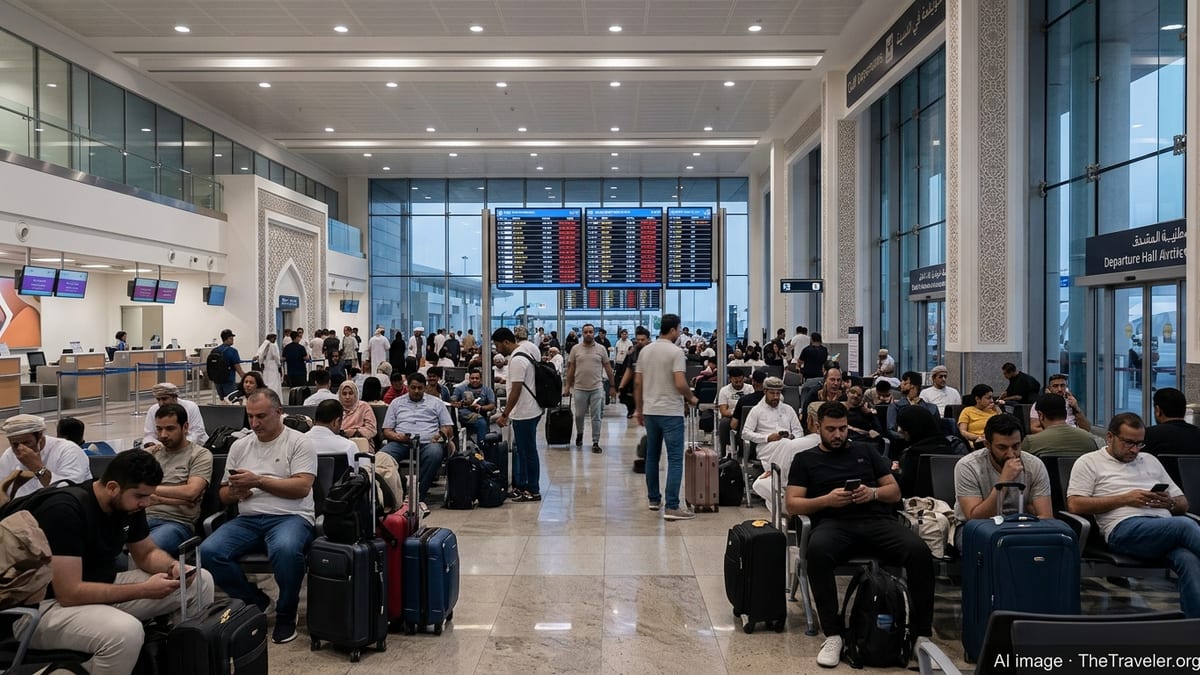
Regional Airspace Turmoil Hits Oman Hard
Oman, which initially served as a crucial alternative gateway during the recent wave of airspace restrictions across the Gulf, is now experiencing its own wave of disruption as carriers trim or cancel services. Publicly available industry updates show that ongoing missile and drone attacks in parts of the region have led to temporary closures or tight restrictions in several neighboring countries, forcing airlines to redraw flight plans and suspend selected routes.
Within this shifting landscape, flights that once made Muscat a convenient connection point to Bahrain and the United Arab Emirates are under renewed pressure. Travel advisories circulated to corporate clients in early March describe Muscat as functioning as a regional exit point while larger hubs such as Dubai and Abu Dhabi operated only limited schedules. As the crisis has dragged on, that fragile role has become harder to sustain, with some airlines now scaling back from Oman itself.
For passengers who chose Muscat as a safer or more reliable staging point just days ago, the latest cancellations are compounding uncertainty. Many are now confronting a second or even third round of itinerary changes, as links onward to Manama, Dubai, and other Gulf cities are curtailed or removed from schedules at short notice.
Nine Key Flights Cut as Gulf Air Adjusts Bahrain Links
Gulf Air, the flag carrier of Bahrain, has been particularly exposed to the conflict-driven restrictions affecting Bahraini airspace and surrounding flight corridors. Public posts on travel forums and airline communications shared with customers indicate that the carrier has progressively widened a temporary cancellation and refund window through late March, reflecting the continued operational challenges around Bahrain.
Within this context, at least nine Muscat services that previously fed passengers into the Manama hub have been withdrawn over recent days, according to traveler reports tracking changes on booking systems. These include a mix of Muscat to Manama departures and corresponding return flights that formed part of popular itineraries for onward travel to Europe, the Indian subcontinent, and other Middle Eastern destinations.
Travelers holding Gulf Air tickets from Muscat describe being notified of cancellations in successive waves, often starting with flights closest to departure before the airline extended disruption coverage to later dates. Some passengers report receiving options for full refunds or free rebooking onto dates beyond the current suspension window, while others say they are still waiting to see if later services will proceed as scheduled.
The loss of these Bahrain-bound flights is particularly significant for Oman-based travelers who rely on Gulf Air’s regional network and for visitors who had planned to exit the region via Manama. With nearby hubs constrained, each lost frequency from Muscat further reduces the pool of available exit routes and increases pressure on remaining services.
Flydubai Cuts Muscat Services Amid Reduced Dubai Operations
Low-cost carrier Flydubai, a key operator on the busy Muscat to Dubai corridor, is also paring back its Oman schedule as it navigates a reduced operating program from Dubai International Airport. Published coverage of aviation conditions in the United Arab Emirates indicates that Dubai resumed only a limited number of commercial flights in early March, prioritizing select routes and repatriation journeys while airspace restrictions and safety assessments continued.
Flydubai statements and customer updates cited in regional media and online advisories confirm that the airline has been running with a trimmed network and reduced frequencies, with Muscat among the destinations affected at various points in the rolling schedule changes. Passengers have shared accounts of Muscat–Dubai flights disappearing from timetables, being consolidated into fewer daily services, or being canceled outright as the carrier adjusts day by day to permitted operations.
The net effect for Oman-based travelers has been a sharp reduction in low-cost connectivity to Dubai, traditionally one of the most reliable and frequent short-haul links from Muscat. For many, Flydubai’s Muscat services serve not only point-to-point travel but also an affordable first leg into a vast web of onward routes from Dubai, meaning each cancellation can unravel multi-stop itineraries.
With both Gulf Air and Flydubai trimming Muscat operations, Oman’s position as a fall-back hub has weakened, and passengers are increasingly competing for seats on remaining services operated by other carriers or on the limited flights still available into and out of Dubai.
Passengers Face Isolation, Costly Detours and Long Delays
The immediate consequence of the latest cancellations is a growing sense of isolation among passengers scattered across Oman, from Muscat to regional cities that depend on the capital for international access. Reports on travel discussion boards describe travelers who had already diverted to Oman after previous cancellations in the United Arab Emirates or Bahrain now finding themselves stranded once again, with onward options shrinking by the day.
Some travelers recount turning to long overland journeys, including road trips between Dubai and Muscat or cross-border transfers to Saudi Arabia, when flights via Bahrain or the UAE fell through. Others have opted to rebook onto alternative carriers at substantially higher fares, particularly where a last-minute long-haul departure represents the only viable way home.
Accommodation and incidental costs are also mounting. With airline-operated relief flights and limited schedules often prioritizing passengers with earlier bookings, those who only recently shifted to Muscat may face several days’ wait before being re-accommodated. Travel insurance coverage varies widely, and many policies treat war-related airspace closures or missile-related disruption as exclusions, leaving affected passengers to absorb hotel, food, and visa extension expenses themselves.
At the same time, Oman’s own tourism and hospitality sector is feeling the impact of unpredictable arrivals and departures. Hoteliers in Muscat are seeing stays extended unexpectedly, while inbound group tours have reported cancellations or partial group arrivals when members cannot secure replacement flights. The uncertainty around air links to Manama and Dubai, two of the region’s principal connecting hubs, is complicating forward planning for both leisure and business visitors.
What Travelers Through Muscat Should Do Now
With the situation shifting day by day, publicly available guidance from travel management companies, airlines, and airports across the Gulf emphasizes the need for passengers to remain flexible and informed. Travelers holding Gulf Air tickets from Muscat are being encouraged, through published advisories, to monitor booking status closely and to use official airline channels to request refunds or rebookings where their flights fall within announced disruption periods.
For Flydubai customers, the most recent network updates point to a gradual rebuilding of the schedule but with continued constraints, especially on services tied to heavily affected airspace. Passengers are advised in airline communications and third-party travel alerts to avoid going to the airport without a confirmed, operating flight and to keep contact details updated within their bookings so that schedule changes reach them quickly.
More broadly, travel risk analysts note in open briefings that aviation disruption around the Gulf is likely to persist while missile and drone threats remain active and regional airspace is subject to sudden closures. For passengers planning to use Muscat as a connection point to Manama, Dubai, or other nearby hubs, that means allowing extra time, considering fully refundable or flexible tickets where possible, and being prepared for itineraries to change at short notice.
As Oman navigates its role in a reshaped regional aviation map, Muscat’s once-straightforward links to Bahrain and the United Arab Emirates have become a barometer of broader instability in Gulf air travel. Until safety conditions and airspace access stabilize, travelers through the Sultanate can expect a more complex and unpredictable journey than they were accustomed to just weeks ago.