

More news on this day
Travelers across the Gulf are facing mounting disruption after Gulf Air suspended 96 flights to and from Bahrain International Airport, stranding passengers and severing key links to Dubai, Riyadh, Doha, Kuwait City, Abu Dhabi and other major hubs as regional airspace restrictions continue.
Get the latest news straight to your inbox!
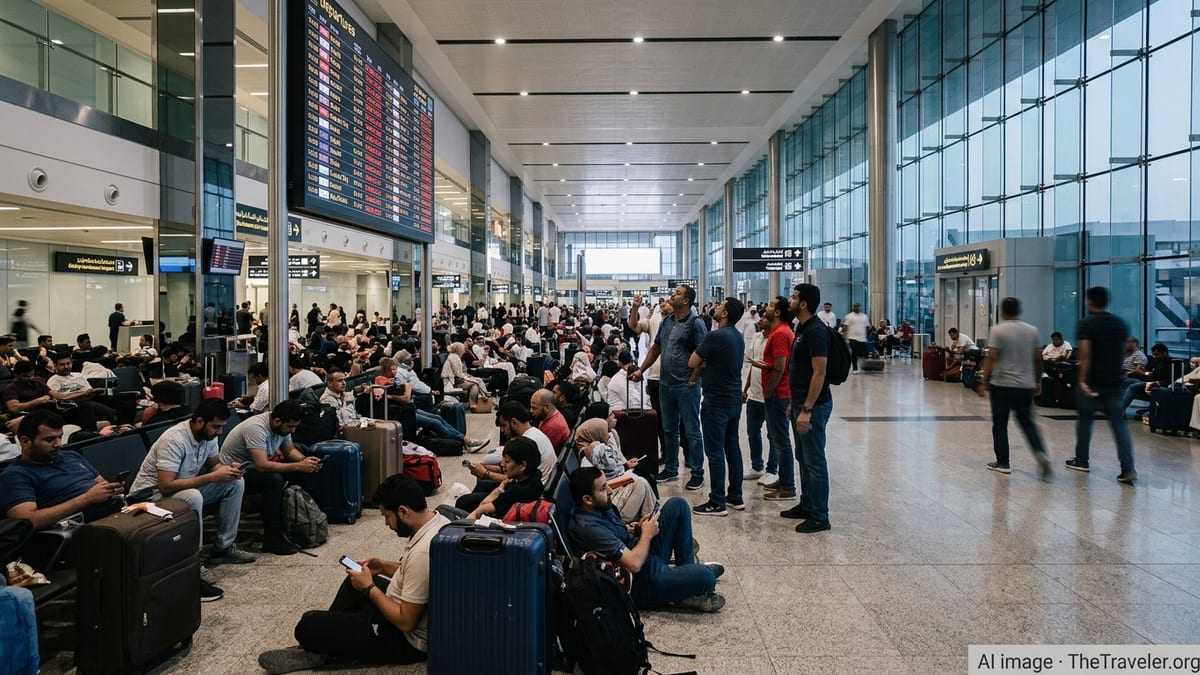
Major Hub Brought to a Standstill
The sudden suspension of 96 Gulf Air services has sharply reduced activity at Bahrain International Airport, which normally functions as the airline’s primary hub for connections across the Middle East, Europe and Asia. Publicly available information indicates that the cancellations affect a mix of short-haul regional sectors and onward long-haul itineraries that rely on Bahrain as a transfer point.
Reports from travelers and operational updates show that departures and arrivals on high-frequency routes such as Dubai, Riyadh, Doha, Kuwait City and Abu Dhabi have been heavily curtailed, with many services removed from schedules or listed as canceled. Bahrain’s role as a mid-Gulf transfer point means that disruption on these corridors has had a cascading impact on passengers whose journeys extend far beyond the region.
The reduced schedule comes amid broader turbulence in Gulf airspace, where recent missile and drone activity has led to temporary closures, capacity constraints and rerouting across multiple states. As carriers adjust flight paths and ground aircraft, the loss of 96 Gulf Air rotations in and out of Bahrain has become one of the most significant single-airline interruptions affecting the country’s main airport.
Operational data from previous seasons shows that Gulf Air typically mounts dozens of weekly flights from Bahrain to major Gulf cities alone. Against that baseline, the current suspension represents a steep, sudden contraction in connectivity for both local residents and international travelers transiting the Kingdom.
Passengers Face Long Delays, Confusing Options
Stranded passengers at Bahrain International Airport describe a patchwork of delays, rolling cancellations and limited onward options as airlines react to shifting airspace conditions. Social media posts and traveler forums refer to lengthy queues at service desks, difficulty reaching call centers and confusion over which flights are still operating.
Publicly available information indicates that some travelers holding Gulf Air tickets have been rebooked onto later dates, in certain cases more than a week beyond their original travel plans. Others report being advised to seek alternative routings via airports that currently remain more accessible, such as Muscat or certain Saudi Arabian gateways, although availability out of these cities is also tight due to heightened demand.
Travel waiver policies published online suggest that eligible passengers on affected flights may be able to change dates or request refunds without standard penalties, but the exact options vary by fare type and itinerary. With so many cancellations concentrated in a short window, travelers have reported inconsistent experiences depending on when they were able to contact the airline and whether alternative flights were still open.
For those stuck in transit rather than at home, accommodation and basic logistics have become an added concern. Public reports highlight travelers struggling to extend hotel stays, adjust visas or manage additional costs, as the disruption extends from hours into days for some passengers.
Key Gulf Corridors Severely Disrupted
The suspension of 96 Gulf Air flights has landed hardest on some of the region’s busiest business and leisure corridors. Flight schedules and official statistics published prior to the disruption show dense connectivity from Bahrain to Dubai, Doha, Riyadh, Kuwait City and Abu Dhabi, with multiple daily services that function as feeders for long-haul routes.
With many of these flights removed from the board, frequent travelers report that what were once short hops of under an hour have turned into multi-leg detours, often involving overnight stops. In some cases, passengers have sought overland alternatives, driving across the King Fahd Causeway into Saudi Arabia in the hope of securing flights from Dammam or Riyadh, where more services are currently operating.
Travel discussion platforms indicate that a limited number of Gulf Air flights have operated from alternative gateways in the region, but availability is constrained and primarily targeted at clearing backlogs of stranded customers. Competing carriers in neighboring hubs are also running reduced or altered schedules due to the wider security environment, narrowing the options for rebooking.
The knock-on effect extends beyond the Gulf itself. European, Asian and African cities that typically rely on Bahrain as a connecting point have seen their inbound and outbound passenger flows disrupted, particularly for travelers whose itineraries were built around tight same-day connections through the Kingdom.
Operational Uncertainty Amid Regional Tensions
The disruption to Gulf Air’s network is unfolding against a backdrop of heightened regional tension and airspace risk that has affected multiple Gulf states. Open-source reporting on recent missile and drone activity shows that airports and fuel facilities across the region have been subject to intermittent closures, damage assessments and increased security postures.
In parts of the Gulf, temporary airspace shutdowns and restrictions on overflights have forced carriers to suspend services or adopt longer, less direct routings. This has placed pressure on scheduling, crew availability and aircraft utilization, all of which contribute to the kind of large-scale flight suspensions now seen in Bahrain.
Aviation risk briefings circulated in early March point to an expectation of continued volatility, with analysts warning that airlines may need to retain flexible schedules and contingency plans for days or weeks. For Gulf Air, headquartered in Bahrain and heavily dependent on the country’s airspace, any renewed restrictions or security incidents can have an outsize effect on its ability to operate a stable timetable.
While some neighboring hubs have begun operating limited repatriation or relief flights, the broader pattern across the region remains one of cautious, incremental resumption rather than a rapid return to normal traffic levels. That context helps explain the scale of Gulf Air’s suspensions and the slow pace at which affected routes are being restored.
What Travelers Can Do Now
With conditions changing frequently, travel specialists emphasize that passengers booked on Gulf Air or itineraries that transit Bahrain should treat upcoming plans as fluid. Publicly available guidance from airlines and airports across the region recommends that travelers monitor flight status in real time, using official channels rather than third-party apps where possible.
Passengers on canceled flights are generally advised, according to airline notices, to avoid heading to the airport without a confirmed alternative booking. Instead, they are encouraged to use online manage-booking tools or customer-service hotlines to request rebooking or refunds, though high call volumes may lead to extended wait times.
Travel insurance documents and credit card benefits are also worth reviewing, as some policies provide coverage for additional accommodation, meals or alternative transport when disruption is caused by airspace closures or security events. However, coverage can vary significantly, and travelers may need to supply documentation such as cancellation notices or revised itineraries.
For those yet to depart, industry observers suggest considering routings that avoid current bottlenecks where possible, or building in extra buffer time for connections. Until Gulf Air is able to restore a larger proportion of its Bahrain operation, passengers relying on the carrier’s hub are likely to face limited options and should plan for potential changes at short notice.