

More news on this day
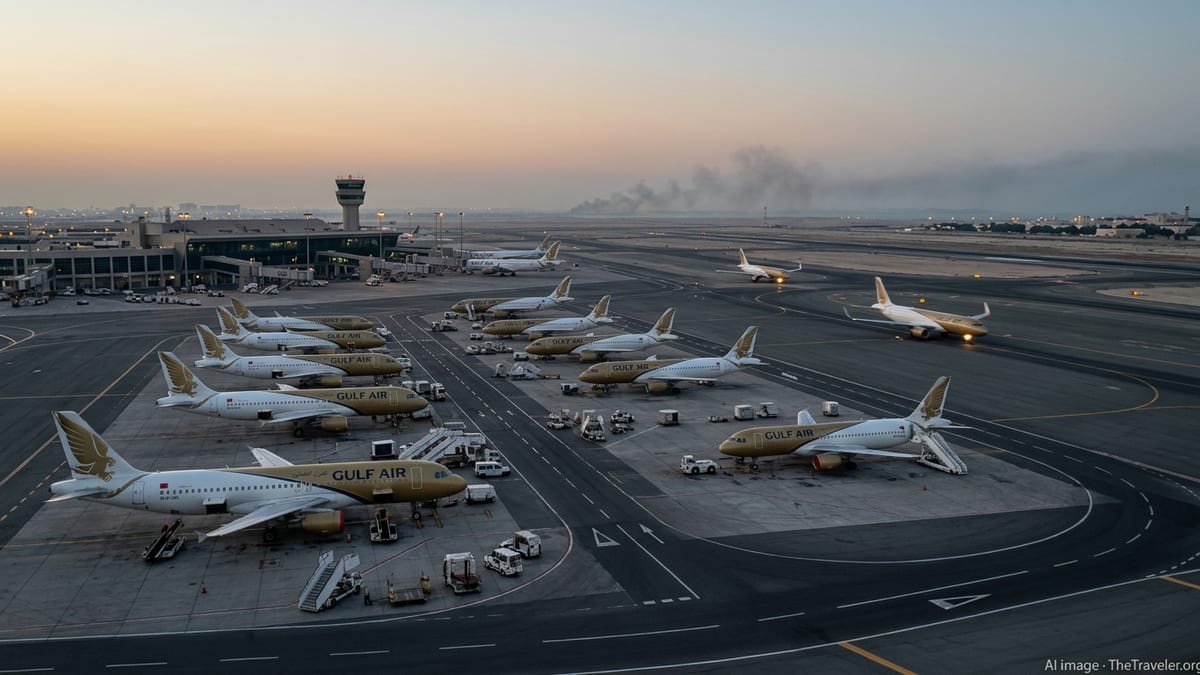
Gulf Air has evacuated most of its aircraft from Bahrain International Airport amid escalating security threats, in a dramatic move that underscores the deepening impact of regional conflict on Middle Eastern air travel and global connectivity.
Get the latest news straight to your inbox!
Security Strikes Push Bahrain’s Flag Carrier to Act
The decision by Gulf Air, Bahrain’s national airline, to reposition its fleet out of the kingdom’s airspace marks one of the most visible aviation responses yet to the latest round of missile and drone attacks across the Gulf. Following strikes on infrastructure in and around Manama and repeated alerts at Bahrain International Airport, the carrier quietly ferried aircraft to airports in neighboring Saudi Arabia in recent days, according to industry bulletins and regional risk advisories.
Gulf Air has not announced a formal suspension of operations in the way some regional rivals have done during the crisis, but with Bahrain’s airspace subject to tight restrictions and intermittent closures, commercial passenger flights have largely been halted. A limited number of positioning and rescue services are understood to be operating from Saudi airports to help move stranded passengers onward where possible.
The relocation of the fleet is designed to keep aircraft out of potential strike zones and away from critical fuel and maintenance facilities around Bahrain’s main airport. It also gives the airline the option to restart partial operations more quickly from alternative hubs if security conditions allow, rather than waiting for a full reopening of Bahrain’s airspace.
The move follows days of heightened alert after attacks damaged civilian sites and energy infrastructure in Bahrain, and comes against the backdrop of a wider regional conflict that has already prompted temporary airspace closures in the United Arab Emirates, Qatar and other Gulf states.
Regional Airspace Closures Ripple Across Global Routes
Gulf Air’s evacuation of its aircraft is part of a much broader pattern of disruption to air travel across the Middle East as missile and drone strikes, along with military activity in the Strait of Hormuz, have pushed regulators to close or severely restrict key flight corridors. Airspace over Bahrain, Iran, Iraq, Qatar and parts of the United Arab Emirates has been subject to rolling closures or tight routing constraints since late February, forcing airlines to cancel or reroute hundreds of services.
Major Gulf carriers have suspended large parts of their networks at various points during the crisis, while others have shifted to skeleton schedules designed mainly to facilitate repatriation flights. Aviation security notices distributed to corporate clients warn that capacity for both passengers and air cargo remains sharply constrained, particularly on routes linking Europe and North America with South and Southeast Asia, which normally rely heavily on Gulf hubs.
With Bahrain positioned near the narrow Strait of Hormuz, even temporary restrictions there can have an outsized effect on flight planning. Airlines that would normally overfly the Gulf are instead being pushed north over Turkey and the Caucasus or south along the Arabian Sea, increasing flight times, fuel burn and crew duty hours. The result has been higher fares on remaining services and growing uncertainty for travelers trying to transit through the region.
Insurers and risk consultants say underwriters are now scrutinizing aircraft ground accumulations at major hubs and asking more detailed questions about airline contingency plans, including how quickly fleets can be dispersed if a particular airport is threatened. Gulf Air’s decision to preemptively move its aircraft out of Bahrain is likely to be studied by other operators as a template for managing concentrated risk in an era of increasingly precise long-range strikes.
Passengers Face Cancellations, Detours and Long Layovers
For passengers, Gulf Air’s fleet evacuation and the closure of Bahrain’s airspace have translated into a cascade of cancellations and last-minute itinerary changes. Travelers booked on multi-leg journeys that use Bahrain as a connecting hub have reported seeing their flights abruptly pulled from schedules, often with little more than automated messages advising them not to proceed to the airport.
In response, the airline has expanded its waiver policies, allowing customers scheduled to travel through at least late March to rebook journeys for later dates or request refunds. Travel agents across South Asia and Europe report a surge in calls from Gulf Air passengers looking for alternative routings that bypass Bahrain entirely, often at additional cost or with overnight layovers in third countries.
Scenes of uncertainty have echoed across the region, with stranded passengers shuttled between hotels and terminals as authorities weigh security alerts against limited windows of safe airspace. Some Gulf Air customers have been re-accommodated on departures from Saudi airports where the carrier has temporarily based aircraft, but capacity on those services remains limited and subject to change at short notice.
Travel advisers are urging passengers with upcoming Gulf Air itineraries not to assume their flights will operate, even if they appear as confirmed in booking systems. Instead, they recommend checking directly with the airline and monitoring official channels from Bahrain International Airport, as schedule changes are being made day by day in line with security assessments.
Airports and Airlines Test Emergency Playbooks
The forced reshaping of Gulf Air’s operations is also a live test of the emergency playbooks that airlines and airports have developed in recent years for dealing with conflict-driven airspace disruptions. Since the downing of civilian aircraft in previous conflicts, regulators and carriers have invested in more sophisticated risk modeling to determine when to close airspace or reroute flights. The current crisis in the Gulf is stretching those systems to their limits.
Airport operators across the region have activated shelter-in-place protocols, including moving passengers and staff to protected areas when warning sirens sound or when interception debris is expected to fall nearby. At Bahrain International Airport, repeated alerts and concerns about fuel storage facilities have reinforced the logic of moving Gulf Air’s fleet to safer locations, even at the cost of near-term commercial revenue.
Airlines are also leaning heavily on their operations control centers, where teams of dispatchers, security specialists and meteorologists are tasked with constantly updating flight paths and contingency plans. For Gulf Air, this has meant balancing humanitarian considerations like repatriation flights with the imperative to keep aircraft and crews out of high-risk zones. Each decision to operate or cancel a flight now carries not only financial implications, but also complex assessments of threat intelligence and diplomatic signaling.
Industry analysts say the current disruptions will likely accelerate a trend toward more diversified basing strategies for Gulf carriers, with aircraft and crews spread across multiple airports rather than concentrated at a single home hub. For a relatively small but strategically located airline such as Gulf Air, the experience of evacuating its fleet may reshape long-term thinking about where it maintains maintenance bases, crew housing and critical spare parts.
Uncertain Timeline for Recovery in Gulf Skies
Despite some tentative signs of de-escalation in parts of the region, there is no clear timeline for a full reopening of Bahrain’s airspace or for Gulf Air to restore its usual level of service from Manama. Officials in several Gulf capitals have emphasized that civilian safety and the protection of critical infrastructure will remain paramount in decisions about lifting restrictions, suggesting that closures could persist even if the tempo of strikes slows.
Travel industry forecasters warn that once restrictions are eased, airlines will still face bottlenecks as they work to reposition aircraft, recall crew and clear backlogs of displaced passengers. Gulf Air will have to sequence the return of its fleet from Saudi airports and possibly other locations, while coordinating with air traffic control authorities to avoid congestion in newly reopened corridors.
For now, the evacuation of Gulf Air’s fleet stands as a stark symbol of how quickly regional security crises can upend one of the world’s most interconnected aviation markets. What began as a series of military exchanges has evolved into a major shock to civil air travel, exposing the vulnerability of hub-and-spoke networks that rely on a small number of strategically placed airports.
Travel experts say that if the current conflict drags on, airlines may need to reimagine how they serve the Gulf, with more point-to-point services that reduce reliance on any single hub and more robust contingency plans for rapidly relocating aircraft. Until then, passengers flying to, from or over the region face an extended period of uncertainty, and Gulf Air’s grounded home base in Bahrain remains one of the clearest indicators of the instability still roiling Gulf skies.