

More news on this day
Nine key flights operated by Gulf Air, Philippine Airlines and several regional carriers were cancelled at Singapore Changi Airport this week, stranding passengers bound for Bahrain, Kuala Lumpur, Penang, Manila, Shah Alam and other popular regional gateways as ongoing airspace disruptions and operational constraints ripple across Asian routes.
Get the latest news straight to your inbox!
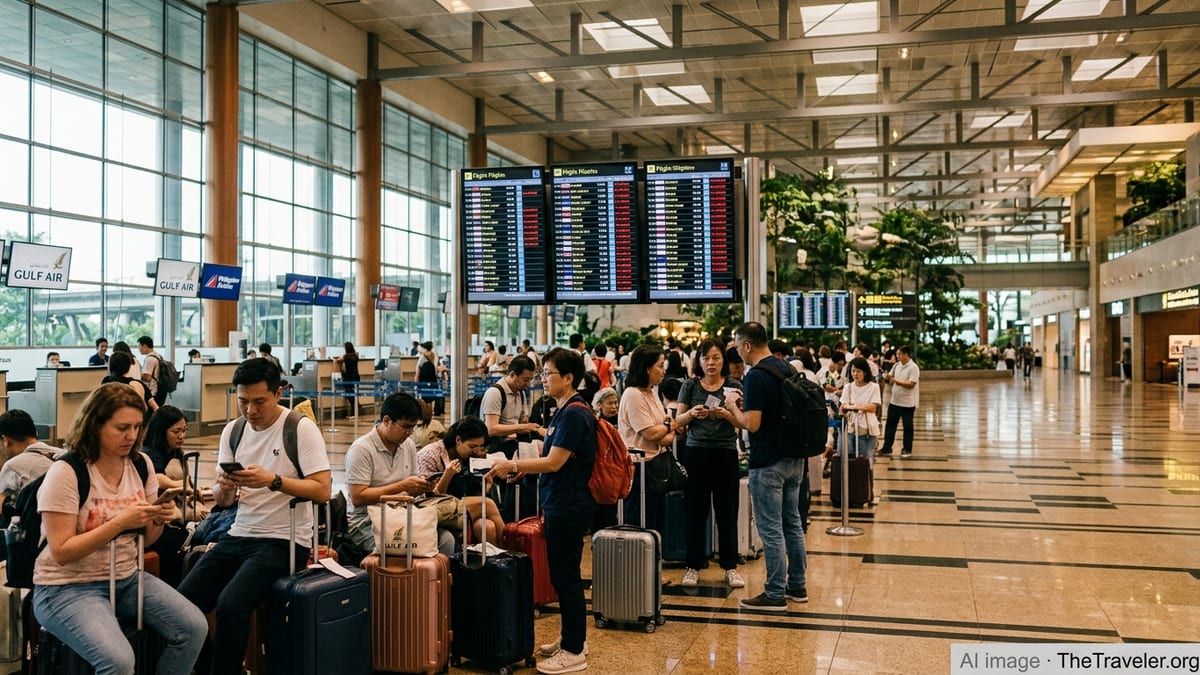
Chain reaction from Middle East airspace closures hits Singapore
Publicly available flight data and regional aviation reports indicate that the latest round of cancellations at Changi is closely linked to ongoing airspace restrictions across parts of the Middle East. Airspace closures around Bahrain, Qatar and neighboring states since late February have forced airlines to reroute or suspend services, creating knock-on effects for flights that normally use these hubs for onward connectivity.
According to regional coverage, Bahrain’s role as a transit point has been curtailed since the end of February, with Gulf Air adjusting schedules and publishing waivers for affected passengers as it navigates altered routings and slot constraints. This has translated into targeted cancellations on Singapore connections, including services that would normally carry travelers between Changi and Bahrain for business trips, onward European links and major events in the Gulf.
Industry analyses of the current disruption describe the situation as structural rather than temporary, with hundreds of cancellations and more than a thousand delays logged across Asia in the first days of March. Singapore Changi has recorded multiple cancellations on Middle East facing routes in that period, and the latest batch of nine flights reflects those pressures cascading into Southeast Asian and South Asian city pairs.
While no single airport closure in Southeast Asia is driving the disruption, the loss of key air corridors and the need for longer routings has tightened aircraft availability and crew schedules. This has raised the likelihood that carriers will preemptively cancel selected departures from hub airports such as Changi when operational buffers become too thin.
Gulf Air’s Bahrain link from Changi among the hardest hit
Gulf Air’s Singapore to Bahrain service has been one of the most visible casualties of the latest network reshuffle. Flight tracking tools and airline advisories show that the carrier has repeatedly suspended or trimmed frequencies on Bahrain bound routes, while also widening fee waivers to allow rebooking or refunds for affected travelers through mid to late March.
For passengers at Changi, this has meant that selected Singapore to Bahrain departures, as well as corresponding inbound flights, were dropped from the schedule at short notice. With Bahrain’s own airport operating under restrictions and airspace congestion extending across the wider region, replacement routings often require long detours via other Gulf or European hubs, adding both cost and travel time.
Travelers heading from Singapore to major events in Bahrain, including motorsport and regional conferences, have reported on public forums that they are seeking alternative itineraries via other Gulf carriers or European connections. Some accounts describe successful full refunds where flights were cancelled outright, while others reference challenges in securing timely rebookings due to high demand on remaining services.
Advisories shared by travel-industry intermediaries show Gulf Air offering flexible options for tickets issued on affected routes, but with strict cut off dates for completing new travel. For passengers whose Singapore sectors fall on days when key Bahrain services are canceled, this has effectively grounded plans unless they accept significantly altered routings.
Philippine Airlines passengers to Manila and beyond face knock on delays
Philippine Airlines operations between Singapore and Manila have also experienced disruption in recent weeks, according to published coverage and tracking data. While the flag carrier’s main corridor between Changi and Ninoy Aquino International Airport remains active, select services have been affected by the broader regional upheaval and by aircraft rotations that depend on smooth flows through Middle Eastern and East Asian airspace.
As schedules tightened, at least one round of cancellations linked to Manila facing flights from Singapore was recorded this week, contributing to the tally of nine key services dropped at Changi. The impact for travelers has been particularly acute for those using Manila as a gateway to onward domestic flights to secondary Philippine cities, where tight connection windows leave little margin for disruption.
Passenger reports from aviation and travel forums describe missed onward links and overnight stays in either Singapore or Manila when Singapore originated flights are removed from the schedule. Some travelers have been offered rebooking on later Philippine Airlines departures or on partner carriers, while others have opted for refunds and new itineraries via alternative Southeast Asian hubs.
Industry analysts note that airlines with complex regional networks, such as Philippine Airlines, are especially exposed when major air corridors in another part of the region are curtailed. Even when flights do not route directly through the affected airspace, aircraft and crew positioning can be knocked out of alignment, increasing the likelihood that peripheral city pairs, including Singapore to Manila, will see short notice cancellations.
Regional links to Kuala Lumpur, Penang and Shah Alam disrupted
The latest wave of cancellations at Changi has not been limited to long haul or Gulf bound services. Short haul flights to nearby Malaysian cities, including Kuala Lumpur, Penang and Shah Alam’s catchment area, have also featured in the list of nine key flights grounded in recent days, based on publicly available departure and arrival boards and regional news summaries.
Industry observers point out that these relatively short legs are often used as feeders into larger long haul networks. When an airline reduces or suspends a key long haul service, it may also trim associated short haul segments to right size capacity. This appears to be the case for some Changi departures to Malaysian gateways, where schedules have been thinned in tandem with adjustments on longer routes.
Travelers on these regional sectors have encountered a mix of schedule changes, outright cancellations and retimed services. Reports describe some passengers being moved onto later same day departures, while others were shifted to next day flights when load factors and crew duty limits allowed only limited consolidation of services.
Airport monitoring data for early March already showed elevated disruption in Southeast Asian regional traffic due to weather events, operational constraints and airspace congestion. The inclusion of Malaysia bound flights in the latest Changi cancellations underscores how tightly integrated the region’s air networks have become, and how quickly disruption in one part of the system can cascade into others.
Passengers navigate waivers, rebooking and uncertain timelines
For travelers caught up in the cancellations, the immediate challenges have revolved around understanding waiver policies, securing rebookings and estimating how long the disruption will last. Gulf Air has circulated updated ticketing guidance indicating that passengers on affected routes may rebook or refund within specific windows, while Philippine Airlines and regional carriers have publicized their own service recovery measures through websites and travel agency channels.
Consumer advisories from aviation analysts and travel groups generally recommend that passengers with tickets to or from Singapore over the coming weeks monitor their booking status frequently, rather than relying solely on day of departure notifications. Given the evolving nature of airspace restrictions and the rolling adjustments to airline schedules, flight status can change several times in the days leading up to departure.
Travel experts quoted in regional coverage suggest that travelers with time sensitive itineraries consider building in longer connection buffers, especially when itineraries rely on Gulf hubs or Middle Eastern overflight. Some are also recommending that passengers research alternative routings via unaffected corridors, even before an airline formally cancels a flight, so that options are ready if a rebooking opportunity arises.
With no firm timeline yet for a full normalization of airspace conditions and hub operations in the Middle East, the nine key cancellations at Singapore Changi this week are being viewed by analysts as part of a broader, medium term reshaping of regional air travel patterns. Travelers heading to Bahrain, Manila, Kuala Lumpur, Penang, Shah Alam and other linked cities are being advised to remain flexible, stay informed and prepare for the possibility of further last minute changes to their plans.