

More news on this day
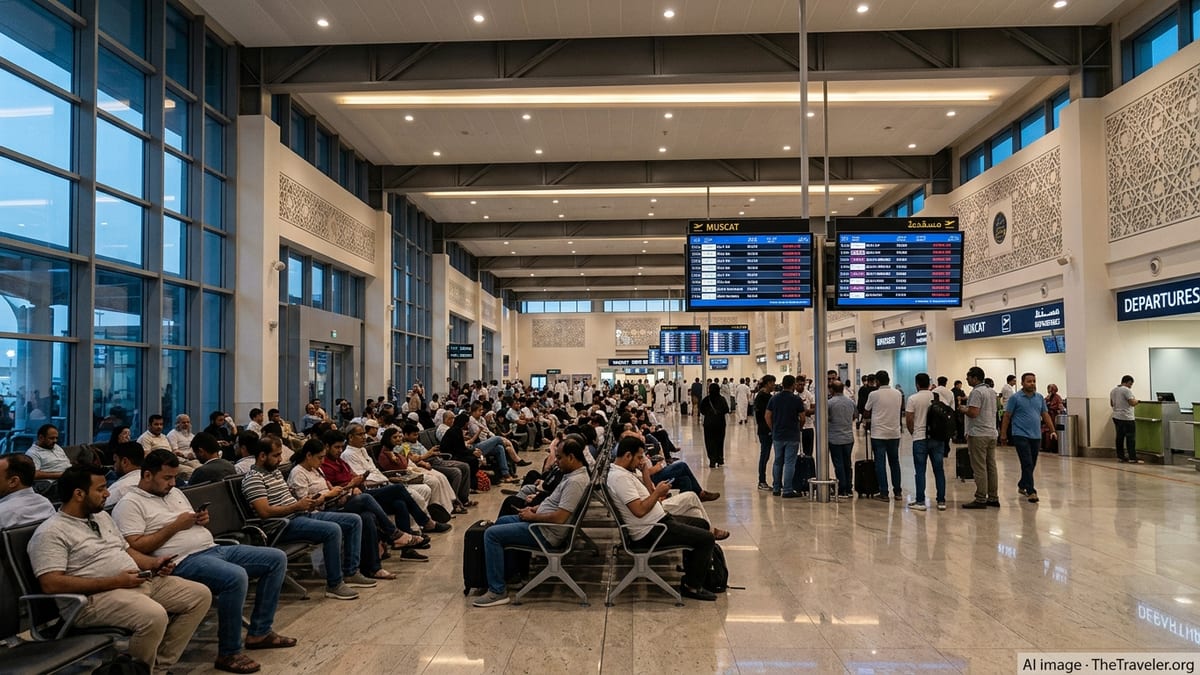
Passengers traveling through Muscat’s Seeb International Airport faced fresh disruption this week as at least five Gulf Air and Qatar Airways services were cancelled, interrupting key links to Bahrain, Dubai, Doha and other regional hubs amid wider airspace and security turbulence across the Gulf.
Get the latest news straight to your inbox!
Key Cancellations Hit Bahrain, Dubai and Doha Routes
Publicly available flight-tracking data and airline schedule updates indicate that Seeb International Airport in Muscat has seen a fresh wave of cancellations affecting Gulf Air and Qatar Airways services. On routes that normally provide important short-haul connectivity, at least five flights linking Muscat with Bahrain, Dubai, Doha and additional onward destinations were removed from operating schedules or re‑timed at short notice.
Gulf Air, the flag carrier of Bahrain, typically operates multiple daily services between Manama and Muscat, forming a key bridge for travelers connecting between the Gulf, the Indian subcontinent and Europe. Recent schedule changes show several Muscat-bound and Muscat-originating flights cancelled within a compressed window, forcing passengers to reroute through alternative hubs or defer travel altogether.
Qatar Airways, which has maintained only limited operations since regional airspace closures and conflict-related disruptions emerged in late February 2026, has also reduced or reshuffled its Muscat services. Reports from passenger forums and airline communication channels describe Muscat–Doha flights being withdrawn or consolidated, affecting travelers relying on Doha for long-haul connections to Europe, Asia and Oceania.
Although the total number of affected departures and arrivals at Muscat remains modest compared with pre-crisis volumes, the cancellation of five tightly scheduled Gulf Air and Qatar Airways flights has had an outsized impact because of their role as feeder services into two of the Gulf’s largest connecting hubs.
Regional Security Turmoil Ripples Into Omani Skies
The disruption in Muscat is unfolding against the backdrop of the widening 2026 Iran conflict, which has generated repeated missile and drone incidents across several Gulf states. Open-source reporting on recent Iranian strikes in the region notes that airports and civil aviation infrastructure have been among the sensitive locations exposed to risk, prompting precautionary airspace closures and reduced airline operations in multiple countries.
In Oman, publicly accessible security and aviation summaries describe a series of drone attacks since early March that targeted strategic ports and areas close to key shipping lanes. While Seeb International Airport itself has not been identified as a direct target, the broader security posture and evolving risk assessments appear to be feeding into airlines’ scheduling decisions, as carriers reassess routings, crew positioning and overflight permissions on an almost daily basis.
Qatar has experienced even heavier disruption, with its main international gateway in Doha operating under severely constrained conditions. Qatar Airways has been running a significantly reduced network and has rerouted or diverted flights through nearby airports, including Muscat, to maintain some connectivity. As routing options in and out of Doha remain limited, the knock‑on effect on Muscat’s timetable has grown, particularly on shorter regional sectors that can be trimmed or consolidated to free up aircraft for longer-haul missions.
Industry analysts point out that Muscat’s proximity to contested airspace corridors, combined with the need for flexible diversion options for flights already in the air, makes its schedule especially vulnerable to last‑minute changes. When security alerts rise or airspace restrictions tighten, airlines may cancel shorter segments or turn Muscat into a temporary diversion point, straining its capacity and leading to cascading adjustments on services such as those operated by Gulf Air and Qatar Airways.
Passengers Confront Last‑Minute Changes and Complex Rebookings
For travelers booked on the affected Gulf Air and Qatar Airways flights, the most immediate impact has been uncertainty. Messages shared across passenger discussion forums and social channels describe itineraries that vanished from airline apps, repeated schedule changes and difficulties securing timely rebookings, particularly for journeys involving multiple connections.
In several cases, passengers reported that Muscat flights were cancelled just days before departure, even when broader route maps still suggested limited operations were available. This pattern reflects what frequent flyers have observed across the Gulf in recent weeks: airlines often wait until closer to departure to finalize decisions on whether a flight can safely operate, based on the latest airspace assessments, crew availability and aircraft positioning.
Travelers transiting Muscat as a secondary hub have faced especially complex scenarios. Some itineraries that originally relied on Doha as the primary gateway were first diverted to Muscat when Qatar’s airspace shut, only to encounter fresh cancellations as carriers trimmed their temporary workarounds. In practice, this has meant overnight stays in Muscat, extended layovers, and rerouting through alternative hubs such as Abu Dhabi, Riyadh or European gateways when seats could be found.
Travel industry observers note that Gulf Air and Qatar Airways have generally been offering standard rebooking and refund options aligned with their disruption policies, but that long call-center wait times and limited seat availability on remaining flights have made it difficult for some passengers to secure swift resolutions.
Economic and Tourism Implications for Muscat and the Wider Gulf
Although Seeb International Airport has remained open, the rolling pattern of cancellations and diversions is weighing on Oman’s wider tourism and business travel sector. Muscat’s role as a quieter alternative hub in the Gulf has grown in recent years, especially for travelers seeking connections to secondary cities in the region and the Indian Ocean. The loss of multiple Gulf Air and Qatar Airways rotations constrains that role at a time when demand patterns are already volatile.
Regional tourism data and historical traffic reports underscore the importance of Gulf carriers in feeding visitors into Oman, both as a final destination and as part of multi‑country itineraries that link Muscat with Bahrain, Qatar, the United Arab Emirates and Saudi Arabia. When high‑frequency shuttle flights between these cities are cancelled, it not only affects point‑to‑point travelers but also reduces the attractiveness of combined Gulf itineraries that rely on seamless short‑haul hops.
Air cargo flows are also feeling the strain. Bahrain and Doha are major transshipment centers for time‑sensitive goods, and Muscat serves as both an origin and a relay point for freight moving between Asia, Africa and Europe. Fewer passenger flights on Gulf Air and Qatar Airways mean less bellyhold cargo capacity, leading to delays and higher spot rates on remaining services. Logistics specialists caution that such disruptions can ripple into supply chains for everything from high‑value electronics to perishable food shipments routed through the Gulf.
For Oman, the timing is particularly challenging. The country has been working to position Muscat and its coastal resorts as attractive alternatives to busier Gulf city‑break destinations. Travel marketers fear that persistent headlines about cancellations and regional security tensions may cause some visitors to postpone or reroute their plans, even though daily life in Muscat remains relatively calm and most flights are still operating.
What Travelers Through Muscat Should Expect Next
With the broader regional conflict still unresolved, aviation planners and analysts caution that schedules into and out of Muscat are likely to remain fluid in the short term. Gulf Air and Qatar Airways timetables are being updated frequently, and previously announced windows of limited operations have already been adjusted more than once in response to shifting security and airspace conditions.
Passengers booked on Muscat services in the coming days are being advised, through airline communications and travel advisories, to monitor their bookings closely via official airline channels and to be prepared for further last‑minute changes. In practice, this may mean building longer connection buffers, considering alternative routings that avoid the most constrained hubs, and remaining flexible about departure dates when possible.
For the airlines themselves, the cancellation of key Muscat flights is part of a wider effort to keep networks functioning at reduced capacity while prioritizing safety and operational reliability. By trimming short‑haul sectors and consolidating lightly booked services, Gulf Air and Qatar Airways can concentrate scarce resources on maintaining essential long‑haul links and repatriation corridors for stranded travelers.
Industry observers suggest that a clearer picture of Muscat’s connectivity is unlikely to emerge until there is a sustained easing of regional tensions and a more predictable framework for airspace access. Until then, the experience of passengers caught up in the latest wave of Gulf Air and Qatar Airways cancellations at Seeb International Airport offers a snapshot of how quickly the region’s intricate web of routes can unravel when geopolitics and aviation intersect.