

More news on this day
Travel across the Gulf region faced fresh disruption this week as a cluster of cancellations by Gulf Air and Qatar Airways at Muscat’s Seeb International Airport led to the grounding of five key services, affecting popular routes to Bahrain, Dubai, Doha and onward long-haul connections.
Get the latest news straight to your inbox!
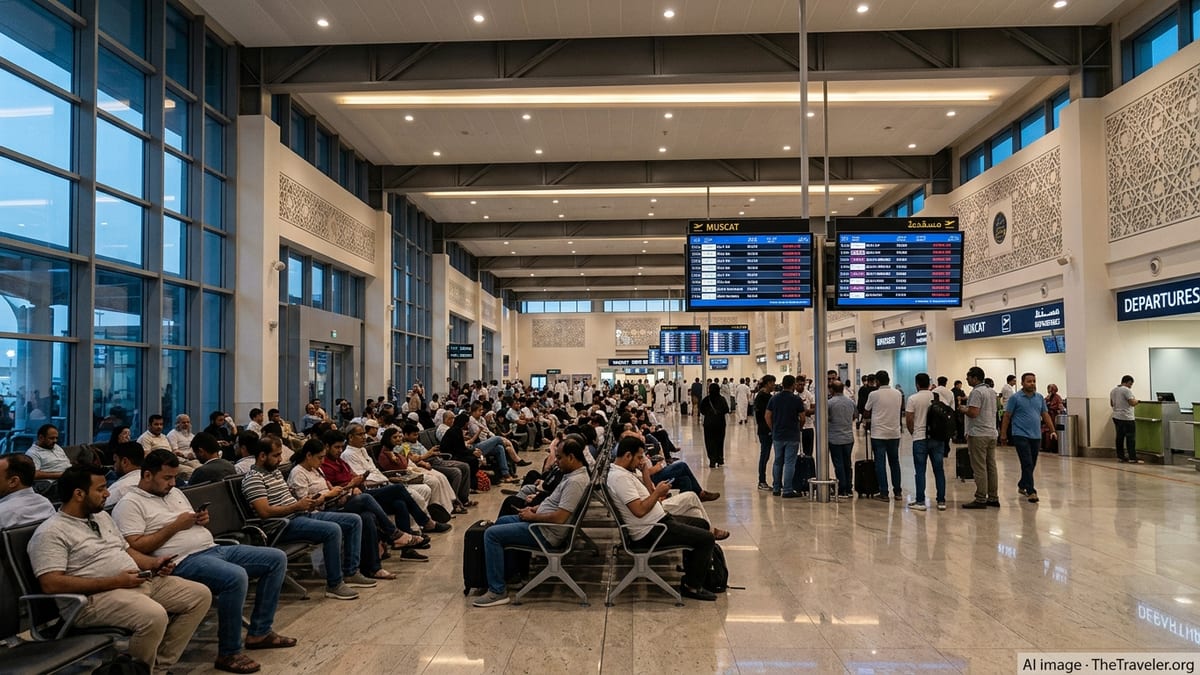
Targeted Cancellations Hit Key Gulf Connectors
According to publicly available flight-tracking data and regional travel advisories, five departures and arrivals operated by Gulf Air and Qatar Airways at Muscat’s Seeb International Airport were cancelled within a single operational window, removing several of the airport’s most heavily used regional links. The affected services included rotations to Bahrain and Doha, as well as itineraries using Muscat as a stepping stone to Dubai and other onward destinations.
The cancellations came amid broader instability in Gulf airspace following recent regional tensions and intermittent airspace restrictions. Reports indicate that while Oman’s airspace and Muscat’s main hub remain formally open, airlines are continuously adjusting schedules and routings in response to evolving risk assessments, operational constraints and altered traffic flows across neighboring states.
Gulf Air’s Bahrain services and Qatar Airways’ Doha flights typically function as high-frequency connectors, feeding long-haul networks to Europe, Asia and Africa. The sudden removal of multiple rotations in and out of Muscat therefore had an outsized impact, leaving passengers with missed onward connections and limited same-day rebooking options.
Regional security briefings describe Muscat as one of the main diversion and exit points while neighboring hubs manage disrupted operations and constrained capacity. This status has concentrated demand on a smaller number of remaining flights, amplifying the effect of each cancellation on travelers in transit.
Wider Regional Tensions Weigh on Airline Operations
The localized disruption in Muscat is occurring against the backdrop of an ongoing conflict that has triggered missile and drone activity across parts of the Gulf. Public reporting on the conflict and associated airspace responses shows that several Gulf countries, including Qatar and Bahrain, have imposed varying degrees of temporary airspace closures or restrictions in recent weeks, prompting airlines to reroute or suspend some services.
Travel risk assessments for the Middle East describe a highly fluid operational environment, with some airports functioning normally while others face intermittent pressure from changing flight paths, air defense activity and precautionary measures. While Muscat’s Seeb International Airport has largely remained open, the airport is exposed to knock-on effects when airlines adjust their networks around nearby closures or restricted corridors.
Qatar Airways, whose hub in Doha has been heavily affected by earlier airspace interruptions, has been operating a patchwork schedule that includes selective use of Muscat for diversions and contingency routings. Gulf Air, operating from Bahrain, has been similarly affected by regional airspace decisions and shifting traffic patterns. The latest cancellations in Muscat reflect how even a relatively small number of flights can become vulnerable when carriers are balancing safety considerations, crew availability and aircraft positioning across multiple jurisdictions.
Industry analysts note that this environment complicates planning both for airlines and passengers. Schedules published weeks in advance can change at short notice, and network planners increasingly treat each day as a fresh puzzle shaped by risk assessments, regulatory notices and the capacity of alternate airports such as Muscat.
Passengers Face Missed Connections and Limited Alternatives
The immediate impact of the five cancellations at Seeb International Airport has been felt most acutely by transit passengers using Muscat as a connecting point. Travelers heading to or from South and Southeast Asia via Bahrain, Dubai or Doha have reported last-minute itinerary changes, unexpected overnight stays and long waits for alternative routings.
Accounts shared on social media and public travel forums describe cases where flights initially scheduled to connect through Doha or Bahrain were rerouted via Muscat, only for onward segments to be cancelled or significantly delayed. In several instances, passengers reported being rebooked onto Oman Air or other regional carriers, but often with multi-day gaps between available seats, especially on popular Europe and Asia links.
This tightening of capacity has driven fuller loads on the flights that do operate, leaving fewer spare seats for disrupted travelers. Some passengers have opted to purchase entirely new tickets with competing airlines in order to secure more predictable itineraries, while seeking refunds or travel credits for the original Gulf Air or Qatar Airways bookings through standard customer service channels.
Travel advisories published by risk consultancies reiterate that, although Muscat’s airport infrastructure is functioning and core domestic and regional services continue to operate, travelers should anticipate schedule volatility, particularly on itineraries involving hubs directly affected by airspace restrictions.
Operational Priorities and Safety Considerations
While neither Gulf Air nor Qatar Airways has issued detailed public breakdowns of the individual Muscat cancellations, industry practice and prior statements from carriers in similar situations suggest that decisions of this kind are typically rooted in a combination of safety, regulatory compliance and operational efficiency. Airlines are required to align with airspace notices, risk assessments and route availability, and may cancel or consolidate flights when detours or holding patterns would render operations impractical.
In addition, crew-duty limitations and aircraft positioning play a crucial role. With many flights needing to take longer paths around restricted areas, airlines can face tight crew-hour constraints that force last-minute changes to rotations touching Muscat and other secondary hubs. Aircraft may also need to be repositioned to support priority trunk routes, temporarily reducing capacity on shorter regional sectors such as Muscat to Bahrain or Muscat to Doha.
Publicly available operational briefings for the Gulf region describe a system still in the process of rebalancing after weeks of intermittent disruption. In such conditions, targeted cancellations of lower-yield or easily reroutable flights are a common strategy, even when airports remain physically open and capable of handling traffic.
For Muscat, this means that the airport can appear outwardly calm, with terminal facilities and ground services running normally, even as certain high-profile services disappear from departure boards with little warning, leaving travelers scrambling for alternatives.
What Travelers Through Muscat Should Expect Now
Travel experts advise passengers booked on Gulf Air or Qatar Airways services through Muscat in the coming days to monitor their reservations closely, particularly if their journeys involve onward connections in Bahrain, Dubai or Doha. Given the recent cluster of five cancellations at Seeb International Airport, additional short-notice adjustments remain possible if regional conditions change or if airspace restrictions tighten again.
Standard guidance is for passengers to check their flight status frequently on airline apps or through official customer-service channels before setting out for the airport, and to build in additional buffer time for connections. Travelers on complex itineraries may also wish to research contingency routings via alternative hubs such as Abu Dhabi or Riyadh, subject to current operational status and visa requirements.
At the airport level, Muscat continues to function as a key regional node, with most domestic and a significant share of international services still operating. However, the pattern of cancellations by Gulf Air and Qatar Airways underlines how quickly circumstances can shift when airlines are managing networks around a volatile geopolitical backdrop, even without a formal closure of Omani airspace.
For now, the situation remains dynamic. The experience of travelers affected by the five cancelled flights in Muscat illustrates the importance of flexible planning, comprehensive travel insurance and a clear understanding of passenger rights in the event of cancellations, as Gulf carriers and regional authorities work to stabilize operations across the wider network.