

More news on this day
Passengers flying through Muscat’s Seeb International Airport on routes to Bahrain, Dubai, Doha and other Gulf hubs faced fresh disruption this weekend after at least five key Gulf Air and Qatar Airways services were cancelled, underscoring the fragility of regional air links amid wider Gulf airspace uncertainty.
Get the latest news straight to your inbox!
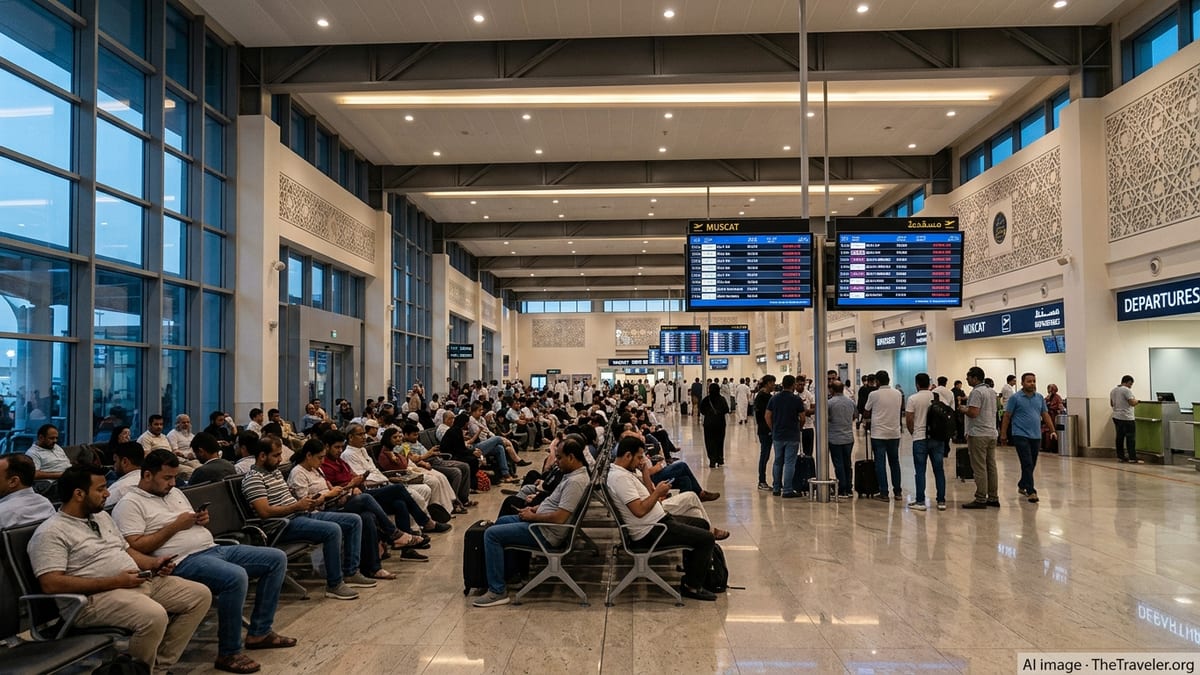
Key Gulf Connections From Muscat Abruptly Withdrawn
Publicly available flight-status information for Seeb International Airport shows that a cluster of Gulf Air and Qatar Airways departures and arrivals on core regional routes were marked as cancelled within hours of their scheduled operation. The affected services include Gulf Air flights between Muscat and Bahrain, as well as Qatar Airways connections linking Muscat with Doha and onward long haul itineraries. Additional disruption has been reported on itineraries that typically use Muscat as a secondary gateway to Dubai and other Gulf destinations via codeshare or through-ticketed connections.
The cancellations have hit at least five services that form part of the short-haul shuttle pattern connecting Muscat with neighboring hubs. These high-frequency flights are typically relied upon by business travelers, expatriate workers and transfer passengers seeking alternatives to busier hubs such as Dubai and Doha. With several of these services removed from the schedule on short notice, passengers have been left facing extended layovers, unplanned overnight stays and, in some cases, complete itinerary overhauls.
Flight-tracking data and published timetables indicate that the disruption has not been limited to a single time band, with cancellations scattered across the day. That pattern has complicated rebooking efforts, as fewer remaining services are available to absorb displaced travelers. While some passengers have managed to reroute via alternative carriers or different Gulf gateways, others report long waits before they can secure replacement journeys.
Broader Gulf Airspace Tensions Feed Into Muscat Operations
The latest cancellations at Muscat are unfolding against a backdrop of heightened volatility across Gulf aviation. Open-source reporting on the ongoing regional conflict shows that airspace closures and intermittent restrictions around Qatar, Bahrain and parts of the United Arab Emirates have forced airlines to reconfigure schedules, divert flights and in some cases suspend routes altogether. According to recent aviation and security advisories, Muscat and Oman’s airspace remain open but are increasingly used as alternative corridors for rerouted traffic that previously flowed through Doha or Dubai.
Industry briefings on the evolving situation describe a complex operating environment in which carriers are constantly recalibrating flight paths and frequencies in response to shifting risk assessments. Although Oman’s Muscat hub has been positioned as a comparatively stable waypoint during the current turbulence, the cancellations by Gulf Air and Qatar Airways demonstrate that even airports in open airspace are not insulated from the knock-on effects of regional instability.
Analysts following Middle East aviation note that when neighboring hubs experience constraints, pressure often builds on secondary airports and their airline partners. As carriers redeploy aircraft, crew and maintenance resources to support emergency repatriations or priority long haul routes, short regional hops can be particularly vulnerable to adjustment. The pattern of cancellations in Muscat appears consistent with this broader trend, in which regional connectors are scaled back to free capacity for higher-priority operations elsewhere.
Knock-On Impact for Transit and Expatriate Travelers
The cancellation of several high-demand flights at Seeb International Airport has had an outsized impact on travelers who rely on Muscat as a connecting point rather than an origin or final destination. Publicly available accounts from passengers on social platforms describe disrupted itineraries that had been stitched together using Muscat as a bridge between South Asian cities and Gulf hubs such as Doha, Dubai and Bahrain. When the short Muscat sector is removed, entire multi-leg journeys can unravel.
For expatriate workers traveling on tight vacation windows or those returning to projects across the Gulf, such disruptions can carry financial and professional consequences. Missed report dates, additional accommodation costs and the need to purchase last-minute replacement tickets are all being reported as common themes among those affected. Families attempting to reunite through Muscat have similarly described having to split journeys or accept convoluted routings at short notice.
Travel advisors monitoring the situation note that the cancellations also complicate baggage handling and through-checking where itineraries involve multiple carriers. When one regional leg is removed from the ticket, passengers can find themselves separated from luggage that is tagged to a final destination beyond the Gulf. This adds another layer of uncertainty for those already dealing with rebooking queues and changing travel advisories.
Carriers Adjust Schedules as Passengers Seek Alternatives
Schedule updates published by Gulf Air and Qatar Airways in recent weeks have highlighted a pattern of rolling adjustments across their regional networks, including in and out of Muscat. As these airlines respond to evolving operational constraints around the Gulf, their Muscat services have been periodically thinned, with some flights removed entirely and others consolidated onto fewer daily rotations. The latest set of cancellations at Seeb International Airport aligns with this broader recalibration of capacity.
Travel industry observers say that such short-notice schedule changes reflect both operational and commercial pressures. Airlines must weigh aircraft availability, crew duty limits, overflight permissions and shifting passenger demand when deciding which sectors to operate. When conditions tighten, lightly loaded or shorter regional flights are often among the first to be cut, particularly if alternative routings exist through other carriers or hubs.
In response, passengers affected by the Muscat cancellations have increasingly turned to Oman’s home carrier and other regional airlines to salvage travel plans. Publicly available booking data indicate a rise in demand for alternative routings that bypass the most constrained hubs, even when that involves longer journey times or additional stops. However, with many routes across the wider region already running close to capacity, spare seats can be limited, driving up fares and narrowing options for late-booking travelers.
What Travelers Using Muscat Should Expect in the Coming Days
With Gulf Air and Qatar Airways continuing to fine-tune their schedules, industry commentary suggests that travelers planning to use Muscat as either a destination or a transfer point should be prepared for further short-notice changes. Advisories from travel risk consultancies emphasize that while Oman’s airspace remains open, airlines operating in and out of the country remain exposed to ripple effects from any renewed disruption in neighboring flight information regions.
Passengers holding tickets on affected routes between Muscat and Bahrain, Doha, Dubai or other nearby hubs are being encouraged by travel intermediaries to monitor their booking status frequently and to build additional buffer time into itineraries. Those with long haul connections may be particularly vulnerable if a short regional hop is modified or cancelled, and contingency planning is being recommended for critical trips such as medical travel, work assignments or time-sensitive family events.
Industry analysts expect airlines to continue prioritizing flexibility within their operational constraints, including the possibility of further consolidating services or rerouting aircraft through Muscat when neighboring hubs are under greater pressure. For now, Seeb International Airport retains its role as a functioning gateway in a strained Gulf aviation system, but the latest round of Gulf Air and Qatar Airways cancellations serves as a reminder that even relatively stable nodes can experience sudden and significant disruption.