

More news on this day
Travelers moving through Turkey and the northern United States are facing another wave of disruption as Gulf Air, Qatar Airways, Flydubai and other carriers cancel nearly a dozen additional flights, affecting links between Istanbul, Bahrain, Doha, Dubai and the regional route from Marquette to Detroit, according to airline updates and airport advisories published in recent days.
Get the latest news straight to your inbox!
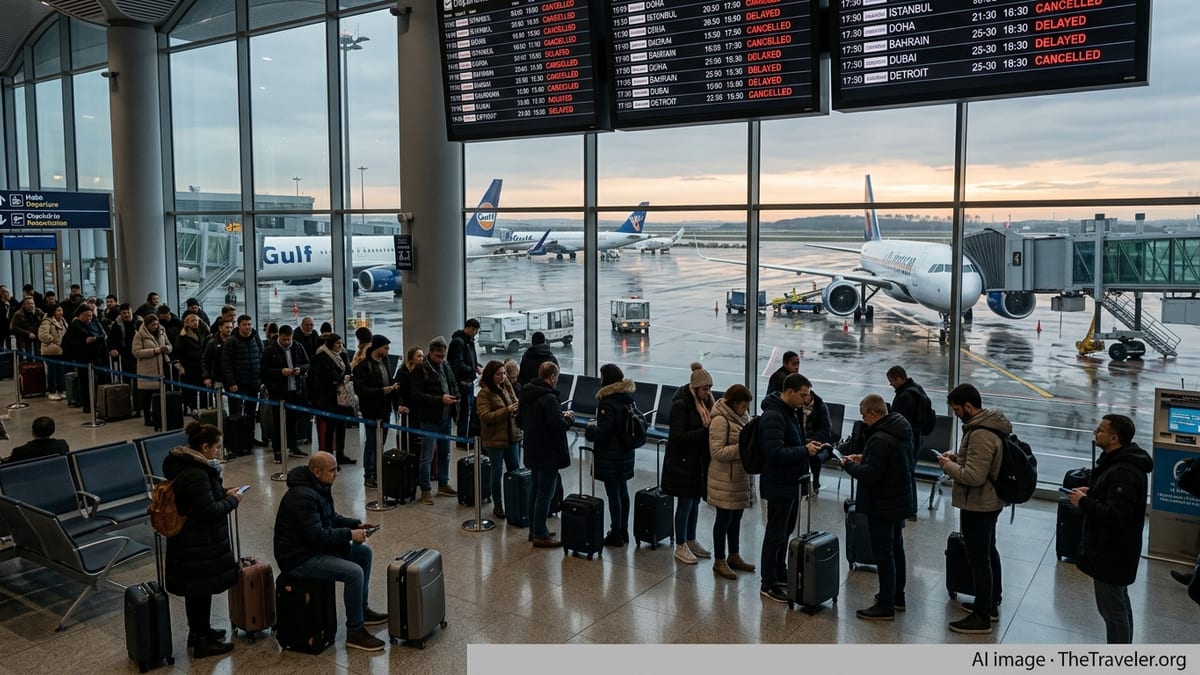
Middle East Tensions Keep Pressuring Gulf Flight Schedules
Published coverage indicates that airlines based in the Gulf region are still adjusting their networks in response to security concerns and airspace restrictions linked to the recent escalation involving Iran and Qatar, which has repeatedly affected Doha’s Hamad International Airport. Flight-program changes that began in late February have continued into March, leading to rolling cancellations and reduced frequencies on some routes touching Turkey.
Qatar Airways has already been operating under a special disruption policy that allows passengers on affected dates to reroute, refund or rebook, with frequent updates to the validity period of that policy. Publicly available information shows that although certain long-haul routes are being restored under limited conditions, commercial schedules remain constrained and subject to late-notice changes, which is feeding uncertainty for travelers using Istanbul as an alternative hub.
Gulf Air and Flydubai have also adjusted services across the region as demand, security assessments and airspace availability shift from week to week. Industry reports describe a pattern of selective cancellations and aircraft redeployments rather than a uniform shutdown, resulting in patchy connectivity and leaving passengers to navigate a landscape where some flights operate as planned while near-identical rotations on neighboring days are withdrawn.
As a consequence, Istanbul’s role as a diversion and rerouting point has grown, with regional travelers increasingly steered through Turkey when flights via Doha or other Gulf hubs are constrained. This has helped soften the overall impact on connectivity but has also concentrated pressure on a few high-demand corridors that are now experiencing crowding and higher rebooking volumes.
Istanbul Links to Bahrain, Doha and Dubai See Fresh Cancellations
On the Istanbul front, this latest round of schedule changes includes further cancellations on services connecting the Turkish metropolis with Bahrain, Doha and Dubai. Airport timetable snapshots and third-party tracking platforms show that nearly a dozen additional flights operated or marketed by Gulf Air, Qatar Airways, Flydubai and partner carriers have been pulled over the current update cycle.
Routes between Istanbul and Doha have been particularly volatile. Publicly available data suggests that while some frequencies remain in place, others have been cut at short notice as the carrier gauges demand and navigates ongoing constraints around Qatari airspace. Travelers booked on Istanbul to Doha services are being advised through airline channels and travel agents to monitor their bookings closely and to expect possible rerouting via alternative gateways.
Flights between Istanbul and Bahrain, largely operated by Gulf Air, are also affected. Industry schedule feeds indicate that select rotations have been removed from the timetable, with aircraft reassigned to other sectors in the Gulf network. For passengers, this can translate into reduced choice of departure times, longer layovers, or the need to combine multiple airlines to complete a journey that would previously have been a nonstop or simple one-stop itinerary.
Services from Istanbul to Dubai on Flydubai and other carriers are feeling knock-on effects as well. Even when flights remain scheduled, higher rebooking demand from passengers displaced on other routes can result in fuller cabins and fewer seats available for last-minute travelers, a shift that travel agencies in the region note is complicating trip planning for both business and leisure customers.
North American Weather Adds Marquette–Detroit Disruptions
At the same time as Gulf carriers manage geopolitical headwinds, travelers in the Upper Midwest of the United States are contending with weather-related interruptions. A powerful March storm system has recently swept across large sections of the central and northern United States, and meteorological reports for Michigan highlight heavy snow and ice conditions that have affected road transport and regional air links.
Within that broader pattern, the short-haul route between Marquette’s Sawyer International Airport and Detroit Metropolitan Wayne County Airport has seen fresh cancellations. Flight status boards and local advisories indicate that a series of departures were withdrawn as operators responded to deteriorating visibility, runway conditions and air traffic control flow restrictions associated with the storm.
The Marquette to Detroit sector is a key feeder for communities in Michigan’s Upper Peninsula, providing connections onward to the broader domestic and international network via Detroit. When multiple rotations on this route are cancelled within a narrow time frame, passengers can face overnight delays, missed onward flights and the challenge of rebooking on already crowded later services once operations resume.
Travel advisories for the Upper Midwest are emphasizing the possibility of additional schedule changes as airlines assess aircraft positioning and crew availability in the wake of the storm. Even after weather improves, it can take several days for regional networks like Marquette to Detroit to fully normalize, particularly when cancellations coincide with broader national disruption that limits spare capacity.
Passengers Confront Longer Detours, Tight Availability and Policy Changes
The combined effect of Gulf airspace uncertainty and North American winter weather is a patchwork of disruptions that spans multiple continents and carriers. Travelers booked between Istanbul and Gulf hubs such as Doha, Bahrain and Dubai may find themselves funneled through alternate airports, including Istanbul, Muscat, or European gateways, depending on which routes remain active on their travel dates.
Publicly available information from Qatar Airways and other Gulf carriers shows a continuing evolution of disruption policies, including extended windows for refunds or fee-free changes on certain itineraries. However, passengers have reported through online forums that exercising those options often requires persistence, with long wait times for call centers and limited ability to self-manage complex reroutings through mobile apps or websites when partner airlines are involved.
In the United States, passengers on the Marquette to Detroit route are facing a different set of constraints. With relatively few daily frequencies and limited alternative airports within convenient driving distance, any cluster of cancellations can quickly consume available seats on subsequent flights. Travel advisers recommend that affected passengers confirm rebookings as soon as possible and consider flexible arrangements for ground transport and overnight accommodation if weather-related backlogs grow.
Across both regions, industry analysts note that these disruptions highlight the fragility of highly optimized schedules when exposed to overlapping external shocks. Security events in one part of the world and severe weather in another can interact in unexpected ways, challenging passengers who rely on tight connections between regional feeders and long-haul services.
What Travelers Through Istanbul and Detroit Should Watch Next
Looking ahead, travelers routing through Istanbul toward Bahrain, Doha and Dubai are likely to see further short-notice adjustments as Gulf carriers refine their spring schedules. While some routes may gradually stabilize, recent patterns suggest that additional cancellations or time changes are possible, particularly on off-peak days or less heavily booked departures.
For passengers in Michigan’s Upper Peninsula, the key variable will be how quickly regional weather patterns settle and how fast airlines can restore normal frequencies between Marquette and Detroit. Operational data from past storms indicates that once conditions improve, airlines often prioritize restoring core shuttle routes like this one, but lingering crew and aircraft imbalances can still cause intermittent disruption.
Travelers with upcoming trips that combine these affected corridors, such as long-haul journeys from the Middle East to North America with connections in Istanbul and onward through Detroit, face an especially complex environment. Published guidance from airlines and airports consistently stresses the importance of checking flight status repeatedly in the days and hours before departure, confirming contact details in reservations systems and allowing extra time for connections.
As airlines in both regions issue new updates over the coming days, the overall picture is expected to remain fluid. For now, publicly available information points to a travel landscape where flexibility, advance planning and close attention to official status channels are essential for anyone moving along the Istanbul to Gulf routes or the Marquette to Detroit corridor.