

More news on this day
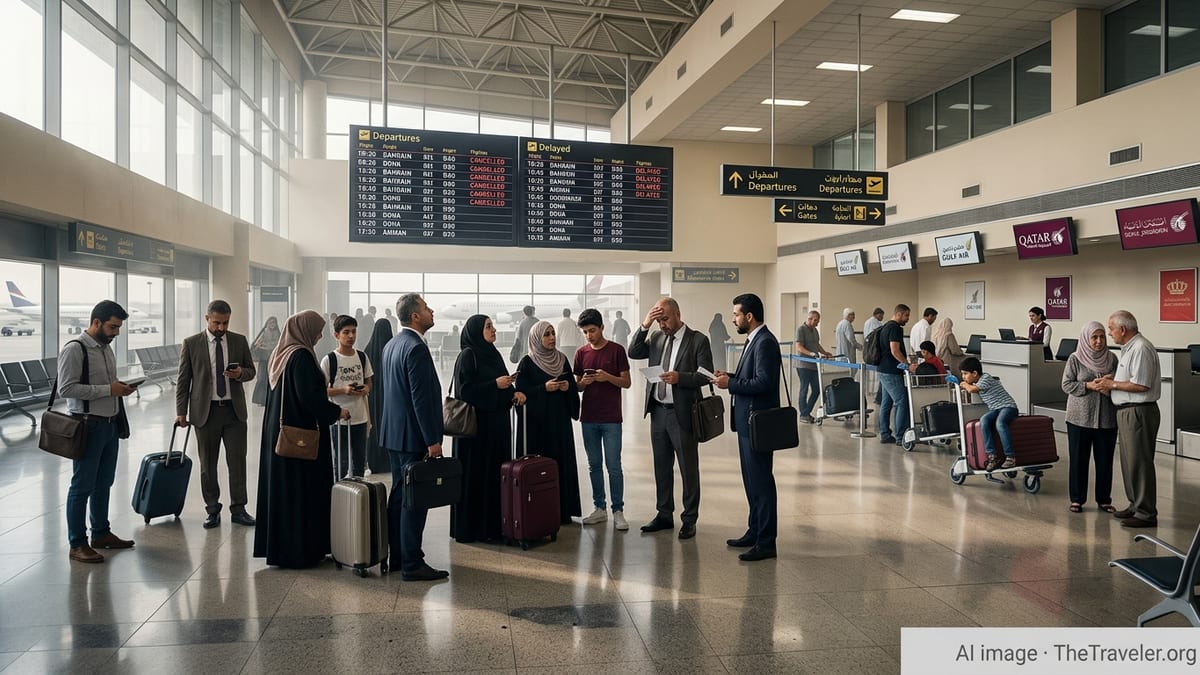
Passengers traveling from Baghdad International Airport to key Gulf hubs were left facing last-minute disruption over the weekend, as multiple services operated by Gulf Air, Qatar Airways, and Royal Jordanian were cancelled amid the wider regional airspace crisis.
Get the latest news straight to your inbox!
Five Cancellations Highlight Fragility of Iraq’s Gulf Links
According to live airport departure boards and airline status pages on March 29, at least five key departures from Baghdad International Airport to Gulf and Levant hubs were marked as cancelled, including services to Bahrain, Doha, and Amman. Published information shows that one Gulf Air flight to Bahrain, two Qatar Airways flights to Doha, and at least two Royal Jordanian services routed via Amman and beyond were among those affected, leaving ticketed passengers unexpectedly grounded at the Iraqi capital’s main gateway.
The cancellations come at a time when airlines across the wider Middle East are already operating on reduced schedules as a result of airspace closures and military tensions involving Iran and several Arab states. Aviation analytics cited in recent industry coverage indicate that Qatar Airways has cancelled the vast majority of its planned flights in recent weeks, while regional carriers such as Gulf Air and Royal Jordanian have also thinned out operations on high-risk routings.
While the number of flights affected at Baghdad on March 29 is modest compared with the thousands of cancellations recorded across the region since late February, the combination of three different national carriers and multiple onward hubs underscores how quickly Baghdad’s connectivity to the Gulf and beyond can be disrupted. For passengers holding through-tickets to Europe, Asia, and North America, the loss of a single Baghdad departure can mean missed long-haul connections and extended delays in rebooking.
Publicly available flight-monitoring data also suggest that some replacement services and positioning flights are operating at short notice, resulting in a patchwork of operating days and timings that is difficult for travelers to predict. This has added to the sense of uncertainty for those planning to use Baghdad as a starting point for international journeys via Bahrain, Doha, or Amman.
Regional Airspace Crisis Drives Ongoing Schedule Cuts
The latest disruption at Baghdad is part of a much broader aviation shockwave that has swept across the Middle East since late February, when strikes and counterstrikes involving Iran and several neighboring countries triggered extensive airspace closures and restrictions. Reporting by international and regional outlets describes large portions of airspace over Iran, Iraq, Bahrain, Kuwait, and adjacent areas as either closed or severely constrained, with “safe corridors” forcing aircraft into narrow, heavily trafficked routes.
Analysis published by Condé Nast Traveler and other travel industry sources indicates that Qatar Airways, in particular, has been heavily impacted, with close to nine out of ten scheduled flights reportedly cancelled between February 28 and March 24. Gulf Air and Royal Jordanian have also logged a wave of suspensions and reroutings, as carriers seek to avoid conflict zones and comply with fast-changing regulatory notices issued by civil aviation authorities.
Specialist aviation advisories circulated to shipping and airline clients in early March highlighted Iraq, along with neighboring Gulf states, as part of a high-risk operating environment in which airspace availability can shift rapidly. These advisories pointed to a sharp fall in commercial traffic across the northern Gulf and emphasized that even where airports remain technically open, operators are trimming or suspending flights on safety and insurance grounds.
In this context, the Baghdad cancellations on March 29 are less an isolated event and more a localized manifestation of a regional crisis that has already forced airlines to redraw route maps, extend flight times, and rely more heavily on alternative hubs such as Cairo, Istanbul, and Delhi for east–west connectivity.
Impact on Passengers Bound for Bahrain, Doha, Amman, and Beyond
For travelers, the immediate impact of the five Baghdad-linked cancellations has been a sudden loss of access to three of the region’s most important connecting hubs. Bahrain, home to Gulf Air, and Doha, the base of Qatar Airways, typically offer dense networks linking Iraq to Europe, the Americas, and Asia. Amman, served by Royal Jordanian, is another key transit point for Iraqi travelers heading onward to destinations across the Levant, North Africa, and the wider world.
Reports from passenger forums and social media over the past several weeks describe repeated rebookings, long waits on customer service phone lines, and confusion over evolving waiver policies as airlines respond to the crisis. Travelers with Baghdad-origin itineraries routed through Doha or Bahrain have reported multiple successive cancellations, while some Royal Jordanian customers have described being shifted to alternative dates or nearby airports when service to Iraq became untenable.
Because many Iraq–Gulf flights feed into tightly banked waves of long-haul departures, a missed short sector from Baghdad can cascade into an entire trip being disrupted. Passengers who lose their initial flight risk falling outside minimum connection windows for onward services to cities like London, New York, Bangkok, or Kuala Lumpur, forcing airlines to place them on later departures that may already be heavily booked due to the broader capacity squeeze.
Travel-industry guidance published in recent days has urged passengers originating in Iraq and other affected countries to monitor their booking status frequently, make use of airline mobile apps where available, and prepare contingency plans such as flexible hotel reservations or alternative routings via more stable hubs.
How the Baghdad Disruptions Fit into the Global Aviation Picture
The cancellations affecting Baghdad’s links to Bahrain, Doha, and Amman are occurring against a backdrop of global aviation upheaval. Coverage in outlets such as Egypt Independent and international travel magazines notes that the Middle East conflict has already forced extensive rerouting of flights between Europe and Asia, with Egypt emerging as a critical corridor and airports like Cairo, Istanbul, and Delhi absorbing diverted demand.
Data cited by aviation analysts suggest that at the peak of the crisis, daily flight cancellations across the wider region reached several thousand, including not only departures from Gulf hubs but also services to cities such as Tel Aviv, Beirut, Erbil, Riyadh, Jeddah, Abu Dhabi, and Dubai. In this environment, any airport located near contested airspace, including Baghdad, is vulnerable to sudden operational changes by multiple carriers simultaneously.
The current pattern of disruption has also contributed to higher airfares on many remaining routes, as airlines face longer flight times, higher fuel burn, and rising insurance costs. Independent reporting from Europe has documented fare increases on some carriers serving the Middle East, with analysts linking the trend directly to the conflict and the reshaping of traditional flight paths.
For Baghdad International Airport, the result is a more volatile operating landscape in which scheduled links to major hubs like Doha, Bahrain, and Amman may fluctuate from day to day. Travelers planning journeys in or out of Iraq over the coming weeks are being advised by travel commentators to build extra flexibility into their itineraries and to expect that even confirmed bookings can change at short notice.
What Travelers from Iraq Can Do Now
With no clear timeline for a full restoration of normal flight patterns, travelers starting or ending journeys in Baghdad face a period of ongoing uncertainty. Public guidance from airlines and travel experts generally emphasizes flexibility: where possible, passengers are encouraged to choose fares that allow date and routing changes, to consider alternative hubs, and to keep digital contact details up to date so that any schedule changes trigger automated notifications.
Published coverage of airline policies shows that several major carriers in the region have introduced temporary waivers, allowing free rebooking or refunds for tickets issued before the escalation, although the exact rules vary widely by airline, route, and travel date. In practice, passengers report that securing preferred alternatives can still be challenging because replacement flights are operating on reduced frequencies and many remaining seats are in high demand.
For those whose itineraries involve Baghdad connections to Bahrain, Doha, or Amman, travel specialists recommend checking live flight status repeatedly in the 24 to 48 hours before departure and, where possible, arriving at the airport early to allow time for any on-the-spot changes. Some travelers have opted to break up longer journeys with overnight stops in relatively less affected hubs in order to improve their chances of making onward connections.
Until regional airspace conditions stabilize, the experience of passengers stranded by the five key cancellations at Baghdad International Airport is likely to be repeated, in varying forms, across the network of routes linking Iraq with the Gulf and the wider world.