

More news on this day
Bahrain’s flag carrier Gulf Air has shifted a large part of its fleet out of the kingdom, repositioning passenger and cargo aircraft to nearby countries as missile and drone attacks linked to the escalating Iran conflict continue to disrupt airspace and halt commercial flights across the Gulf.
Get the latest news straight to your inbox!
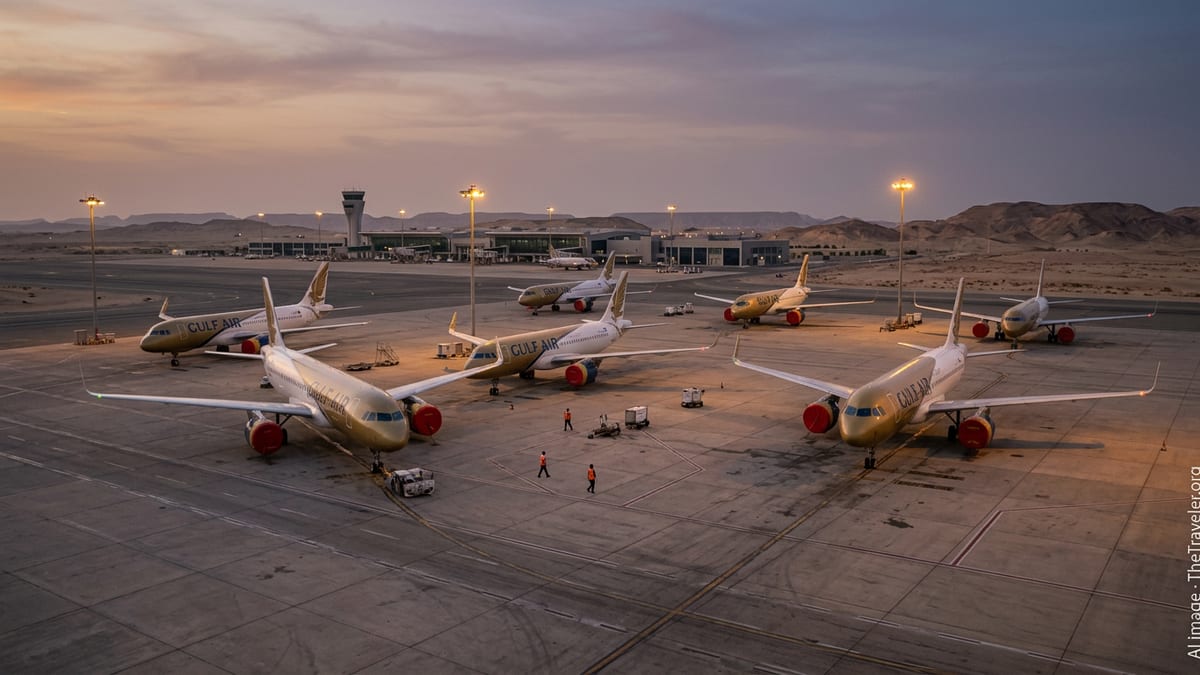
Fleet Moved Overnight As Bahrain Airspace Stays Closed
Gulf Air’s latest operational changes follow a dramatic overnight evacuation of jets from Bahrain International Airport on March 10, when Bahraini airspace was briefly opened to allow a controlled departure window. Industry and local media reports indicate that at least nine Gulf Air aircraft, along with freighters operated by other carriers, left the country during that period before restrictions were reimposed.
Authorities in Manama have kept the country’s airspace effectively closed to regular commercial traffic since the end of February, when Iran launched a series of missile and drone strikes across the region in response to joint United States and Israeli attacks. With further launches targeting Gulf infrastructure and the presence of major military assets in and around Bahrain, the national carrier has faced limited options for safely basing and operating its fleet.
The Civil Aviation Affairs department at Bahrain’s Ministry of Transportation and Telecommunications confirmed that several Gulf Air passenger jets and a number of cargo aircraft were repositioned under what it described as approved operational arrangements. Officials stressed that these movements are considered standard contingency measures designed to preserve assets and enable a quick restart of services when conditions allow.
Tracking data and regional aviation sources suggest that many of the aircraft were ferried to airports in Saudi Arabia, including secondary hubs less exposed to immediate security risks. Additional units have been positioned in other Gulf and Arabian Peninsula locations where airspace remains open to limited commercial and rescue operations.
Regional Conflict Forces Rethink Of Gulf Air Network
The fleet relocation comes as the wider Gulf network has been upended by the sharp escalation in hostilities since February 28, when long-range Iranian strikes began hitting targets in Bahrain, Kuwait, Qatar and the United Arab Emirates. Air defense systems have intercepted many of the incoming projectiles, but authorities have responded by imposing broad closures on civilian air traffic in affected corridors.
For Gulf Air, whose business model has long relied on funneling traffic through its Manama hub, the disruption has effectively frozen its traditional network. The airline has suspended most scheduled passenger operations while it waits for a sustained improvement in the security outlook and the reopening of Bahrain’s skies. Where possible, it has turned to aircraft that were outside the country when the closures began, operating a handful of special flights from airports in Saudi Arabia and Oman.
Travel advisories indicate that Gulf Air is offering flexible options to passengers whose journeys have been cancelled, including rebooking for future dates and, in many cases, refunds. Nonetheless, the sudden loss of its home hub has left thousands of travelers needing to reroute via alternative gateways such as Dubai, Jeddah, Muscat or European capitals, often at short notice and with significantly longer journey times.
The crisis underscores how quickly regional airlines can be forced to redesign their operations when key transit points become inaccessible. The carrier has historically marketed itself as a convenient connector between Europe, Asia and the Indian subcontinent via Bahrain, but in the current environment it is focusing on asset protection and limited point-to-point operations instead of traditional hub-and-spoke scheduling.
Standard Safeguard Or Signal Of Prolonged Disruption
While Bahraini aviation authorities have emphasized that repositioning aircraft is part of established emergency planning, the scale and speed of Gulf Air’s moves have raised questions about how long the disruption may last. Moving widebody and narrowbody jets out of the country reduces exposure to damage from potential strikes on airport infrastructure, but it can also indicate expectations of a sustained period of restricted access.
Aviation analysts note that relocating aircraft to multiple safe airports provides operational flexibility. It allows the airline to mount ad hoc rescue flights, charter services or limited scheduled operations from foreign bases if demand and security assessments warrant. At the same time, maintaining crews and support staff across several locations is costly, and the longer the standoff continues, the more pressure Gulf Air will face on cash flow and fleet utilization.
Industry data from recent days show that hundreds of flights across the broader Gulf region have been cancelled or diverted as airspace closures spread in a band from Iran’s western borders to the eastern Mediterranean. Carriers in Asia and Europe have rerouted services to avoid conflict zones, adding hours to long-haul journeys or suspending certain city pairs altogether, which further constrains connectivity for Gulf Air’s traditional transfer markets.
In this context, observers say Gulf Air’s decision to concentrate its assets in safer neighboring states reflects both immediate security imperatives and a desire to be well placed for a phased restart. If Bahrain’s airspace is reopened in stages, the airline could gradually cycle aircraft back to Manama, rebuilding a skeleton hub operation before restoring its previous schedule.
Ripple Effects For Travelers And Regional Hubs
For passengers, Gulf Air’s aircraft repositioning translates into continued uncertainty around travel plans through at least the coming weeks. Many itineraries involving transits via Bahrain have already been cancelled, while others remain in limbo pending further updates from regulators and the airline. With seats on alternative routes in high demand, some travelers have reported difficulty securing timely rebookings at comparable fares.
Travel agents across South Asia and Europe, key source markets for Gulf Air, report a surge in demand for itineraries that avoid the most heavily affected airspace, pushing more traffic onto hubs such as Istanbul, Riyadh and Muscat. Regional low-cost carriers and rival full-service airlines are also adjusting capacity, adding flights on certain corridors while cutting others that pass close to the conflict zone.
The repositioning of Gulf Air’s fleet has knock-on effects for cargo flows as well. With several Gulf freighters also moved out of Bahrain and other exposed airports, logistics providers are facing tighter capacity for high-value and time-sensitive shipments. Shippers are increasingly turning to multimodal solutions, combining air, sea and land routes to keep supply chains moving despite the volatile security environment.
Airport operators across the region are monitoring the situation closely, balancing heightened security protocols with pressure from airlines and passengers to restore some level of normality. For now, Gulf Air’s aircraft are likely to remain scattered across safer airfields, a visible reminder of how swiftly geopolitical tensions can ground even well-established carriers in one of the world’s most aviation-dependent regions.