

More news on this day
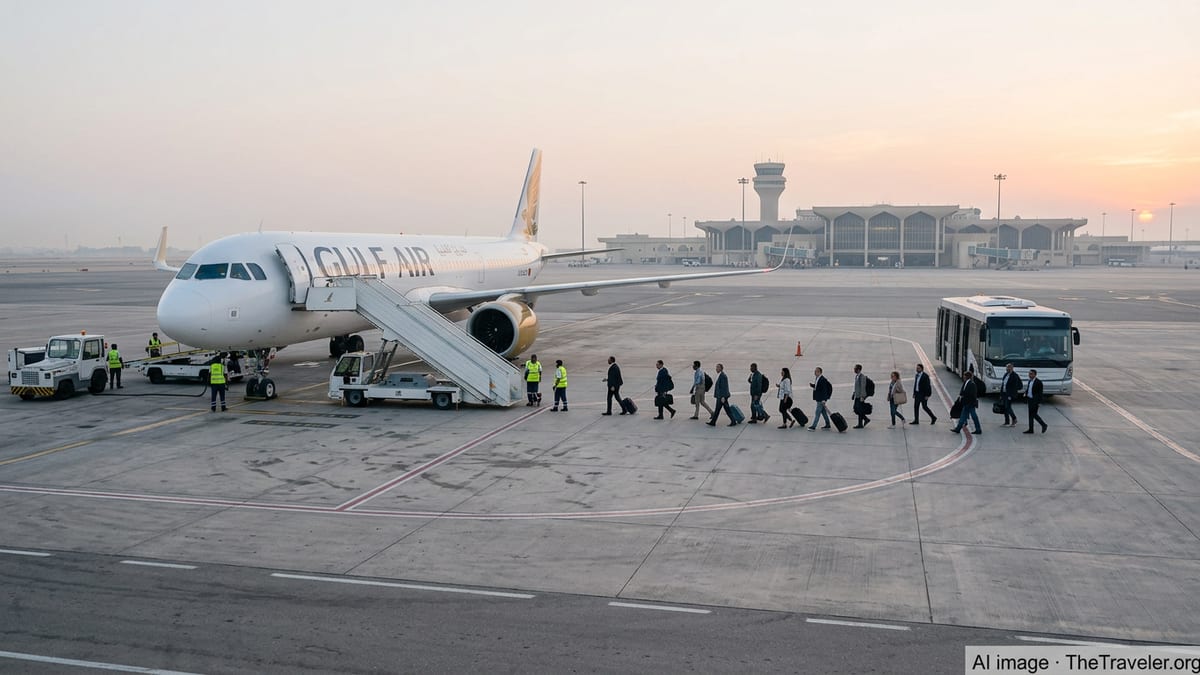
Gulf Air is moving quickly to preserve vital international links as Bahrain’s airspace remains heavily restricted, shifting parts of its network to operate through Saudi Arabia’s Dammam hub in a bid to keep passengers connected to London Heathrow, Mumbai, and Bangkok.
Get the latest news straight to your inbox!
Regional Airspace Crisis Forces Rapid Rethink
Travel across the Gulf has been thrown into turmoil in recent weeks as conflict-related tensions triggered widespread airspace restrictions across several states, including Bahrain. Publicly available aviation advisories and travel alerts describe a patchwork of closures and limitations affecting commercial flights, disrupting long-established routes and forcing airlines to improvise new operating patterns virtually overnight.
Bahrain International Airport, normally the heart of Gulf Air’s operations, has faced a particularly acute impact. Reports indicate that the national carrier relocated much of its fleet to neighboring Saudi Arabia to safeguard aircraft and position them closer to open corridors. For travelers, this has translated into last-minute cancellations, extended layovers, and complex rebooking processes as airlines work around constrained skies.
The airspace crisis has coincided with volatility around the Strait of Hormuz and heightened military activity across the wider region, adding further uncertainty for aviation planners. While cargo and essential movements have in some cases continued under special arrangements, standard commercial schedules in and out of Bahrain have been significantly curtailed, prompting carriers to explore temporary alternatives.
Dammam Emerges as a Lifeline Hub
Against this backdrop, Gulf Air has begun using King Fahd International Airport in Dammam as a critical operational bridge. Publicly shared passenger updates and travel forums describe an emerging pattern in which Bahrain-based travelers are transported by road to Dammam, where they can join specially arranged Gulf Air flights to key long-haul and regional destinations.
This pivot effectively turns Dammam into a temporary satellite hub for the airline, enabling continued connectivity even as Bahrain’s airspace remains constrained. For passengers booked on services that previously connected through Manama, itineraries are being adjusted to originate or terminate in Dammam, particularly on routes viewed as strategically important for business and diaspora travel.
While capacity from Dammam is still limited compared with Gulf Air’s pre-crisis schedule out of Bahrain, the move is providing a crucial outlet for travelers who might otherwise face prolonged disruption. For many, overland transfers combined with adjusted flight timings are preferable to indefinite cancellations or the need to find entirely new routings on other carriers through already congested regional hubs.
Focus on London Heathrow, Mumbai, and Bangkok Links
Among the destinations drawing particular attention are London Heathrow, Mumbai, and Bangkok, three of Gulf Air’s most prominent routes in terms of both passenger volume and strategic value. London serves as a gateway for corporate travelers, students, and the extensive Gulf diaspora in the United Kingdom, while Mumbai connects key business and family links between the Gulf and western India. Bangkok, meanwhile, is a major leisure and medical tourism destination, heavily relied upon by travelers from Bahrain and the wider Gulf.
According to publicly available booking information and traveler accounts, Gulf Air has prioritized maintaining at least a skeleton schedule on these corridors via Dammam wherever practicable. In some cases, these services have been described as “special flights,” with passengers encouraged to register quickly as seats are made available. The aim is to offer a dependable, if reduced, bridge between the Gulf and major global hubs while the airline’s primary base remains constrained.
Maintaining these links is not only important for individual travelers but also for business continuity and trade. London Heathrow offers onward access to North America and Europe, Mumbai anchors vital connections into the Indian subcontinent, and Bangkok provides a jumping-off point for Southeast Asia. By preserving these routes through Dammam, Gulf Air is helping to keep a portion of the region’s broader connectivity intact during an unpredictable period.
Passenger Experience: Complex Journeys, High Demand
For travelers, the shift to Dammam has introduced a new layer of complexity to journeys that were once straightforward connections via Bahrain. Many passengers now face a multimodal trip, beginning with an overland transfer from Bahrain to Saudi Arabia before checking in for an international flight. This can add several hours to total travel time, particularly when accounting for border procedures and security checks on both sides.
Travel discussion boards reflect a mix of relief and frustration: relief that a pathway out of the region still exists, and frustration at limited availability, rolling schedule changes, and the extra logistics involved. In some instances, short-notice flight announcements have left passengers scrambling to adjust plans or reach Dammam in time for departure. Others report that previously booked itineraries via Bahrain have been canceled outright, with rebooking or refunds offered on a case-by-case basis.
Despite these challenges, there are indications that demand for the Dammam-operated services remains strong, especially to London and major South Asian cities. As connecting options through other Gulf gateways are also constrained by regional airspace issues, Gulf Air’s workaround is emerging as a valuable alternative, even if it falls short of pre-crisis convenience and frequency.
Outlook: Temporary Solution in a Shifting Landscape
How long Gulf Air will need to depend on Dammam as an operational springboard remains unclear. Aviation and maritime advisories portray a fluid security environment in and around the Gulf, with changing risk assessments, fluctuating restrictions, and evolving diplomatic efforts all shaping the trajectory of the crisis. Any lasting resolution of Bahrain’s airspace limitations is likely to depend on broader regional de-escalation.
In the meantime, the airline appears focused on stabilizing a workable, predictable pattern of flights that can serve as many passengers as possible within the constraints. Industry observers suggest that the current arrangement could be adjusted further, with frequencies increased or additional destinations added from Dammam if conditions in Bahrain do not improve quickly.
For now, travelers looking to reach London, Mumbai, Bangkok, and other key destinations are advised, according to publicly shared guidance, to stay closely informed about schedule changes and routing updates. While the Gulf’s skies remain far from normal, the rapid extension of operations through Dammam underscores how carriers like Gulf Air are seeking to maintain global connectivity even in the midst of one of the region’s most disruptive aviation crises in recent years.