

More news on this day
Escalating conflict across the Gulf has triggered sweeping airspace restrictions over Qatar, the United Arab Emirates and Bahrain, forcing more than 400 flights to be scrapped or held on the ground and turning the region’s major hubs in Doha, Bahrain and Dubai into chokepoints for stranded travelers.
Get the latest news straight to your inbox!
Conflict Fallout Closes Skies Over Qatar, UAE and Bahrain
The latest round of Iranian missile and drone strikes on Gulf states, and retaliatory military action by the United States and Israel, has pushed the region’s airspace to its most fragile point in years. Aviation authorities in Qatar, Bahrain and parts of the United Arab Emirates have imposed rolling closures and severe restrictions, citing security risks from ongoing attacks and debris in key flight corridors.
Qatar’s Doha Flight Information Region has operated under de facto shutdowns since late February, with the Qatar Civil Aviation Authority confirming that only tightly controlled contingency routes are available and that capacity remains sharply limited. Qatar Airways has responded by axing large portions of its schedule and concentrating on a skeleton network of long haul and repatriation services.
In Bahrain, authorities suspended all commercial movements at Bahrain International Airport for extended periods as regional skies tightened further. Gulf Air has shifted aircraft to safer airports in neighboring Saudi Arabia to protect its fleet, leaving its Manama hub largely offline and disrupting connections across the Middle East, Europe, South Asia and beyond.
The United Arab Emirates, home to Dubai International Airport and several fast growing carriers, initially shut wide swaths of airspace after Iranian projectiles were intercepted over Emirati territory and infrastructure near Dubai was damaged. While some operations have tentatively resumed, the Emirates Flight Information Region continues to operate under heavy restrictions, and carriers warn that schedules remain highly volatile.
Hundreds of Flights Scrapped as Airlines Race to Adapt
Across the three Gulf states, airlines have abandoned at least 403 flights in recent days, with a further 36 held back or significantly delayed as operational plans are rewritten hour by hour. The bulk of cancellations are concentrated at Doha’s Hamad International Airport, Bahrain International Airport and Dubai International Airport, all of which normally serve as critical transfer points linking Europe, Asia, Africa and Australasia.
Qatar Airways has focused on consolidating capacity on a handful of trunk routes to cities such as London, Paris, Madrid, Frankfurt, Delhi and Beijing, while grounding or diverting many regional flights that would normally fan out across the Middle East. The carrier has also operated select repatriation services approved case by case by regulators, but warns that further disruption is possible at short notice as the security picture evolves.
Gulf Air’s schedule from Bahrain has been dramatically thinned, with many flights canceled outright and others rerouted via Saudi airports. FlyDubai, the Dubai based low cost airline, has also cut dozens of services and shifted aircraft to operate through the safest available corridors, prioritizing essential routes and repatriation demand where possible.
Industry analysts say the combined impact of these moves amounts to one of the most serious shocks to Gulf aviation since the pandemic. With airspace over Iran and Iraq effectively off limits and neighboring Flight Information Regions operating under emergency rules, many long haul routes that once relied on efficient Gulf stopovers are being forced into longer, more circuitous paths or suspended altogether.
Long Queues, Missed Connections and Uncertain Timelines for Travelers
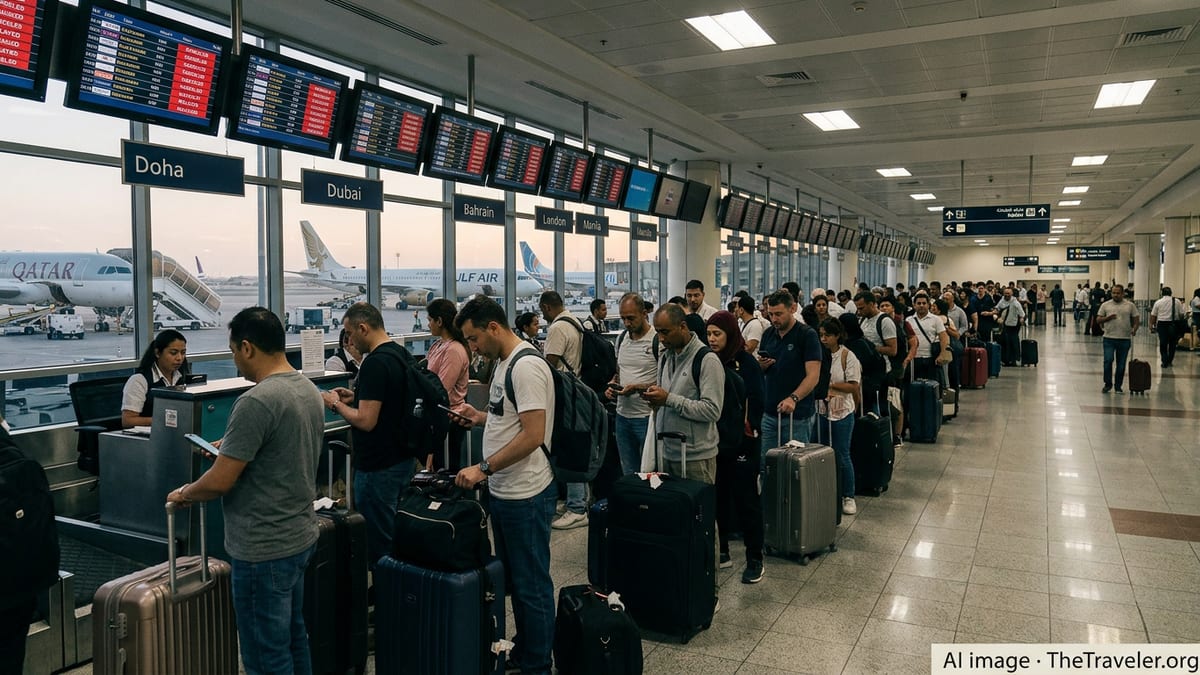
For passengers caught in the middle of the upheaval, the numbers translate into long queues at check in desks, packed airport lounges and an endless cycle of rebookings and rolling delay announcements. Transit travelers who began their journeys well before the latest escalation are among the worst affected, often arriving in Doha, Bahrain or Dubai to discover that onward legs have been canceled or delayed indefinitely.
At Hamad International, travelers report being reprotected on limited Qatar Airways departures days later than planned or being offered reroutes via European or Asian hubs that still have safe access routes around the Gulf. Hotel vouchers and meal assistance have been issued in many cases, but capacity in nearby accommodation is increasingly stretched as disruption spills into a second week.
In Bahrain, Gulf Air customers have faced similar challenges, with some passengers bussed or rebooked through airports in Saudi Arabia after the Manama hub sharply curtailed operations. Those holding separate tickets on onward carriers have been hit particularly hard, as missed connections cascade through multi stop itineraries.
Dubai International, normally one of the world’s most efficient mega hubs, has struggled with the stop start nature of operations under partial airspace reopening. While some flights on Emirates and FlyDubai have resumed along designated safe corridors, travelers continue to experience lengthy delays at security and passport control as departure boards shift constantly and ground handlers work with truncated staffing and shifting slot allocations.
Global Ripple Effects and Official Travel Warnings
The disruption in Gulf airspace is rippling far beyond the region. European, Asian and African carriers that depend on overflight rights or interline partnerships with Qatar Airways, Gulf Air and FlyDubai have been forced to cancel or reroute their own services, adding hours of extra flying time and driving up fuel and crew costs. Cargo movements through the Gulf, a vital artery for high value goods, have also slowed significantly.
Several governments have updated travel advisories, urging citizens to avoid non essential travel through affected hubs and to consider alternative routings where possible. European regulators have extended guidance warning airlines to avoid overflying multiple Gulf Flight Information Regions at all altitudes, a move that further constrains available airspace and complicates flight planning for international carriers.
Travel insurance providers are reporting a spike in inquiries as customers seek clarity on coverage for cancellations linked to conflict, while consumer rights groups remind passengers that standard compensation rules may not apply when disruption is caused by security emergencies and airspace closures rather than airline operational failures.
With oil prices rising on fears for the Strait of Hormuz and insurers reassessing risk premiums for flights into the Gulf, analysts warn that the financial fallout for airlines could be substantial even once skies begin to reopen. Carriers that built their business models on dense, high frequency networks through Gulf hubs may need weeks or months to fully restore connectivity.
What Passengers Should Do Now
Airlines and travel agencies are urging affected customers to avoid unnecessary airport trips and instead manage bookings through digital channels where possible. With call centers stretched and airport desks overwhelmed, most carriers are waiving change fees and allowing free date or routing changes for tickets touching Doha, Bahrain or the United Arab Emirates during the disruption window.
Passengers already in transit are advised to monitor airline apps and airport information screens closely and to keep contact details updated in booking records so they can receive real time alerts. Those with tight onward connections in Europe, Asia or North America are being encouraged to build in extra buffer time or request rerouting through hubs that are not directly impacted by Gulf airspace restrictions.
Travel planners say that, for the moment, flexibility is essential. Even where limited flights are operating, last minute airspace closures or new security directives can force sudden diversions or returns to origin. Until a broader de escalation in regional tensions takes hold and authorities begin to systematically reopen closed Flight Information Regions, airlines, airports and passengers alike are bracing for continued uncertainty in one of the world’s most important aviation crossroads.