

More news on this day
The abrupt shutdown of the Gulf air corridor amid the escalating war involving Iran, the United States and Israel has plunged global aviation into its deepest crisis since the pandemic, stranding passengers on multiple continents and exposing just how dependent long-haul travel has become on a handful of Middle East hubs.
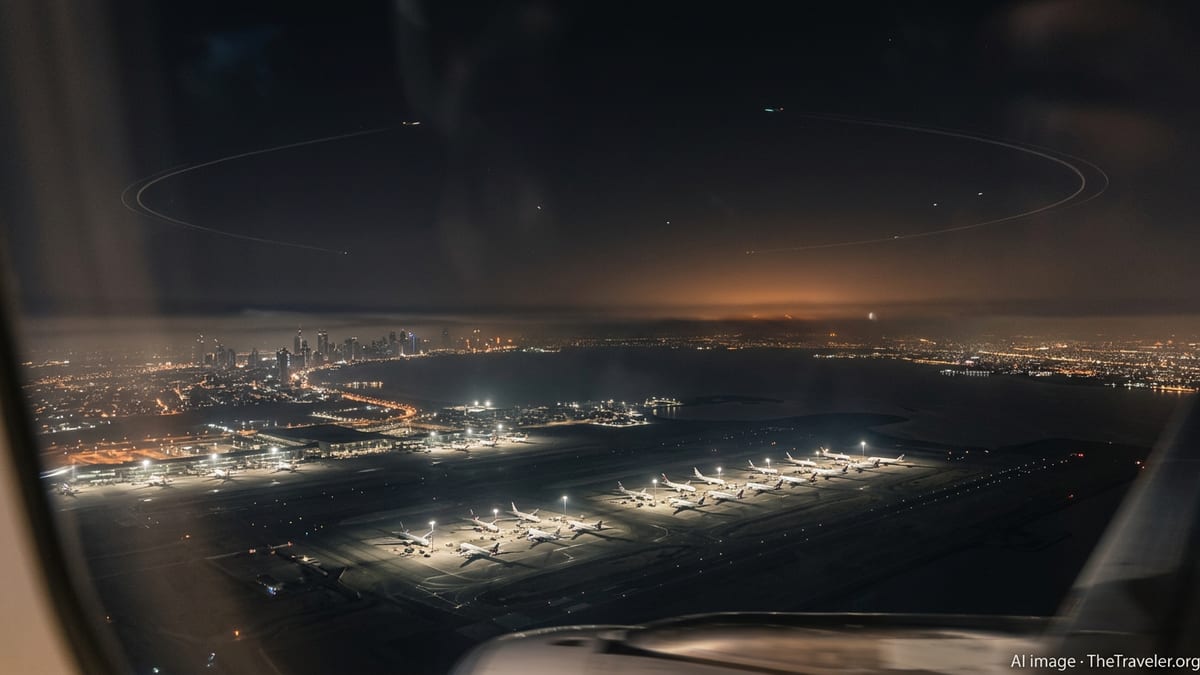
Key Gulf Hubs Go Dark as Conflict Escalates
When coordinated strikes on Iran began on 28 February, authorities across West Asia moved swiftly to close large swaths of airspace. Within hours, the main Gulf corridor linking Europe and Africa to Asia was effectively severed, as Iran, Iraq, Qatar, Bahrain, Kuwait and parts of the United Arab Emirates and Saudi Arabia imposed full or partial shutdowns for civilian traffic.
Those closures hit at the heart of global connectivity. Dubai, Abu Dhabi and Doha, home to Emirates, Etihad and Qatar Airways, normally funnel tens of thousands of connecting passengers each day between Europe and Asia and onwards to Australasia and Africa. Aviation data firms estimate that roughly one third of passengers flying between Europe and Asia, and more than half of those traveling between Europe and Australia or New Zealand, were routed through these hubs before the crisis.
As missiles and drones targeted infrastructure around the Gulf, major airports suspended operations or shifted to emergency modes. Flights already in the air were forced into time-consuming diversions, with some ultra-long-haul services burning hours of fuel only to return to their point of origin. Within the first days, thousands of flights were canceled outright and thousands more delayed, according to multiple aviation tracking and consultancy reports.
By early March, Emirates and Etihad had begun cautiously restoring skeletal schedules from Dubai and Abu Dhabi, even as Qatar Airways kept most operations grounded in Doha. Capacity through Dubai International Airport, normally the world’s busiest for international traffic, remained a fraction of normal levels, underlining the fragility of the network that depends on the Gulf.
Global Ripple Effects From a Single Chokepoint
The shutdown of the Gulf corridor has demonstrated how a regional conflict can instantly snarl travel plans for people who never set foot in the Middle East. Passengers flying between cities such as London and Bangkok, Frankfurt and Sydney or New York and Delhi have seen itineraries upended as airlines scramble to find viable alternatives to the blocked route.
With Iranian and Iraqi skies largely off limits and several neighboring states imposing restrictions, the remaining east–west arteries are under intense pressure. Flights are being pushed north via the Caucasus and Central Asia or south along Egypt, Saudi Arabia and Oman, adding between three and six hours to typical Europe–Asia journeys in many cases. Longer flight times mean higher fuel burn, heavier crew demands and tighter aircraft rotation schedules, squeezing capacity even where airlines want to add extra services.
The knock-on effects extend well beyond passenger cabins. Airfreight operators report significant disruption to cargo flows linking Asian manufacturing hubs with European and North American markets, as fewer widebody aircraft transit the Gulf and detours erode payload margins. Logistics firms warn of delays and higher costs for high-value goods and critical spare parts, with some supply chains still recovering from pandemic-era bottlenecks.
Financial markets have reacted quickly. Airline shares across Asia-Pacific and Europe have come under pressure amid forecasts of higher fuel bills, reduced demand for itineraries routed via the Middle East and warnings of potential multi-billion-dollar revenue hits if the closures persist. Analysts note that the Gulf crisis comes on top of the still-closed Russian and Ukrainian airspace for many Western carriers, shrinking the available sky for long-haul operations.
Stranded Passengers and Patchwork Contingency Plans
For ordinary travelers, the crisis has been felt most acutely in airport departure halls and at crowded transfer desks. Hundreds of thousands of passengers are estimated to have been stranded or significantly delayed since the end of February, from migrant workers and religious pilgrims in the region to tourists and business travelers as far away as Australasia and North America.
Gulf carriers and their partners have launched large-scale rebooking efforts, waiving change fees and offering refunds, yet many customers report waits of days rather than hours for new itineraries. Alternative routings via European, African or East Asian hubs often involve multiple layovers, overnight hotel stays and sharply higher fares as remaining seats are snapped up. In some countries, governments have coordinated special evacuation or repatriation flights to bring home citizens who were transiting Gulf airports when the corridor closed.
The crisis has also exposed the limits of airline and government contingency planning. While conflict-related no-fly zones are hardly new for the industry, few scenarios fully anticipated the simultaneous closure of so many neighboring airspaces at a moment when other major corridors were already constrained. Crews are grappling with rapidly changing overflight permissions, GPS interference in conflict zones and shifting security assessments that can alter a route plan just hours before departure.
Industry groups and pilot unions are calling for clearer international protocols on conflict-zone risk, arguing that the current patchwork of advisories from national regulators and voluntary airline assessments leaves too much room for confusion when crises escalate at speed.
A Decade of Hub Strategy Put to the Test
The Gulf corridor crisis has thrown a harsh spotlight on the hub-and-spoke model that has defined long-haul travel over the past two decades. By concentrating traffic in a few mega-hubs with efficient banks of connecting flights, airlines such as Emirates, Qatar Airways and Etihad built powerful global networks that could link secondary cities across continents with a single stop in the Middle East.
That strategy has delivered lower fares and greater choice for many passengers, especially in markets in South Asia, Africa and Australasia that gained one-stop access to Europe and North America. But the current shutdown illustrates the systemic risk of concentrating so much capacity in one geographic corridor. When the Gulf goes offline, there is limited slack elsewhere in the system to absorb displaced demand at short notice.
European and Asian carriers that once maintained their own long-haul connectors through hubs like London, Frankfurt, Hong Kong or Bangkok had already trimmed or reshaped those networks in response to fierce competition from Gulf airlines and the earlier closure of Russian airspace. Rebuilding that capacity quickly is difficult, given pilot shortages, aircraft delivery delays and thin margins across the sector.
Some analysts predict that airlines and regulators will now revisit the balance between efficiency and resilience. That could mean incentivizing more point-to-point ultra-long-haul services that bypass traditional hubs, diversifying transfer traffic across a wider set of airports, or embedding explicit resilience tests into alliance route-planning and bilateral air service agreements.
Rethinking the Future of Long-Haul Travel
As the conflict and associated airspace restrictions drag into a second week, there is growing recognition that the Gulf disruption may not be a short-lived anomaly. Industry veterans point to the enduring closure of large parts of Eastern European airspace after Russia’s 2022 invasion of Ukraine as a warning that politically driven flight bans can become semi-permanent features of the map.
For governments, the episode is a reminder that aviation is both an economic engine and a strategic vulnerability. States whose citizens and exporters rely heavily on Gulf hubs are reassessing emergency options, from chartering dedicated evacuation flights to negotiating backup transit corridors with partner countries. Regulators are also likely to scrutinize airlines’ financial buffers and insurance coverage to ensure they can withstand a prolonged rerouting shock.
Travelers, meanwhile, are learning new lessons in risk management. Corporate travel managers and tour operators are factoring geopolitical exposure into route choices, while some leisure travelers are showing a renewed willingness to pay more for itineraries that avoid perceived flashpoints, even at the cost of longer journeys or extra stops.
What emerges from this crisis could fundamentally reshape how and where the world connects. Whether through more distributed hub systems, new ultra-long-range routes or greater regional self-reliance, the shutdown of the Gulf corridor has made one point unmistakably clear: the convenience of routing much of the world’s east–west traffic through a narrow band of Middle Eastern sky carries vulnerabilities that can no longer be ignored.