

More news on this day
Regional aviation disruption spread further across Egypt this week as more than 20 additional flights operated by EgyptAir, Gulf Air, Emirates, Kuwait Airways and other carriers were cancelled on routes linking Cairo and Alexandria with major Gulf and Levant hubs, affecting connections to Riyadh, Dammam, Abu Dhabi, Dubai, Sharjah, Bahrain, Kuwait City, Amman and beyond.
Get the latest news straight to your inbox!
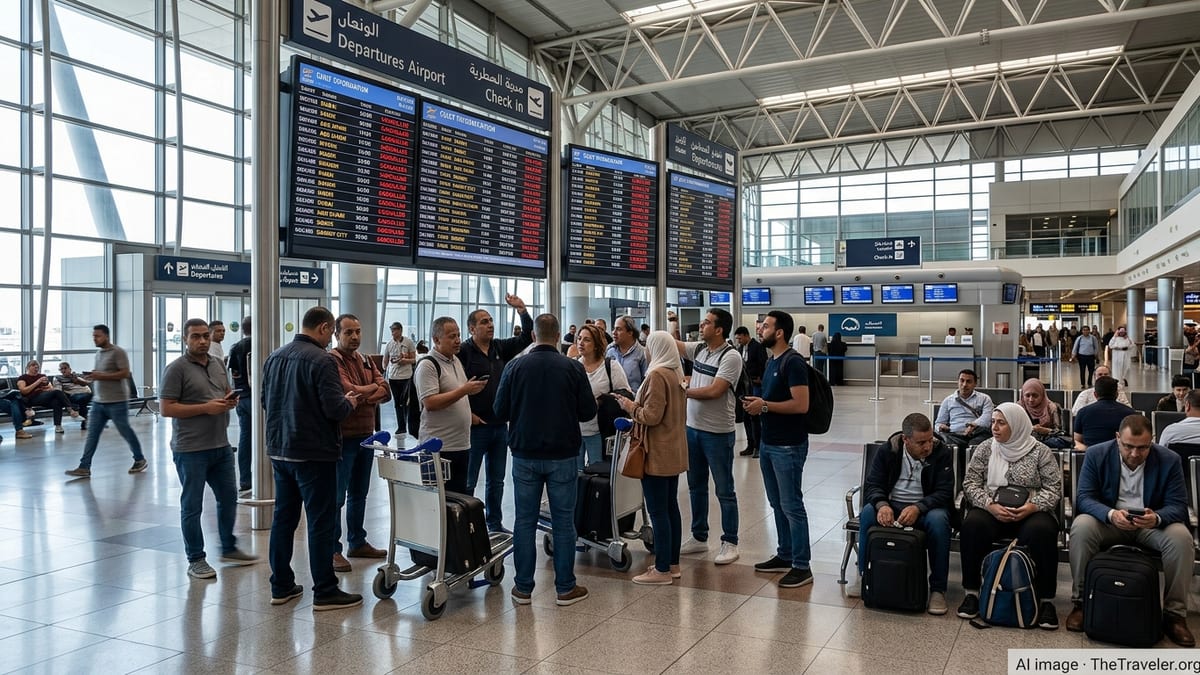
Fresh Wave of Cancellations Hits Cairo and Alexandria
Publicly available airport schedules and industry advisories indicate that departures and arrivals at Cairo International Airport and Alexandria’s Borg El Arab Airport have been trimmed again, with at least 20 newly cancelled services concentrated on high-demand regional routes. The latest cuts primarily affect short-haul flights to Saudi Arabia, the United Arab Emirates, Bahrain, Kuwait and Jordan, compounding weeks of rolling schedule changes triggered by regional airspace restrictions and security concerns.
EgyptAir, Gulf Air, Emirates and Kuwait Airways feature prominently in the updated cancellation lists, alongside a handful of other regional and codeshare partners. The affected services include links from Cairo to Riyadh, Dammam, Dubai, Abu Dhabi, Sharjah, Bahrain and Kuwait City, as well as Alexandria services to Gulf hubs and Amman. While airports in Egypt remain classified as open in recent aviation and logistics bulletins, those same reports note continuing delays and cancellations linked to rerouted traffic and limited capacity on alternative corridors.
The new cancellations follow a pattern seen across the Middle East in recent weeks, where airlines have repeatedly adjusted timetables in response to shifting overflight permissions and operational risk assessments. For Egyptian gateways, this has translated into a patchwork of last-minute changes, with some rotations operating as planned while others are abruptly removed from daily schedules.
Regional Airspace Disruption Continues to Ripple Into Egypt
The wider backdrop to Egypt’s latest flight reductions is the ongoing disruption to Middle East airspace triggered by the conflict involving Iran and several regional states. Analysis of open-source aviation tracking, travel-management advisories and specialist risk bulletins shows that airspace closures or severe restrictions in parts of the Gulf have forced airlines to suspend or heavily modify services, particularly those transiting hubs in the United Arab Emirates, Bahrain, Kuwait and Qatar.
Logistics and travel-risk updates this month describe UAE airspace as only partially open, with Emirates and other carriers operating reduced schedules and carefully managed transit flows. Similar notes highlight heavy disruption and limited availability at Kuwait International Airport and a largely halted operation at Bahrain International Airport. Although Egypt’s airspace is open, carriers operating in and out of Cairo and Alexandria have been compelled to reconfigure their networks, trimming frequencies and pruning connections that rely on now-constrained Gulf hubs.
The result for Egyptian travelers and transit passengers is a disproportionate impact on regional links rather than on long-haul flights that avoid the most restricted airspace. Routes to Riyadh and Dammam in Saudi Arabia, as well as to Abu Dhabi, Dubai and Sharjah in the UAE, have been particularly sensitive to any change in routing options or slot availability, making them among the first to see cancellations when airlines rebalance their operations.
Stranded Passengers Face Rebookings, Longer Detours and Limited Options
For passengers holding tickets on the newly cancelled flights, disruption has often translated into extended layovers, forced overnight stays or complex rerouting via alternative hubs. Accounts shared in public travel forums, together with recent airline schedule updates, point to travelers being shifted to indirect routings that add several hours to journeys, or being offered departure dates several days later than originally planned.
On some Egypt–Gulf routes, capacity constraints mean there are few immediate substitutes when a single frequency is removed, especially where airlines are already operating reduced schedules. Travelers flying from Cairo or Alexandria to Riyadh, Dammam, Bahrain or Kuwait City have reported tight availability on remaining flights, with some itineraries selling out quickly after cancellations are posted. In certain cases, passengers have been encouraged through publicly available guidance to consider rebooking via relatively less affected hubs or to split journeys using separate point-to-point tickets, albeit with additional cost and risk.
The knock-on effects are also being felt by tour operators and corporate travel planners, who rely on dense, predictable schedules between Egypt and the Gulf. Industry advisories describe a need for more conservative connection times, closer monitoring of real-time flight status and contingency planning for groups transiting Cairo on their way to or from the wider region.
Airlines Adjust Schedules as Situation Remains Fluid
Published timetables and operational notices from multiple carriers show that airlines continue to treat the situation as highly fluid, with rolling adjustments rather than a fixed, long-term schedule plan. Emirates, Gulf Air and Kuwait Airways, among others, have already announced phased resumptions or partial restorations on selected routes in recent days, even as other flights are cut or consolidated.
For services touching Egypt, this has meant that some suspended links to Dubai, Abu Dhabi or Sharjah have reappeared on booking systems for later dates, while departures in the immediate term have been pared back. EgyptAir and other regional airlines have likewise updated schedules incrementally, sometimes adding extra capacity on certain days to clear backlogs of passengers affected by earlier cancellations.
Aviation and logistics updates suggest that more stable patterns may only emerge once regional airspace regimes settle and ground infrastructure at key Gulf hubs is operating at more normal levels. Until then, airlines are likely to continue tactically cancelling frequencies that prove hardest to operate within the current constraints, including several of the short-haul segments connecting Cairo and Alexandria to nearby Gulf cities.
What Travelers Using Egyptian Gateways Should Expect Now
Given the continuing uncertainty, publicly available guidance from travel-management firms and risk consultancies consistently recommends that passengers using Cairo or Alexandria build in additional time, flexibility and backup plans. Travelers are advised to monitor their bookings closely in the days leading up to departure, as cancellations on regional routes are often loaded with less than 48 hours’ notice, and to make use of airline self-service tools or mobile applications where possible to secure earlier rebooking options.
Those connecting in Egypt between Gulf destinations and Europe, Africa or North America may face the highest exposure to short-notice changes. With EgyptAir, Gulf Air, Emirates, Kuwait Airways and other carriers still fine-tuning their networks, same-day alternatives are not guaranteed, particularly on the most affected city pairs such as Cairo–Riyadh, Cairo–Dubai, Cairo–Kuwait City and Alexandria–Amman. Travelers with time-sensitive itineraries are increasingly encouraged in public commentary to consider routes that avoid the most disrupted hubs, even if that means longer detours.
For now, Egypt’s main airports remain operational and continue to process significant volumes of traffic, but the additional wave of more than 20 cancellations underlines how exposed the country’s role as a regional air crossroads is to turbulence elsewhere in the Middle East. As airspace restrictions and operational constraints evolve, further timetable changes on Egypt–Gulf routes remain possible in the days ahead.